
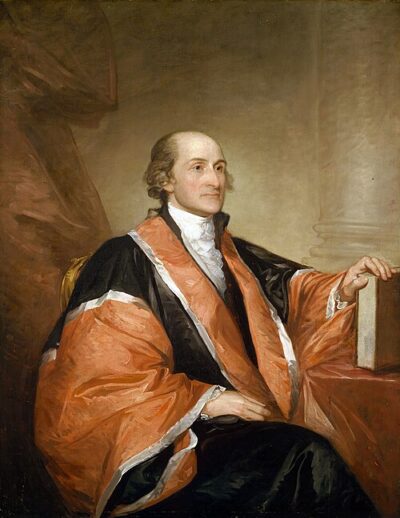
John Jay
John Jay was a Founding Father, U.S. Chief Justice from 1789 to 1795. Born December 12, 1745, in New York City. Died May 17, 1829, in Bedford. Positions held include President of the Continental Congress (1778–1779), United States Ambassador to Spain (1779–1782) and United States Secretary of Foreign Affairs (1784–1789). Educated at Columbia College and Columbia University. Awards include Fellow of the American Academy of Arts and Sciences.
Facts
36 facts · 1 confirmed by two sources · 13 cited · 21 from one source · 1 where the sources disagree
What’s different
- Born: we show December 12, 1745 (Sources disagree). Wikipedia says December 23, 1745
Where this comes from
Papalocal keeps its own record. It started from these sources; what each one said is kept here as it was copied, so a change on their side never changes this page by itself. Tap one to read its version.
What Wikidata says · copied November 13, 2026 · revision 2562945274
- Described as
- Founding Father, U.S. Chief Justice from 1789 to 1795
- Other names
- John Jay (1745-1829)
- Born
- December 12, 1745 · 9 references
- Died
- May 17, 1829 · 7 references
- Born in
- New York City · 1 reference
- Died in
- Bedford · 1 reference
- Buried in
- John Jay Cemetery · 1 reference
- Cause of death
- stroke
- Citizen of
- United States
- Occupation
- judge · 1 reference; lawyer; diplomat; politician · 2 references; governor · 1 reference; jurist · 1 reference; foreign minister · 1 reference
- Positions held
- President of the Continental Congress (1778–1779); United States Ambassador to Spain (1779–1782); United States Secretary of Foreign Affairs (1784–1789); United States Secretary of State (1789–1790); Chief Justice of the United States (1789–1795); Governor of New York (1795–1801)
- Political party
- Federalist Party
- Education
- Columbia College; Columbia University
- Member of
- American Academy of Arts and Sciences; American Antiquarian Society; American Philosophical Society (1780–)
- Awards
- Fellow of the American Academy of Arts and Sciences (1790–) · 1 reference
- Spouse
- Sarah Jay · 2 references
- Children
- William Jay; Peter A. Jay · 1 reference; Maria Jay Banyer
- Father
- Peter Jay · 1 reference
- Mother
- Mary Van Cortlandt · 1 reference
- Siblings
- James Jay
- Religion
- Episcopal Church
- Lived in
- John Jay Homestead State Historic Site · 1 reference
- Wikipedias with a page
- 56
Wikidata item Q310847 (wikidata.org/wiki/Q310847), public domain (CC0). Copied November 13, 2026.
What Wikipedia says · copied November 13, 2026 · revision 1384422516
John Jay (December 23 [O.S. December 12], 1745 – May 17, 1829) was a Founding Father of the United States. He served as the first Chief Justice from 1789 to 1795 and as the second governor of New York from 1795 to 1801. Jay was a statesman and diplomat who signed the Treaty of Paris that ended the American Revolutionary War and directed U.S. foreign policy for much of the 1780s. He was also an important leader of the Federalist Party following the ratification of the U.S. Constitution in 1788.
Jay was born into a wealthy family of merchants and New York City government officials of French Huguenot and Dutch descent. He became a lawyer and joined the New York Committee of Correspondence, organizing American opposition to British policies such as the Intolerable Acts in the leadup to the American Revolution. Jay was elected to the First Continental Congress, where he signed the Continental Association, and to the Second Continental Congress, where he served as its president. From 1779 to 1782, Jay served as the ambassador to Spain; he persuaded Spain to provide financial aid to the fledgling United States. He also served as a negotiator of the Treaty of Paris, in which Britain recognized American independence. Following the end of the war, Jay served as Secretary of Foreign Affairs, directing United States foreign policy under the Articles of Confederation government. He also served as the first secretary of state on an interim basis.
A proponent of strong, centralized government, Jay worked to ratify the United States Constitution in New York in 1788. He was a co-author of The Federalist Papers along with Alexander Hamilton and James Madison, and wrote five of the eighty-five essays. After the establishment of the new federal government, Jay was appointed by President George Washington the first Chief Justice of the United States, serving from 1789 to 1795. The Jay Court experienced a light workload, deciding just four cases over six years. In 1794, while serving as chief justice, Jay negotiated the highly controversial Jay Treaty with Britain. Jay received a handful of electoral votes in three of the first four presidential elections but never undertook a serious bid for the presidency.
Jay served as the governor of New York from 1795 to 1801. Although he successfully passed gradual emancipation legislation as governor of the state, he owned five slaves as late as 1800. In the waning days of President John Adams' administration, Jay was confirmed by the Senate for another term as chief justice, but he declined the position and retired to his farm in Westchester County, New York.
- Born, in its opening lines
- December 23, 1745
- Died, in its opening lines
- May 17, 1829
From the Wikipedia article “John Jay” (en.wikipedia.org/wiki/John_Jay), by its contributors, under CC BY-SA 4.0 (creativecommons.org/licenses/by-sa/4.0/). Copied November 13, 2026; not changed.
Confirmed Two sources agree. Cited One source, and it names where it got it. One source One source, without a reference of its own. Sources disagree The sources disagree. We show the best-supported value and keep theirs below.
