
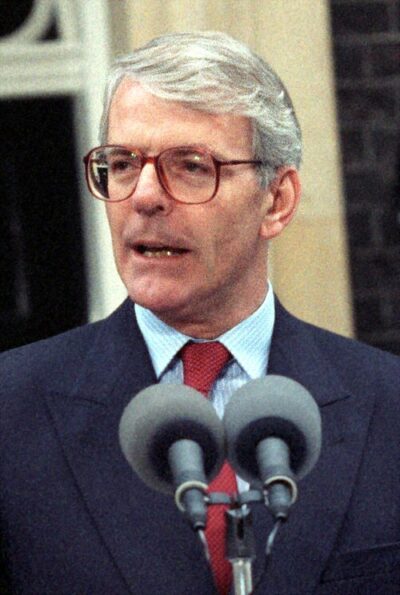
John Major
John Major is a Prime Minister of the United Kingdom from 1990 to 1997. Born March 29, 1943, in London. Positions held include Prime Minister of the United Kingdom (1990–1997), Leader of the Opposition (1997) and Leader of the Conservative Party (1990–1997). Educated at Rutlish School. Awards include Knight of the Garter, British Sports Book Awards and Grand Cordon of the Order of the Rising Sun.
Facts
41 facts · 1 confirmed by two sources · 20 cited · 20 from one source
Where this comes from
Papalocal keeps its own record. It started from these sources; what each one said is kept here as it was copied, so a change on their side never changes this page by itself. Tap one to read its version.
What Wikidata says · copied November 16, 2026 · revision 2567379418
- Described as
- Prime Minister of the United Kingdom from 1990 to 1997
- Other names
- Rt. Hon. Sir John Major, John Roy Major, Sir John Major
- Born
- March 29, 1943 · 8 references
- Born in
- London · 1 reference
- Citizen of
- United Kingdom · 1 reference
- Occupation
- politician · 2 references; bank manager; autobiographer · 1 reference; banker · 1 reference
- Positions held
- Prime Minister of the United Kingdom (1990–1997); Leader of the Opposition (1997); Leader of the Conservative Party (1990–1997) · 1 reference; Chancellor of the Exchequer (1989–1990); Chief Secretary to the Treasury (1987–1989); Secretary of State for Foreign and Commonwealth Affairs (1989); Shadow Foreign Secretary (1997); First Lord of the Treasury (1990–1997); Minister for the Civil Service (1990–1997); Member of the Privy Council of the United Kingdom (1987–) · 1 reference; member of the 52nd Parliament of the United Kingdom (1997–2001) · 1 reference; member of the 51st Parliament of the United Kingdom (1992–1997) · 1 reference; member of the 50th Parliament of the United Kingdom (1987–1992) · 1 reference; member of the 49th Parliament of the United Kingdom (1983–1987) · 1 reference; member of the 48th Parliament of the United Kingdom (1979–1983) · 1 reference
- Political party
- Conservative Party
- Education
- Rutlish School · 1 reference
- Member of
- Order of the Garter (2005–)
- Awards
- Knight of the Garter (2005–); British Sports Book Awards; Grand Cordon of the Order of the Rising Sun (2012) · 1 reference; Order of the Companions of Honour · 1 reference
- Field
- politics · 1 reference
- Spouse
- Norma Major (1970–) · 1 reference
- Children
- Elizabeth Major · 1 reference; James Major · 1 reference
- Father
- Tom Major-Ball · 1 reference
- Mother
- Gwendolyn Minny Coates · 1 reference
- Siblings
- Terry Major-Ball
- Religion
- Church of England; Anglicanism
- Lived in
- Great Stukeley
- Height
- 1.83 m (6 ft 0 in) · 1 reference
- Website
- http://www.johnmajorarchive.org.uk/
- Wikipedias with a page
- 105
Wikidata item Q9559 (wikidata.org/wiki/Q9559), public domain (CC0). Copied November 16, 2026.
What Wikipedia says · copied November 16, 2026 · revision 1385690570
Sir John Major (born 29 March 1943) is a British statesman who served as Prime Minister of the United Kingdom and Leader of the Conservative Party from 1990 to 1997. He previously held various Cabinet positions under Margaret Thatcher. Major was the Member of Parliament (MP) for Huntingdon, formerly Huntingdonshire, from 1979 to 2001. Since stepping down, Major has focused on writing and his business, sporting, and charity work, and commentating on political developments.
Major left school before 16, worked as an insurance clerk, joined the Young Conservatives in 1959, and became a highly active member. He was elected to Lambeth London Borough Council in 1968 and, a decade later, to parliament as a Conservative MP at the 1979 general election. Major held junior government positions under Thatcher from 1984 to 1987, including parliamentary private secretary and assistant whip. He served as Chief Secretary to the Treasury from 1987 to 1989, Foreign Secretary in 1989, and Chancellor from 1989 to 1990. Following Thatcher's resignation in 1990, Major stood in the 1990 Conservative leadership election and emerged victorious, becoming prime minister.
Major's more conciliatory political style contrasted with Thatcher's, though much of his policy agenda continued the Thatcherite programme. His government introduced the Citizen's Charter, replaced the poll tax with Council Tax, oversaw Britain's participation in the Gulf War, took charge of the UK's negotiations over the Maastricht Treaty, led the country during the early 1990s economic crisis, withdrew the pound from the European Exchange Rate Mechanism on Black Wednesday, launched the Back to Basics campaign, and oversaw the privatisation of the railways and coal industry. Two years into his premiership, Major led the Conservatives to a fourth consecutive electoral victory, winning more than 14 million votes, which remains the highest total won by a British political party. The struggle to ratify Maastricht deepened Conservative divisions over Europe, and Major's small and later shrinking Commons majority gave dissenting MPs substantial leverage over his government. With Irish taoiseach Albert Reynolds, Major issued the 1993 Downing Street Declaration, which helped establish the basis for the Northern Ireland peace process. In 1995, Major resigned as party leader amid internal divisions over UK membership of the EU, parliamentary scandals and questions over his economic credibility. Despite winning the 1995 leadership election, his government remained unpopular and lost its majority. The Labour Party pulled ahead of the Conservatives in every local election during Major's premiership, and its lead increased after Tony Blair became Labour leader in 1994. The Conservatives were defeated by Labour in a landslide in the 1997 general election, ending 18 years of Conservative government.After Blair became prime minister, Major served as Leader of the Opposition during the leadership election to replace him, which was won by William Hague. Major remained in the House of Commons as a backbencher, regularly attending and contributing to debates, until he stood down at the 2001 election to focus on writing and his business, sporting and charity work. Major has maintained a low profile, occasionally making political interventions. He supported the unsuccessful Britain Stronger in Europe campaign for the UK to remain in the European Union, and has often criticised Brexit since the 2016 referendum. Major was appointed a Knight Companion of the Order of the Garter (KG) in 2005 for services to politics and charity, and became a member of the Order of the Companions of Honour in 1999 for his work on the Northern Ireland peace process. Major's premiership has generally ranked near the middle of later survey tables: in a 2021 survey of historians and political scientists it placed joint seventh among fourteen completed post-war premierships, while a public Ipsos survey that year placed Major sixth by the proportion saying he had done a good job. Since Thatcher's death in 2013, he has been the oldest living former British prime minister.
- Born, in its opening lines
- March 29, 1943
From the Wikipedia article “John Major” (en.wikipedia.org/wiki/John_Major), by its contributors, under CC BY-SA 4.0 (creativecommons.org/licenses/by-sa/4.0/). Copied November 16, 2026; not changed.
Confirmed Two sources agree. Cited One source, and it names where it got it. One source One source, without a reference of its own. Sources disagree The sources disagree. We show the best-supported value and keep theirs below.
