
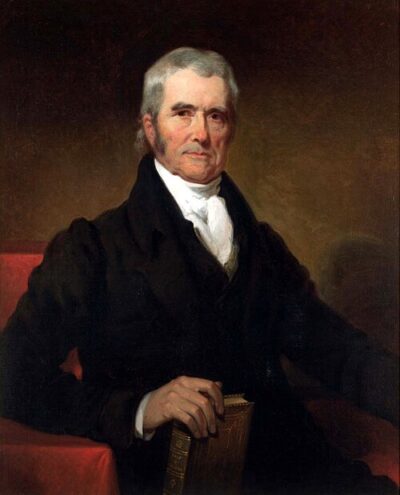
John Marshall
John Marshall was a chief justice of the United States from 1801 to 1835,. Born September 24, 1755, in Germantown. Died July 6, 1835, in Philadelphia. Positions held include United States representative (1799–1800), Member of the United States House of Representatives from Virginia (1782–1796) and United States Secretary of State (1800–1801). Educated at College of William & Mary and William & Mary Law School. Awards include Fellow of the American Academy of Arts and Sciences.
Facts
41 facts · 2 confirmed by two sources · 10 cited · 29 from one source
Where this comes from
Papalocal keeps its own record. It started from these sources; what each one said is kept here as it was copied, so a change on their side never changes this page by itself. Tap one to read its version.
What Wikidata says · copied November 13, 2026 · revision 2562945279
- Described as
- chief justice of the United States from 1801 to 1835, (1755-1835)
- Born
- September 24, 1755 · 8 references
- Died
- July 6, 1835 · 8 references
- Born in
- Germantown · 1 reference
- Died in
- Philadelphia · 1 reference
- Buried in
- Shockoe Hill Cemetery
- Citizen of
- United States
- Occupation
- politician · 3 references; judge; lawyer; diplomat; jurist · 1 reference; writer · 1 reference
- Positions held
- United States representative (1799–1800); Member of the United States House of Representatives from Virginia (1782–1796); United States Secretary of State (1800–1801); Chief Justice of the United States (1801–1835); member of the Virginia House of Delegates · 1 reference
- Political party
- Federalist Party
- Education
- College of William & Mary; William & Mary Law School
- Member of
- American Philosophical Society; American Academy of Arts and Sciences; Phi Beta Kappa Society; American Antiquarian Society
- Awards
- Fellow of the American Academy of Arts and Sciences
- Field
- law · 1 reference
- Spouse
- Mary Willis Ambler Marshall · 1 reference
- Children
- Edward Carrington Marshall; Jaquelin Ambler Marshall; Thomas Marshall; James Keith Marshall
- Father
- Thomas Marshall · 1 reference
- Mother
- Mary Randolph Keith · 1 reference
- Siblings
- Louis Marshall; James Markham Marshall; Thomas Marshall; Mary Ann Marshall; Charles Fleming Marshall
- Religion
- Anglicanism; Episcopal Church
- Military branch
- Continental Army
- Wikipedias with a page
- 53
Wikidata item Q310829 (wikidata.org/wiki/Q310829), public domain (CC0). Copied November 13, 2026.
What Wikipedia says · copied November 13, 2026 · revision 1384160978
John Marshall (September 24, 1755 – July 6, 1835) was an American statesman, jurist, lawyer, and Founding Father who served as the fourth chief justice of the United States from 1801 until his death in 1835. He remains the longest-serving chief justice and fifth-longest-serving justice in the history of the U.S. Supreme Court, and he is widely regarded as one of the most influential justices ever to serve. Prior to joining the court, Marshall briefly served as both the U.S. secretary of state under President John Adams and a U.S. representative from Virginia, making him one of the few Americans to have held a constitutional office in each of the three branches of the United States federal government.
Marshall was born in Germantown in the Colony of Virginia in British America in 1755. After the outbreak of the American Revolutionary War, he joined the Continental Army, serving in numerous battles. During the later stages of the war, he was admitted to the state bar and won election to the Virginia House of Delegates. Marshall favored the ratification of the U.S. Constitution, and he played a major role in Virginia's ratification of that document. At the request of President Adams, Marshall traveled to France in 1797 to help bring an end to attacks on American shipping. In what became known as the XYZ Affair, the government of France refused to open negotiations unless the United States agreed to pay bribes. Upon his return from France, he led the Federalist Party in Congress. He was appointed secretary of state in 1800 after a cabinet shake-up, becoming an important figure in the Adams administration.
In 1801, Adams appointed Marshall to the Supreme Court. Marshall quickly emerged as the key figure on the court, due in large part to his personal influence with the other justices. Under his leadership, the court moved away from seriatim opinions, instead issuing a single majority opinion that elucidated a clear rule. The 1803 case of Marbury v. Madison presented the first major case heard by the Marshall Court. In his opinion for the court, Marshall upheld the principle of judicial review, whereby courts could strike down federal and state laws if they conflicted with the Constitution. Marshall's holding avoided direct conflict with the executive branch, which was led by Democratic-Republican president Thomas Jefferson. By establishing the principle of judicial review while avoiding an inter-branch confrontation, Marshall helped implement the principle of separation of powers and cement the position of the American judiciary as an independent and co-equal branch of government.
After 1803, many of the major decisions issued by the Marshall Court confirmed the supremacy of the federal government and the federal Constitution over the states. In Fletcher v. Peck and Dartmouth College v. Woodward, the court invalidated state actions because they violated the Contract Clause. The court's decision in McCulloch v. Maryland upheld the constitutionality of the Second Bank of the United States and established the principle that the states could not tax federal institutions. The cases of Martin v. Hunter's Lessee and Cohens v. Virginia established that the Supreme Court could hear appeals from state courts in both civil and criminal matters. Marshall's opinion in Gibbons v. Ogden established that the Commerce Clause bars states from restricting navigation. In the case of Worcester v. Georgia, Marshall held that the Georgia criminal statute that prohibited non-Native Americans from being present on Native American lands without a license from the state was unconstitutional. Marshall died of natural causes in 1835, and Andrew Jackson appointed Roger Taney as his successor.
- Born, in its opening lines
- September 24, 1755
- Died, in its opening lines
- July 6, 1835
From the Wikipedia article “John Marshall” (en.wikipedia.org/wiki/John_Marshall), by its contributors, under CC BY-SA 4.0 (creativecommons.org/licenses/by-sa/4.0/). Copied November 13, 2026; not changed.
Confirmed Two sources agree. Cited One source, and it names where it got it. One source One source, without a reference of its own. Sources disagree The sources disagree. We show the best-supported value and keep theirs below.
