
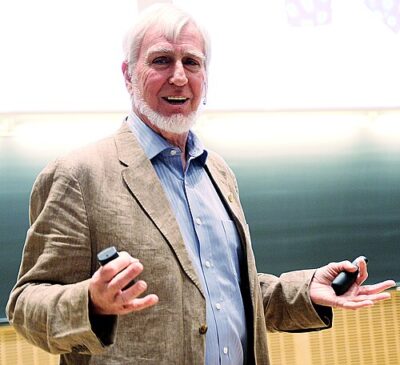
John O'Keefe
John O'Keefe is an American British neuroscientist, 2014 Nobel laureate in Physiology or Medicine. Born November 18, 1939, in New York City. Educated at City College of New York and McGill University. Awards include Nobel Prize in Physiology or Medicine, Feldberg Foundation Prize and Grawemeyer Awards.
Facts
29 facts · 1 confirmed by two sources · 17 cited · 11 from one source
Where this comes from
Papalocal keeps its own record. It started from these sources; what each one said is kept here as it was copied, so a change on their side never changes this page by itself. Tap one to read its version.
What Wikidata says · copied November 13, 2026 · revision 2567340675
- Described as
- American British neuroscientist, 2014 Nobel laureate in Physiology or Medicine
- Other names
- John M. O'Keefe, John Michael O'Keefe, John O’Keefe
- Born
- November 18, 1939 · 4 references
- Born in
- New York City · 1 reference
- Citizen of
- United Kingdom; United States
- Occupation
- neurologist; university teacher; psychologist; scientist; neuroscientist · 1 reference
- Worked for
- University College London · 1 reference
- Education
- City College of New York; McGill University (–1967) · 1 reference; Regis High School · 1 reference
- Member of
- Royal Society of London (1992–) · 1 reference; National Academy of Sciences (2016–) · 1 reference; Royal Irish Academy (2018–) · 1 reference
- Awards
- Nobel Prize in Physiology or Medicine (2014) · 2 references; Feldberg Foundation Prize (2001) · 1 reference; Grawemeyer Awards (2006) · 1 reference; Gruber Prize in Neuroscience (2008) · 1 reference; Louisa Gross Horwitz Prize (2013) · 1 reference; Kavli Prize in Neuroscience (2014) · 1 reference; Annual Review Prize Lecture (2016) · 1 reference; Fellow of the Academy of Medical Sciences; APA Award for Distinguished Scientific Contributions to Psychology (2020) · 1 reference; honorary doctor of the Aix-Marseille University (2015) · 1 reference
- Field
- neurobiology
- Website
- http://www.ucl.ac.uk/cdb/research/okeefe; http://iris.ucl.ac.uk/iris/browse/profile?upi=JOKEE52 · 1 reference
- Wikipedias with a page
- 55
Wikidata item Q1701279 (wikidata.org/wiki/Q1701279), public domain (CC0). Copied November 13, 2026.
What Wikipedia says · copied November 13, 2026 · revision 1381856144
John Michael O'Keefe (born November 18, 1939) is an American-British neuroscientist, psychologist and a professor at University College London.
O'Keefe discovered place cells in the hippocampus, and that they show a specific kind of temporal coding in the form of theta phase precession. He shared the Nobel Prize in Physiology or Medicine in 2014, together with May-Britt Moser and Edvard Moser; he has received several other awards.
- Born, in its opening lines
- November 18, 1939
From the Wikipedia article “John O'Keefe (neuroscientist)” (en.wikipedia.org/wiki/John_O'Keefe_(neuroscientist)), by its contributors, under CC BY-SA 4.0 (creativecommons.org/licenses/by-sa/4.0/). Copied November 13, 2026; not changed.
Confirmed Two sources agree. Cited One source, and it names where it got it. One source One source, without a reference of its own. Sources disagree The sources disagree. We show the best-supported value and keep theirs below.
