
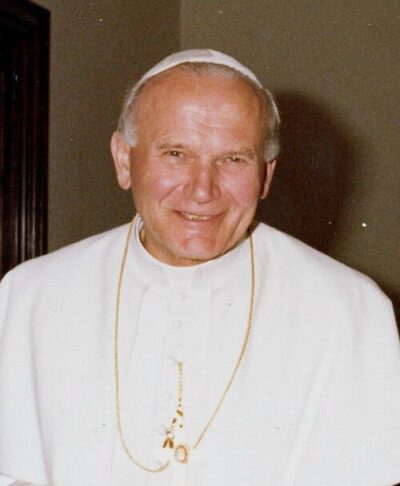
John Paul II
John Paul II was a pope, cardinal, bishop, priest, author. Born May 18, 1920, in Holy Father John Paul II Family Home in Wadowice. Died April 2, 2005, in Rome. Positions held include titular bishop (1958–1964), auxiliary bishop (1958–1964) and Archbishop of Kraków (1964–1978). Educated at Pontifical University of Saint Thomas Aquinas and Theology faculty of the Jagiellonian University. Awards include Order of the Smile, Order of St. Gregory the Great and Order of Pius IX.


Facts
60 facts · 2 confirmed by two sources · 12 cited · 45 from one source · 1 where the sources disagree
What’s different
- Cause of death: we show senility (Sources disagree). Wikidata also lists sepsis and Parkinson's disease
Where this comes from
Papalocal keeps its own record. It started from these sources; what each one said is kept here as it was copied, so a change on their side never changes this page by itself. Tap one to read its version.
What Wikidata says · copied November 16, 2026 · revision 2568445616
- Described as
- pope, cardinal, bishop, priest, author
- Other names
- Pope John Paul II, JP II, JPII, Saint John Paul II, Pope Saint John Paul II the Great, Joannes Paulus, Juan Pablo, Jean Paul, Jan Paweł, Johannes Paul, Giovanni Paolo, Ĭoan Pavel
- Born
- May 18, 1920 · 15 references
- Died
- April 2, 2005 · 14 references
- Born in
- Holy Father John Paul II Family Home in Wadowice · 2 references
- Died in
- Rome · 1 reference
- Buried in
- St. Peter's Basilica · 1 reference
- Cause of death
- senility; sepsis; Parkinson's disease
- Name at birth
- Karol Józef Wojtyła
- Citizen of
- Poland · 3 references; Vatican City · 4 references; Second Polish Republic · 2 references
- Occupation
- transitional deacon (1946) · 1 reference; Latin Catholic priest (1946–2005) · 1 reference; latin catholic deacon (1946–2005) · 1 reference; Catholic bishop (1958–2005) · 1 reference; poet; politician; human rights defender; professor
- Positions held
- titular bishop (1958–1964) · 1 reference; auxiliary bishop (1958–1964) · 1 reference; Archbishop of Kraków (1964–1978) · 2 references; cardinal (1967–2005) · 3 references; San Cesareo in Palatio (1967–2005); Pope (1978–2005) · 2 references; Vice-President of the Polish Episcopal Conference (1969–1978)
- Worked for
- Jagiellonian University; John Paul II Catholic University of Lublin · 1 reference
- Education
- Pontifical University of Saint Thomas Aquinas (1946–1947); Theology faculty of the Jagiellonian University (1953–1954); John Paul II Catholic University of Lublin · 1 reference
- Member of
- Pontifical Academia Mariana Internationalis; Polskie Towarzystwo Turystyczno-Krajoznawcze · 1 reference
- Awards
- Order of the Smile; Order of St. Gregory the Great; Order of Pius IX; Order of the Golden Spur; Armia Krajowa Cross; honorary doctor of the Jagiellonian University of Krakow; Knight of St. Sylvester; honorary citizen of Łódź · 1 reference; Order Ecce Homo · 1 reference; Aquinas Medal (1979); Gold Olympic Order (1981) · 1 reference; Gold medal of Galicia (1992); Order of the White Eagle (1993); Time Person of the Year (1994); Order of Bethlehem (2000)
- Field
- Petrine ministry · 1 reference; poetry; drama; scientific writing; pastoral care; education
- Father
- Karol Wojtyła
- Mother
- Emilia Wojtyła · 1 reference
- Siblings
- Edmund Wojtyła
- Religion
- Catholic Church · 1 reference; Catholicism · 1 reference
- Military branch
- Armia Krajowa · 1 reference
- Website
- http://www.vatican.va/holy_father/john_paul_ii/index.htm
- Wikipedias with a page
- 210
Wikidata item Q989 (wikidata.org/wiki/Q989), public domain (CC0). Copied November 16, 2026.
What Wikipedia says · copied November 16, 2026 · revision 1385548373
Pope John Paul II (born Karol Józef Wojtyła; 18 May 1920 – 2 April 2005) was the head of the Catholic Church and sovereign of Vatican City from 16 October 1978 until his death in 2005. He was the first non-Italian pope since Adrian VI in the 16th century, as well as the third longest-serving pope in history, after St. Peter and Pius IX. In addition to this, he was an important philosopher and theologian of the 20th century.
In his youth, Wojtyła worked occasionally as a stage actor. He graduated from an all-boys high school in Wadowice, Poland in 1938, shortly before World War II broke out. During the war, to avoid being kidnapped and sent to a German forced labour camp, he signed up for work in harsh conditions in a quarry. Wojtyła eventually took up acting and developed a love for the profession and participated at a local theatre. The linguistically skilled Wojtyła wanted to study Polish in university. During his studies, he was encouraged by a conversation with Adam Stefan Sapieha to study theology and become a priest. Eventually, Wojtyła rose to the position of Archbishop of Kraków and then to cardinal, both positions held by his mentor. Wojtyła was elected pope on the third day of the October 1978 conclave, becoming one of the youngest popes in more than a century. The conclave was called after the death of John Paul I, who served only 33 days as pope. Wojtyła adopted the name of his predecessor in tribute to him.
Pope John Paul II attempted to improve the Catholic Church's relations with Judaism, Islam, and the Eastern Orthodox Church in the spirit of ecumenism, holding atheism as the greatest threat. He maintained the Church's previous positions on such matters as abortion, artificial contraception, the ordination of women, and a celibate clergy, and although he supported the reforms of the Second Vatican Council, he was seen as generally conventional in their interpretation. He put emphasis on family and identity, while questioning consumerism, hedonism and the pursuit of wealth. He was one of the most-travelled world leaders in history, visiting 129 countries during his pontificate. As part of his special emphasis on the universal call to holiness, Pope John Paul II beatified 1,344 people, and canonised 483 saints, more than the combined tally of his predecessors during the preceding five centuries. By the time of his death, he had named most of the College of Cardinals, consecrated or co-consecrated many of the world's bishops, and ordained many priests. Pope John Paul II died on 2 April 2005, and was succeeded by Pope Benedict XVI.
Pope John Paul II has been credited with fighting against dictatorships and with helping to end communist rule in his native Poland and the rest of Europe. Under John Paul II, the Catholic Church greatly expanded its influence in Africa and Latin America and retained its influence in Europe and the rest of the world. He was proclaimed venerable by Pope Benedict XVI on 19 December 2009, and on 1 May 2011 (Divine Mercy Sunday) he was beatified. On 27 April 2014, Pope John Paul II was canonised by Pope Francis, alongside Pope John XXIII. He has been criticised for allegedly not acting against or having been insufficiently harsh against the sexual abuse of children by priests, both as archbishop in the Polish People's Republic and during his papacy. After his canonisation, he has been referred to by some Catholics as "Pope Saint John Paul the Great", though that title is not official.
Under Pope John Paul II, two of the most important documents of the contemporary Catholic Church were drafted and promulgated: the 1983 Code of Canon Law, which revised and updated the 1917 Code of Canon Law, and the Catechism of the Catholic Church, the first universal catechism to be issued since the Roman Catechism.
- Born, in its opening lines
- May 18, 1920
- Died, in its opening lines
- April 2, 2005
From the Wikipedia article “Pope John Paul II” (en.wikipedia.org/wiki/Pope_John_Paul_II), by its contributors, under CC BY-SA 4.0 (creativecommons.org/licenses/by-sa/4.0/). Copied November 16, 2026; not changed.
Confirmed Two sources agree. Cited One source, and it names where it got it. One source One source, without a reference of its own. Sources disagree The sources disagree. We show the best-supported value and keep theirs below.
