
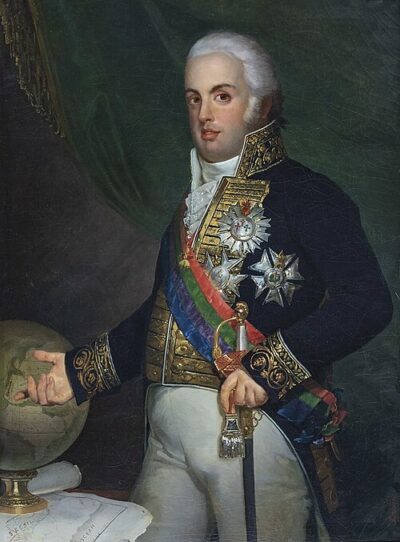
John VI of Portugal
John VI of Portugal was a King of the United Kingdom of Portugal, Brazil and the Algarves from 1816 to 1825. Born May 13, 1767, in Lisbon. Died March 10, 1826, in Lisbon. Positions held include Monarch of Portugal (1816–1826), King of the United Kingdom of Portugal, Brazil and the Algarve (1816–1822) and Regent of Portugal (1799–1816). Awards include Knight of the Order of the Holy Spirit, Knight of the Order of Saint Michael and Knight of the Order of the Golden Fleece.
Facts
44 facts · 2 confirmed by two sources · 3 cited · 39 from one source
Where this comes from
Papalocal keeps its own record. It started from these sources; what each one said is kept here as it was copied, so a change on their side never changes this page by itself. Tap one to read its version.
What Wikidata says · copied November 16, 2026 · revision 2559700692
- Described as
- King of the United Kingdom of Portugal, Brazil and the Algarves from 1816 to 1825
- Other names
- D. João VI, Dom João VI, John VI, John the Clement, João VI of Portugal
- Born
- May 13, 1767 · 3 references
- Died
- March 10, 1826 · 3 references
- Born in
- Lisbon · 1 reference
- Died in
- Lisbon · 1 reference
- Buried in
- Monastery of São Vicente de Fora
- Cause of death
- poison
- Citizen of
- Kingdom of Portugal; Kingdom of Brazil; United Kingdom of Portugal, Brazil and the Algarves
- Occupation
- king · 1 reference
- Positions held
- Monarch of Portugal (1816–1826); King of the United Kingdom of Portugal, Brazil and the Algarve (1816–1822); Regent of Portugal (1799–1816); Emperor of Brazil (1825–1826)
- Awards
- Knight of the Order of the Holy Spirit; Knight of the Order of Saint Michael; Knight of the Order of the Golden Fleece; Order of Saint Anna, 1st class; Order of Saint Alexander Nevsky; Order of St. Andrew; Knight Grand Cross of the Order of Saint Stephen of Hungary; Grand Cross of the Imperial Order of Leopold; Order of the Garter · 1 reference; Knight of the Order of the Elephant (1824); Grand Cross of the Sash of the Three Orders; Order of the Black Eagle · 1 reference; Grand Master of the Order of the Immaculate Conception of Vila Viçosa · 1 reference; Order of the Iron Crown (Austria) · 1 reference; Grand Master of the Order of the Tower and Sword
- Spouse
- Carlota Joaquina of Spain (1785–) · 1 reference
- Children
- Maria Teresa de Bragança; Infante Francisco António, Prince of Beira; Queen Maria Isabel of Spain; Pedro I of Brazil; Infanta Maria Francisca of Portugal; Isabel Maria of Portugal; Miguel I of Portugal; Maria da Assunção of Portugal; Infanta Ana de Jesus Maria, Marchioness of Loulé
- Father
- Pedro III of Portugal
- Mother
- Maria I of Portugal
- Siblings
- Infante José, Prince of Brazil; Infanta Mariana Vitória of Portugal
- Religion
- Catholic Church
- Wikipedias with a page
- 56
Wikidata item Q676301 (wikidata.org/wiki/Q676301), public domain (CC0). Copied November 16, 2026.
What Wikipedia says · copied November 16, 2026 · revision 1377757259
Dom John VI (Portuguese: João Maria José Francisco Xavier de Paula Luís António Domingos Rafael; 13 May 1767 – 10 March 1826), known as "the Clement" (o Clemente), was King of the United Kingdom of Portugal, Brazil and the Algarves from 1816 to 1825, and after the recognition of Brazil's independence, titular Emperor of Brazil and King of Portugal until his death in 1826.
John VI was born in Lisbon during the reign of his maternal grandfather, King Dom Joseph I of Portugal. He was the second son of the Princess of Brazil and Infante Peter of Portugal, who later became Queen Dona Maria I and King Dom Peter III. In 1785, John married Carlota Joaquina of Spain, with whom he had nine children. He became heir to the throne when his older brother, Prince José, died of smallpox in 1788. Before his accession to the throne, John bore the titles Duke of Braganza, Duke of Beja, and Prince of Brazil. From 1799, he served as prince regent due to his mother's mental illness. In 1816, he succeeded his mother as monarch of the Portuguese Empire, with no real change in his authority, since he already possessed absolute powers as regent.
One of the last representatives of absolute monarchy in Europe, John lived during a turbulent period; his reign never saw a lasting peace. Throughout his period of rule, major powers such as Spain, France, and Great Britain continually intervened in Portuguese affairs. Forced to flee across the Atlantic Ocean to Brazil when troops of Emperor Napoleon I invaded Portugal, he found himself faced there with liberal revolts; he was compelled to return to Europe amid new conflicts. His marriage was no less conflictual, as his wife Carlota Joaquina repeatedly conspired against John in favor of personal interests or those of her native Spain.
John lost Brazil when his son Pedro declared independence, and his other son Miguel (later Dom Miguel I of Portugal) led a rebellion that sought to depose him. According to recent scholarly research, his death may well have been caused by arsenic poisoning. Notwithstanding these tribulations, John left a lasting mark, especially in Brazil, where he helped to create numerous institutions and services that laid a foundation for national autonomy, and many historians consider him to be a true mastermind of the modern Brazilian state. John's contemporaries viewed him as a kind and benevolent king, although later generations of Portuguese and Brazilians have made him the subject of frequent caricature. However, in recent decades his reputation has been restored as a clever king who was able to balance many competing interests.
- Born, in its opening lines
- May 13, 1767
- Died, in its opening lines
- March 10, 1826
From the Wikipedia article “John VI of Portugal” (en.wikipedia.org/wiki/John_VI_of_Portugal), by its contributors, under CC BY-SA 4.0 (creativecommons.org/licenses/by-sa/4.0/). Copied November 16, 2026; not changed.
Confirmed Two sources agree. Cited One source, and it names where it got it. One source One source, without a reference of its own. Sources disagree The sources disagree. We show the best-supported value and keep theirs below.
