
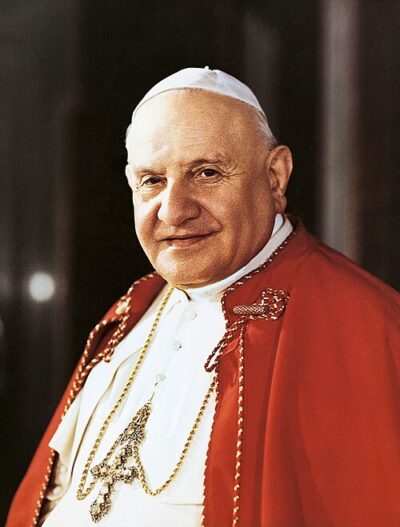
John XXIII
John XXIII was a priest, bishop, cardinal, pope. Born November 25, 1881, in Sotto il Monte Giovanni XXIII. Died June 3, 1963, in Apostolic Palace. Positions held include patriarch of Venice (1953–1958), Pope (1958–1963) and cardinal (1953–). Known for Pacem in Terris, Ad Petri Cathedram and Sacerdotii Nostri Primordia. Educated at Pontifical Roman Seminary and Sapienza University of Rome. Awards include Grand Cross of the Legion of Honour, Presidential Medal of Freedom and Balzan Prize.
Facts
51 facts · 2 confirmed by two sources · 8 cited · 41 from one source
Where this comes from
Papalocal keeps its own record. It started from these sources; what each one said is kept here as it was copied, so a change on their side never changes this page by itself. Tap one to read its version.
What Wikidata says · copied November 16, 2026 · revision 2569001607
- Described as
- priest, bishop, cardinal, pope
- Other names
- Pope John XXIII, Angelo Josef Roncalli, Pope Saint John XXIII, Saint John XXIII, Angelo Giuseppe Roncalli, Andzhelo Dzhuzepe Ronkali, Angelo Roncalli
- Born
- November 25, 1881 · 11 references
- Died
- June 3, 1963 · 12 references
- Born in
- Sotto il Monte Giovanni XXIII · 1 reference
- Died in
- Apostolic Palace · 2 references
- Buried in
- Tomb of John XXIII (2001–) · 1 reference
- Cause of death
- stomach cancer · 1 reference
- Name at birth
- Angelo Giuseppe Roncalli · 1 reference
- Citizen of
- Italy (1946–); Vatican City; Kingdom of Italy (–1946)
- Occupation
- Latin Catholic priest (1904–) · 1 reference; transitional deacon (1903–) · 1 reference; Latin Catholic bishop (1925–) · 1 reference; military chaplain (1914–1918) · 1 reference; bishop; Pope · 1 reference; Catholic priest
- Positions held
- patriarch of Venice (1953–1958); Pope (1958–1963) · 2 references; cardinal (1953–) · 1 reference; titular archbishop (1925–1953) · 1 reference; Apostolic Nuncio to France (1944–1953) · 1 reference; deacon (1903–); apostolic visitor (1925–); apostolic delegate; cardinal priest (1953–1958) · 1 reference
- Education
- Pontifical Roman Seminary; Sapienza University of Rome
- Known for
- Pacem in Terris; Ad Petri Cathedram; Sacerdotii Nostri Primordia; Grata Recordatio; Princeps Pastorum; Mater et Magistra; Aeterna Dei Sapientia; Paenitentiam Agere
- Awards
- Grand Cross of the Legion of Honour (1958); Presidential Medal of Freedom (1963) · 1 reference; Balzan Prize (1963); Order of St. Gregory the Great; Order of Pius IX; Order of the Golden Spur; Grand Cross 1st class of the Order of Merit of the Federal Republic of Germany (1957); Supreme Order of Christ · 1 reference; War Merit Cross (Italy) · 1 reference; Commemorative Medal for the Italo-Austrian War 1915-1918 · 1 reference; Commemorative Medal of the Unity of Italy · 1 reference; Inter-Allied Victory Medal (Italy) · 1 reference
- Father
- Giovanni Battista Roncalli
- Religion
- Catholic Church · 1 reference
- Military rank
- lieutenant (1916–)
- Wikipedias with a page
- 137
Wikidata item Q23873 (wikidata.org/wiki/Q23873), public domain (CC0). Copied November 16, 2026.
What Wikipedia says · copied November 16, 2026 · revision 1385121494
Pope John XXIII (born Angelo Giuseppe Roncalli; 25 November 1881 – 3 June 1963) was head of the Catholic Church and sovereign of Vatican City from 28 October 1958 until his death on 3 June 1963.
Roncalli was among 13 children born to Marianna Mazzola and Giovanni Battista Roncalli in a family of sharecroppers who lived in Sotto il Monte, a village in the province of Bergamo, Lombardy. He was ordained to the priesthood on 10 August 1904 and served in a number of posts, as nuncio in France and a delegate to Bulgaria, Greece and Turkey. In a consistory on 12 January 1953 Pope Pius XII made Roncalli a cardinal as the Cardinal-priest of Santa Prisca in addition to naming him as the Patriarch of Venice. Roncalli was unexpectedly elected pope on 28 October 1958 at age 76 after Pope Pius XII's death. Pope John XXIII surprised those who expected him to be a caretaker pope by calling the historic Second Vatican Council (1962–1965), the first session opening on 11 October 1962, which is now his feast.
John XXIII made many passionate speeches during his pontificate. His views on equality were summed up in his statement, "We were all made in God's image, and thus, we are all Godly alike." He made a major impact on the Catholic Church, opening it up to the changes of the Second Vatican Council and by his own dealings with other churches and nations. In Italian politics, he prohibited bishops from interfering with local elections, and he helped the Christian Democracy party to cooperate with the Italian Socialist Party. In international affairs, his Ostpolitik engaged in dialogue with the communist countries of Eastern Europe. He especially reached out to the Eastern Orthodox churches.
John XXIII's overall goal was to modernize the Church by emphasizing its pastoral role, and its necessary involvement with affairs of state. He dropped the traditional rule of 70 cardinals, increasing the number to 85. He used the opportunity to name the first cardinals from Africa, Japan, and the Philippines. He promoted ecumenical movements in cooperation with other Christian faiths. In doctrinal matters, he ended the practice of automatically formulating social and political policies on the basis of old theological propositions.
John XXIII did not live to see the Second Vatican Council to completion. He was diagnosed with stomach cancer in September 1962 and died on 3 June 1963. His cause for canonization was opened on 18 November 1965 by his successor, Pope Paul VI, who declared him a Servant of God. He was beatified by Pope John Paul II in 2000. On 5 July 2013, Pope Francis, bypassing the traditionally required second miracle, declared John XXIII a saint based on his virtuous lifestyle and because of the good that came from his opening of the Second Vatican Council. He was canonized alongside Pope Saint John Paul II on 27 April 2014. Pope Saint John XXIII today is affectionately known as "the Good Pope" (Italian: il papa buono).
- Born, in its opening lines
- November 25, 1881
- Died, in its opening lines
- June 3, 1963
From the Wikipedia article “Pope John XXIII” (en.wikipedia.org/wiki/Pope_John_XXIII), by its contributors, under CC BY-SA 4.0 (creativecommons.org/licenses/by-sa/4.0/). Copied November 16, 2026; not changed.
Confirmed Two sources agree. Cited One source, and it names where it got it. One source One source, without a reference of its own. Sources disagree The sources disagree. We show the best-supported value and keep theirs below.
