
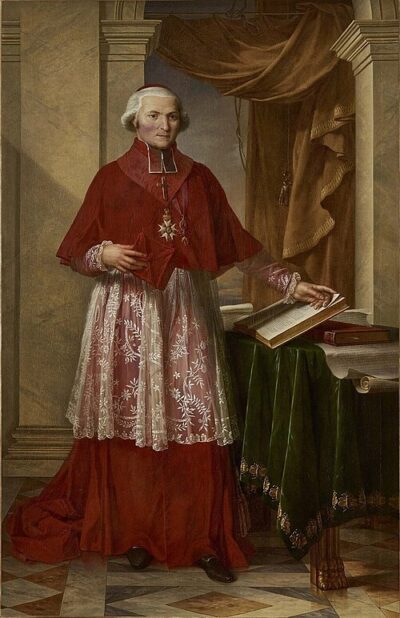
Joseph Fesch
Joseph Fesch was a French cardinal, diplomat, art collector and Prince of France. Born January 3, 1763, in Ajaccio. Died May 13, 1839, in Rome. Positions held include Grand Almoner of France (1805–1814), Catholic archbishop (1802–) and ambassador. Awards include Grand Cross of the Legion of Honour, Knight of the Order of the Golden Fleece and Order of the Golden Spur.
Facts
25 facts · 2 confirmed by two sources · 9 cited · 14 from one source
Where this comes from
Papalocal keeps its own record. It started from these sources; what each one said is kept here as it was copied, so a change on their side never changes this page by itself. Tap one to read its version.
What Wikidata says · copied November 18, 2026 · revision 2558033062
- Described as
- French cardinal, diplomat, art collector and Prince of France (1763-1839)
- Other names
- Joseph, cardinal Fesch, Cardinal Fesch, Cardinal Joseph Fesch, Freche, Cardinal, Fesch
- Born
- January 3, 1763 · 8 references
- Died
- May 13, 1839 · 8 references
- Born in
- Ajaccio
- Died in
- Rome · 2 references
- Buried in
- Chapelle Impériale · 1 reference
- Citizen of
- France
- Occupation
- art collector; Catholic priest (1787–) · 1 reference; diplomat; politician; Catholic bishop; vicar · 1 reference; archbishop · 1 reference
- Positions held
- Grand Almoner of France (1805–1814); Catholic archbishop (1802–) · 2 references; ambassador; member of the Sénat conservateur; Peer of France; cardinal (1803–) · 2 references
- Awards
- Grand Cross of the Legion of Honour; Knight of the Order of the Golden Fleece; Order of the Golden Spur
- Father
- Franz Fesch · 1 reference
- Mother
- Angela Maria Pietra-Santa · 1 reference
- Religion
- Catholic Church · 1 reference
- Wikipedias with a page
- 24
Wikidata item Q450181 (wikidata.org/wiki/Q450181), public domain (CC0). Copied November 18, 2026.
What Wikipedia says · copied November 18, 2026 · revision 1357672145
Joseph Cardinal Fesch, Prince of the Empire (3 January 1763 – 13 May 1839) was a French priest and diplomat, who was the maternal half-uncle of Napoleon Bonaparte (half-brother of Napoleon's mother Laetitia). In the wake of his nephew's rise, he became Archbishop of Lyon and cardinal. He was also one of the most famous art collectors of his period, remembered for having established the Musée Fesch in Ajaccio, which remains one of the most important Napoleonic collections of art.
Born in Corsica, he was the son of Swiss-born Franz Faesch and Angela Maria Pietrasanta, and belonged on his father's side to the Faesch family, one of the most prominent patrician families of Basel. He rose to great prominence in France following Napoleon's coup d'état of 1799. Fesch became Archbishop of Lyon in 1802, a Cardinal in 1803, Ambassador to the Holy See in 1804, a French senator and count in 1805, Grand Almoner of France in 1805, a sovereign prince in 1806, Prince of the Empire ("French Prince") in 1807 (a dignity he shared only with Napoleon's siblings, brother-in-law Joachim Murat, and adopted son Eugène de Beauharnais), and Peer of France in 1815, and was named a Prince of the Papal States by the Pope. He was a member of the Imperial House, and was included in the order of succession to the French imperial throne in accordance with the French constitution of 1804 (Title III, Article 9, "The Imperial Family").
He was Napoleon's most important diplomat in regard to Pope Pius VII, but Napoleon's relationship with his uncle deteriorated as his relationship with the Pope soured. Nevertheless, Napoleon remained loyal to his uncle. Fesch wed his nephew to Joséphine de Beauharnais in Paris in 1804, the day before Bonaparte was crowned as Emperor of the French, in 1810 he wed Napoleon to Marie Louise of Austria, and in 1811 baptized the Emperor's son Napoleon II.
After the end of the French Empire in 1815, he was banished from France in 1815, like the rest of the Imperial House. He relocated to Rome with his half-sister Laetitia, and took up residence at the Palazzo Falconieri, dedicating himself to art and to beneficence.
- Born, in its opening lines
- January 3, 1763
- Died, in its opening lines
- May 13, 1839
From the Wikipedia article “Joseph Fesch” (en.wikipedia.org/wiki/Joseph_Fesch), by its contributors, under CC BY-SA 4.0 (creativecommons.org/licenses/by-sa/4.0/). Copied November 18, 2026; not changed.
Confirmed Two sources agree. Cited One source, and it names where it got it. One source One source, without a reference of its own. Sources disagree The sources disagree. We show the best-supported value and keep theirs below.
