
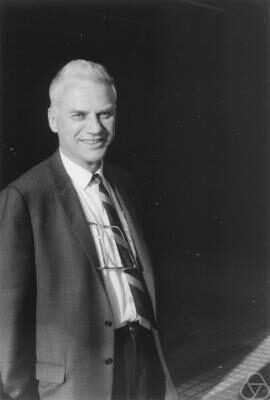
Joseph Leo Doob
Joseph Leo Doob was an American mathematician. Born February 27, 1910, in Cincinnati. Died June 7, 2004, in Urbana. Positions held include chairperson (2 times) (1950–1964). Known for Doob decomposition theorem, optional stopping theorem and Doob–Meyer decomposition theorem. Educated at Harvard University and Ethical Culture Fieldston School. Awards include National Medal of Science, Leroy P. Steele Prize and Fellow of the Institute of Mathematical Statistics.
Facts
33 facts · 2 confirmed by two sources · 18 cited · 13 from one source
Where this comes from
Papalocal keeps its own record. It started from these sources; what each one said is kept here as it was copied, so a change on their side never changes this page by itself. Tap one to read its version.
What Wikidata says · copied November 18, 2026 · revision 2567221766
- Described as
- American mathematician (1910–2004)
- Other names
- Joseph L. Doob, J. L. Doob, Joseph Doob
- Born
- February 27, 1910 · 5 references
- Died
- June 7, 2004 · 5 references
- Born in
- Cincinnati · 1 reference
- Died in
- Urbana · 1 reference
- Citizen of
- United States · 1 reference
- Occupation
- mathematician · 2 references; university teacher · 1 reference; statistician · 1 reference
- Positions held
- chairperson (2 times) (1950–1964) · 1 reference
- Worked for
- University of Illinois Urbana-Champaign (1935–1978) · 1 reference; Columbia University (1932–1935) · 1 reference
- Education
- Harvard University (1926–1932) · 1 reference; Ethical Culture Fieldston School (–1926) · 1 reference
- Member of
- French Academy of Sciences; National Academy of Sciences; American Academy of Arts and Sciences; Institute of Mathematical Statistics (1940–) · 1 reference
- Known for
- Doob decomposition theorem; optional stopping theorem; Doob–Meyer decomposition theorem; Doob's martingale convergence theorems; Doob–Dynkin lemma; Doob martingale; Doob's martingale inequality
- Awards
- National Medal of Science (1979) · 1 reference; Leroy P. Steele Prize (1984) · 2 references; Fellow of the Institute of Mathematical Statistics (1940) · 1 reference
- Field
- probability theory; stochastic process; mathematics · 1 reference; mathematical analysis · 1 reference; potential theory · 1 reference
- Spouse
- Elsie Field · 1 reference
- Wikipedias with a page
- 15
Wikidata item Q1384876 (wikidata.org/wiki/Q1384876), public domain (CC0). Copied November 18, 2026.
What Wikipedia says · copied November 18, 2026 · revision 1381922565
Joseph Leo Doob (February 27, 1910 – June 7, 2004) was an American mathematician and one of the principal architects of modern measure-theoretic probability. Building on Kolmogorov's axiomatization of probability, he established a rigorous framework for continuous-parameter stochastic processes, developed martingale theory into a central method of probability, and pioneered probabilistic potential theory. His 1953 monograph Stochastic Processes became a foundational work in the development of modern probability theory.
- Born, in its opening lines
- February 27, 1910
- Died, in its opening lines
- June 7, 2004
From the Wikipedia article “Joseph L. Doob” (en.wikipedia.org/wiki/Joseph_L._Doob), by its contributors, under CC BY-SA 4.0 (creativecommons.org/licenses/by-sa/4.0/). Copied November 18, 2026; not changed.
Confirmed Two sources agree. Cited One source, and it names where it got it. One source One source, without a reference of its own. Sources disagree The sources disagree. We show the best-supported value and keep theirs below.
