
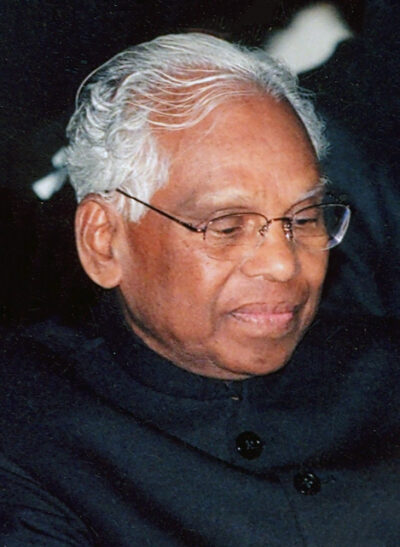
K. R. Narayanan
K. R. Narayanan was a President of India from 1997 to 2002. Born October 27, 1920, in Uzhavoor. Died November 9, 2005, in New Delhi. Positions held include President of India (1997–2002), Vice President of India (1992–1997) and Member of the Lok Sabha. Educated at University of Kerala and London School of Economics and Political Science.
Facts
23 facts · 2 confirmed by two sources · 0 cited · 21 from one source
Where this comes from
Papalocal keeps its own record. It started from these sources; what each one said is kept here as it was copied, so a change on their side never changes this page by itself. Tap one to read its version.
What Wikidata says · copied November 16, 2026 · revision 2563060517
- Described as
- President of India from 1997 to 2002
- Other names
- Kocheril Raman Narayanan
- Born
- October 27, 1920 · 6 references
- Died
- November 9, 2005 · 6 references
- Born in
- Uzhavoor
- Died in
- New Delhi
- Cause of death
- pneumonia
- Citizen of
- British Raj (–1947); India (1950–); Dominion of India (1947–1950)
- Occupation
- politician; diplomat
- Positions held
- President of India (1997–2002); Vice President of India (1992–1997); Member of the Lok Sabha; ambassador; Member of the 9th Lok Sabha (1989–1991); Member of the 8th Lok Sabha
- Political party
- Indian National Congress
- Education
- University of Kerala; London School of Economics and Political Science; University College Thiruvananthapuram
- Spouse
- Usha Narayanan
- Children
- Chitra Narayanan
- Religion
- Hinduism
- Wikipedias with a page
- 62
Wikidata item Q235454 (wikidata.org/wiki/Q235454), public domain (CC0). Copied November 16, 2026.
What Wikipedia says · copied November 16, 2026 · revision 1379646763
Kocheril Raman Narayanan (27 October 1920 – 9 November 2005) was an Indian diplomat, academician, and statesman who served as the president of India from 1997 to 2002 and vice president of India from 1992 to 1997.
Narayanan was born in Perumthanam, Uzhavoor village, in the princely state of Travancore (present day Kottayam district, Kerala) into a Hindu family. After a brief stint with journalism and then studies at the London School of Economics with the assistance of a scholarship, Narayanan began his career in India as a member of the Indian Foreign Service in the Nehru administration. He served as ambassador to a number of countries, most principally to the United States and China, and was referred by Nehru as "the best diplomat of the country". He entered politics at Indira Gandhi's request and won three successive general elections to the Lok Sabha and served as a Minister of State in prime minister Rajiv Gandhi's cabinet. Elected as vice president in 1992, Narayanan went on to become president in 1997 and became the first Dalit to occupy either position.
Narayanan is regarded as an independent and assertive president who set several precedents and enlarged the scope of the presidency. He described himself as a "working president" who worked "within the four corners of the Constitution"; something midway between an "executive president" who has direct power and a "rubber-stamp president" who endorses government decisions without question or deliberation. He used his discretionary powers as a president and deviated from convention and precedent in many situations, including the appointment of the prime minister in a hung Parliament, in dismissing a state government and imposing President's rule there at the suggestion of the Union Cabinet, and during the Kargil conflict. He presided over the golden jubilee celebrations of Indian independence and in the country's general election of 1998, he became the first Indian president to vote when in office, setting another new precedent. As of 2025, he remains the last Indian to have been elected president, while serving as vice president.
- Born, in its opening lines
- October 27, 1920
- Died, in its opening lines
- November 9, 2005
From the Wikipedia article “K. R. Narayanan” (en.wikipedia.org/wiki/K._R._Narayanan), by its contributors, under CC BY-SA 4.0 (creativecommons.org/licenses/by-sa/4.0/). Copied November 16, 2026; not changed.
Confirmed Two sources agree. Cited One source, and it names where it got it. One source One source, without a reference of its own. Sources disagree The sources disagree. We show the best-supported value and keep theirs below.
