
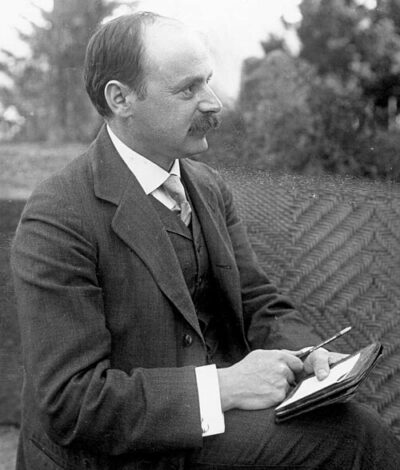
Karl Schwarzschild
Karl Schwarzschild was a German physicist, astronomer and mathematician. Born October 9, 1873, in Frankfurt. Died May 11, 1916, in Potsdam. Positions held include director (1906–1916). Known for Schwarzschild metric, Schwarzschild black hole and Schwarzschild radius. Educated at LMU Munich and University of Strasbourg. Awards include honorary member of the Physics Association (Frankfurt am Main, Germany).
Facts
46 facts · 2 confirmed by two sources · 21 cited · 23 from one source
Where this comes from
Papalocal keeps its own record. It started from these sources; what each one said is kept here as it was copied, so a change on their side never changes this page by itself. Tap one to read its version.
What Wikidata says · copied November 16, 2026 · revision 2569028602
- Described as
- German physicist, astronomer and mathematician (1873–1916)
- Other names
- Karl Scharzschild
- Born
- October 9, 1873 · 7 references
- Died
- May 11, 1916 · 8 references
- Born in
- Frankfurt · 4 references
- Died in
- Potsdam · 4 references
- Buried in
- Göttingen City Cemetery · 1 reference
- Cause of death
- pemphigus · 1 reference
- Citizen of
- Kingdom of Prussia
- Occupation
- physicist; astronomer · 2 references; astrophysicist; university teacher; mathematician
- Positions held
- director (1906–1916) · 1 reference
- Worked for
- University of Göttingen (1901–1906) · 1 reference; Kuffner observatory (1896–1899) · 1 reference; LMU Munich (1899–1901) · 1 reference; Leibniz Institute for Astrophysics Potsdam (1906–1914) · 1 reference
- Education
- LMU Munich (1893–1896); University of Strasbourg (1891–1893) · 1 reference; Lessing-Gymnasium (1884–1891) · 1 reference
- Member of
- Royal Prussian Academy of Sciences; German Academy of Sciences Leopoldina; Göttingen Academy of Sciences and Humanities in Lower Saxony; Royal Astronomical Society · 1 reference
- Known for
- Schwarzschild metric; Schwarzschild black hole; Schwarzschild radius; Schwarzschild effect; Schwarzschild coordinates; de Sitter–Schwarzschild metric; Interior Schwarzschild metric; Schwarzschild telescope; conic constant; Deriving the Schwarzschild solution
- Awards
- honorary member of the Physics Association (Frankfurt am Main, Germany) (1911)
- Field
- astronomy · 1 reference; physics; astrophysics · 1 reference; theory of relativity · 1 reference; quantum mechanics · 1 reference
- Spouse
- Else Schwarzschild · 1 reference
- Children
- Martin Schwarzschild · 1 reference
- Father
- Moses Martin Schwarzschild · 1 reference
- Siblings
- Robert Schwarzschild; Clara Emden · 1 reference; Alfred Schwarzschild · 1 reference
- Wikipedias with a page
- 56
Wikidata item Q57145 (wikidata.org/wiki/Q57145), public domain (CC0). Copied November 16, 2026.
What Wikipedia says · copied November 16, 2026 · revision 1385650903
Karl Schwarzschild (German: [kaʁl ˈʃvaʁtsʃɪlt] ; 9 October 1873 – 11 May 1916) was a German physicist and astronomer.
Schwarzschild provided the first exact solution to the Einstein field equations of general relativity, for the limited case of a single spherical non-rotating mass, which he accomplished in 1915, the same year that Einstein first introduced general relativity. The Schwarzschild solution, which makes use of Schwarzschild coordinates and the Schwarzschild metric, leads to a derivation of the Schwarzschild radius, which is the size of the event horizon of a non-rotating black hole.
Schwarzschild accomplished this while serving in the German army during World War I. He died the following year, possibly from the autoimmune disease pemphigus, which he developed while at the Russian front.
- Born, in its opening lines
- October 9, 1873
- Died, in its opening lines
- May 11, 1916
From the Wikipedia article “Karl Schwarzschild” (en.wikipedia.org/wiki/Karl_Schwarzschild), by its contributors, under CC BY-SA 4.0 (creativecommons.org/licenses/by-sa/4.0/). Copied November 16, 2026; not changed.
Confirmed Two sources agree. Cited One source, and it names where it got it. One source One source, without a reference of its own. Sources disagree The sources disagree. We show the best-supported value and keep theirs below.
