
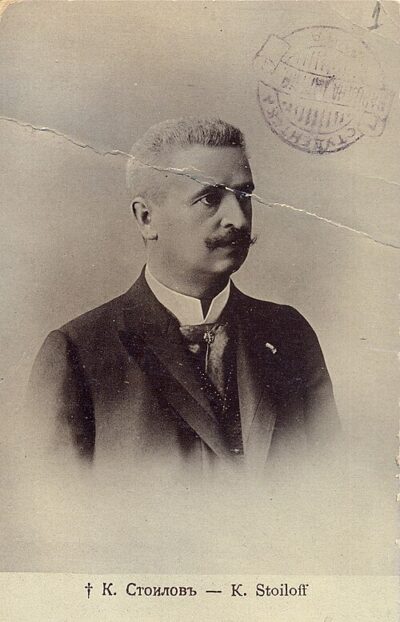
Konstantin Stoilov
Konstantin Stoilov was a Prime Minister of Bulgaria. Born September 23, 1853, in Plovdiv. Died March 23, 1901, in Sofia. Positions held include Minister of Foreign Affairs (4 times) (1881–1899), Minister of Justice (3 times) (1883–1896) and Minister of Finance (1887). Educated at Robert College and Heidelberg University. Awards include Order of Bravery.
Facts
32 facts · 2 confirmed by two sources · 3 cited · 27 from one source
Where this comes from
Papalocal keeps its own record. It started from these sources; what each one said is kept here as it was copied, so a change on their side never changes this page by itself. Tap one to read its version.
What Wikidata says · copied November 18, 2026 · revision 2562788416
- Described as
- Prime Minister of Bulgaria (1853-1901)
- Born
- September 23, 1853 · 1 reference
- Died
- March 23, 1901 · 1 reference
- Born in
- Plovdiv · 1 reference
- Died in
- Sofia · 1 reference
- Buried in
- Central Sofia Cemetery
- Citizen of
- Bulgaria
- Occupation
- judge; diplomat; politician · 1 reference
- Positions held
- Minister of Foreign Affairs (4 times) (1881–1899); Minister of Justice (3 times) (1883–1896); Minister of Finance (1887); Prime Minister of Bulgaria (2 times) (1887–1899); Minister of Interior of Bulgaria (1896–1899); ambassador; member of the Bulgarian National Assembly
- Political party
- People's Party (Bulgaria); Conservative Party
- Education
- Robert College; Heidelberg University
- Member of
- Bulgarian Academy of Sciences; 1st Grand National Assembly of Bulgaria; 1st Regular National Assembly of Bulgaria; 2nd Regular National Assembly of Bulgaria; 2nd Grand National Assembly of Bulgaria; 4th Regular National Assembly of Bulgaria; 3rd Grand National Assembly of Bulgaria; 5th Regular National Assembly of Bulgaria; 6th Regular National Assembly of Bulgaria; 8th Regular National Assembly of Bulgaria
- Awards
- Order of Bravery · 1 reference
- Religion
- Eastern Orthodoxy
- Wikipedias with a page
- 21
Wikidata item Q523488 (wikidata.org/wiki/Q523488), public domain (CC0). Copied November 18, 2026.
What Wikipedia says · copied November 18, 2026 · revision 1384715990
Konstantin Stoilov (Bulgarian: Константин Стоилов) (23 September 1853 O.S. – 23 March 1901 O.S.) was a leading Bulgarian politician and twice Prime Minister. Simeon Radev described him as the most European-like of all Bulgarian politicians.
Born in Plovdiv, Stoilov studied at Robert College in Istanbul, before studying law at Ruprecht Karl University of Heidelberg to doctorate level. Whilst in Germany he became a Freemason.
A career politician with the Conservative Party, and later his own People's Party, he held a number of government portfolios including Foreign Minister, Law Minister and Interior Affairs Minister, and Minister of Finance. His first reign as Prime Minister lasted only for a brief spell in 1887. He returned in 1894 to preside over a longer ministry, which was characterized by increasing toleration for the activities of the Internal Macedonian Revolutionary Organization as well as fairer treatment of the Jews (as a lawyer, Stoilov had successfully defended the Jews of Vratsa from allegations of blood libel in 1890). Stoilov's government faced a campaign of criticism from sections of the press as organised by his main political opponent Stefan Stambolov and as a consequence the Stoilov administration enacted legislation against Stambolov, notably sequestering his land for state use and abolishing the pensions paid to former government ministers. The Stoilov-led coalition remained in office until 1899 when a series of liberal administrations began. He remained an important figure in Bulgarian politics until his death.
- Born, in its opening lines
- September 23, 1853
- Died, in its opening lines
- March 23, 1901
From the Wikipedia article “Konstantin Stoilov” (en.wikipedia.org/wiki/Konstantin_Stoilov), by its contributors, under CC BY-SA 4.0 (creativecommons.org/licenses/by-sa/4.0/). Copied November 18, 2026; not changed.
Confirmed Two sources agree. Cited One source, and it names where it got it. One source One source, without a reference of its own. Sources disagree The sources disagree. We show the best-supported value and keep theirs below.
