
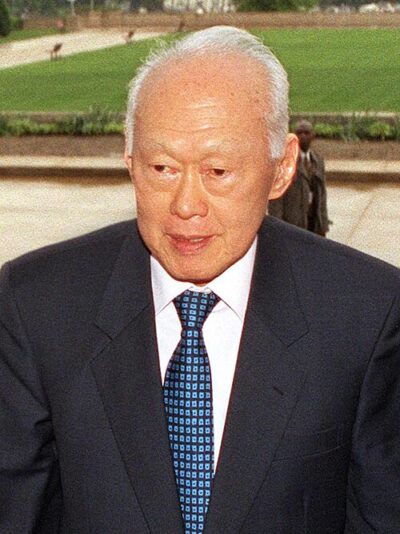
Kuan Yew Lee
Kuan Yew Lee was the 1st Prime Minister of the Republic of Singapore. Born September 16, 1923, in Singapore. Died March 23, 2015, in Singapore. Positions held include Prime Minister of Singapore (1959–1990), Member of the Parliament of Singapore (1955–2015) and Senior Minister (1990–2004). Educated at Fitzwilliam College and London School of Economics and Political Science. Awards include Order of Honour, Knight Grand Cross of the Order of St Michael and St George and Order of the Badge of Honour.
Facts
50 facts · 2 confirmed by two sources · 15 cited · 33 from one source
Where this comes from
Papalocal keeps its own record. It started from these sources; what each one said is kept here as it was copied, so a change on their side never changes this page by itself. Tap one to read its version.
What Wikidata says · copied November 16, 2026 · revision 2568781029
- Described as
- 1st Prime Minister of the Republic of Singapore (1923–2015)
- Other names
- Kuang-yao Li, Guangyao Li, Kūan Yū Lī, Lī Kūan Yū, Quang Diệu Lý, Lī Kuvān̲ Iyū, Kʻwan Yu Yi, Harry Lee
- Born
- September 16, 1923 · 10 references
- Died
- March 23, 2015 · 5 references
- Born in
- Singapore · 3 references
- Died in
- Singapore · 1 reference
- Buried in
- Mandai Crematorium and Columbarium
- Cause of death
- pneumonia
- Citizen of
- Singapore
- Occupation
- philosopher · 1 reference; autobiographer; lawyer · 1 reference; statesperson · 1 reference; politician · 1 reference
- Positions held
- Prime Minister of Singapore (1959–1990); Member of the Parliament of Singapore (1955–2015); Senior Minister (1990–2004) · 1 reference; Minister Mentor (2004–2011) · 1 reference; prime minister
- Political party
- People's Action Party
- Worked for
- University of Cambridge
- Education
- Fitzwilliam College; London School of Economics and Political Science; University of Cambridge; Raffles Institution; National University of Singapore; University of London · 1 reference
- Awards
- Order of Honour; Knight Grand Cross of the Order of St Michael and St George; Order of the Badge of Honour; Order of Friendship; Ig Nobel Prize; Order of the Rising Sun, 1st class; Companion of Honour; medal "for 20 years of Kazakhstan's independence"; Grand Cordon of the Order of the Paulownia Flowers (2015); honorary doctor of the University of Hong Kong; honorary doctor of the Fudan University (2005) · 1 reference; honorary doctor of the Chinese University of Hong Kong; China Reform Friendship Medal (2018) · 1 reference; honorary doctor of the Moscow State Institute of International Relations · 1 reference; Order of the Paulownia Flowers · 1 reference
- Spouse
- Kwa Geok Choo (1950–2010) · 1 reference
- Children
- Lee Hsien Loong · 2 references; Lee Hsien Yang · 1 reference; Lee Wei Ling · 1 reference
- Father
- Lee Chin Koon · 1 reference
- Mother
- Chua Jim Neo · 1 reference
- Siblings
- Freddy Lee
- Religion
- agnosticism
- Lived in
- Singapore General Hospital (2015) · 1 reference; 38 Oxley Road (–2015)
- Wikipedias with a page
- 123
Wikidata item Q131248 (wikidata.org/wiki/Q131248), public domain (CC0). Copied November 16, 2026.
What Wikipedia says · copied November 16, 2026 · revision 1385661102
Lee Kuan Yew (born Harry Lee Kuan Yew; 16 September 1923 – 23 March 2015), also known as LKY, was a Singaporean politician and barrister who served as the first prime minister of Singapore from 1959 to 1990. A member of the People's Action Party (PAP), his authoritarian governance oversaw the transformation of post-independence Singapore into a highly developed country and one of the four Asian Tigers. He is regarded as the founding father of modern Singapore.
Born in Singapore during British colonial rule to a family of Peranakan Chinese descent, Lee studied law in England at Cambridge University and was called to the bar at the Middle Temple in 1950. Shortly after, he returned to Singapore and practised law, founding the law firm Lee & Lee. In 1954, Lee co-founded the PAP, which won significant support among the working class and trade unions in the lead up to the 1955 general election, securing him a seat in the Tanjong Pagar division and making him the de facto leader of the opposition. In 1959, Lee led the PAP to its first electoral victory, becoming Singapore's first prime minister. Seeking sovereignty from the British Empire, Lee led Singapore to a merger with Malaya along with Sarawak and Sabah, forming Malaysia in 1963. Racial strife and ideological differences later led to Singapore's expulsion from Malaysia and consequent independence in 1965.
Lee oversaw major economic reforms and urban development, instituting policies promoting meritocracy, multiracialism and anti-corruption. His administration, generally characterised as an illiberal democracy with nanny state tendencies, restricted press freedoms, public assembly, labour activism and civil liberties. From 1968 to 1981, Singapore was a de facto one-party state, with the PAP facing no opposition in Parliament. Although Lee maintained legal and institutional procedures that formally characterised Singapore as a democratic parliamentary republic, he employed defamation laws, detention without trial and social engineering to ensure continued electoral success.
Lee's political ideology was characterised by his belief in Asian values and the Lee thesis, arguing that communitarianism and limited human rights were necessary for the social cohesion, political stability and rapid economic development of Singapore. Lee stepped down as prime minister in 1990 but continued to serve in the Cabinet as senior minister until 2004 and subsequently as minister mentor until his retirement in 2011. Throughout his political career, he remained an influential figure in shaping Singapore's domestic and foreign policies, at the same time serving as an advisor to foreign leaders as an elder statesman. Lee died of pneumonia on 23 March 2015 at the age of 91.
In Singapore, Lee is widely regarded as instrumental in the development of Singapore's economy, bureaucracy, education system, foreign policy, public housing and healthcare. The Lee Kuan Yew School of Public Policy at the National University of Singapore is named in his honour. Following his death, a week of national mourning was announced, during which approximately 1.7 million people paid their respects at tribute sites around the country.
- Born, in its opening lines
- September 16, 1923
- Died, in its opening lines
- March 23, 2015
From the Wikipedia article “Lee Kuan Yew” (en.wikipedia.org/wiki/Lee_Kuan_Yew), by its contributors, under CC BY-SA 4.0 (creativecommons.org/licenses/by-sa/4.0/). Copied November 16, 2026; not changed.
Confirmed Two sources agree. Cited One source, and it names where it got it. One source One source, without a reference of its own. Sources disagree The sources disagree. We show the best-supported value and keep theirs below.
