
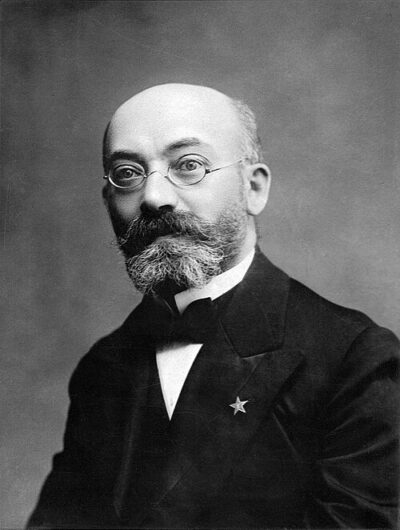
L. L. Zamenhof
L. L. Zamenhof was a Polish-Jewish physician and inventor of Esperanto. Born December 15, 1859, in Białystok. Died April 14, 1917, in Warsaw. Known for Unua Libro, Dua Libro and Fundamento de Esperanto. Educated at Medical faculty of Moscow University and Imperial University of Warsaw. Awards include Knight of the Legion of Honour, Honorary President of the World Esperanto Association and Commander of the Order of Isabella the Catholic.
Facts
55 facts · 2 confirmed by two sources · 12 cited · 40 from one source · 1 where the sources disagree
What’s different
- Buried in: we show Okopowa Street Jewish Cemetery (Sources disagree). Wikidata also lists grave of L. L. Zamenhof
Where this comes from
Papalocal keeps its own record. It started from these sources; what each one said is kept here as it was copied, so a change on their side never changes this page by itself. Tap one to read its version.
What Wikidata says · copied November 16, 2026 · revision 2557123111
- Described as
- Polish-Jewish physician and inventor of Esperanto (1859-1917)
- Other names
- L. M. Zamenhof, Leyzer Zamenhov, Lazar Markovich Zamenhof, Doktoro Esperanto, Lazaro Ludoviko Zamenhof, Ludoviko Lazaro Zamenhofo, Lazar Lyudvik Zamenhof, Louis Lazare Zamenhof, Doctor Esperanto, Dottor Esperanto, Ludovico Lazzaro Zamenhof, LL Zamenhof
- Born
- December 15, 1859 · 8 references
- Died
- April 14, 1917 · 8 references
- Born in
- Białystok · 2 references
- Died in
- Warsaw · 2 references
- Buried in
- Okopowa Street Jewish Cemetery; grave of L. L. Zamenhof
- Name at birth
- Лейзер Мордхович Заменгов · 1 reference
- Citizen of
- Russian Empire · 1 reference; Kingdom of Poland
- Occupation
- linguist · 1 reference; ophthalmologist · 1 reference; inventor; poet · 1 reference; translator; Esperantist; physician · 3 references; physician writer
- Education
- Medical faculty of Moscow University; Imperial University of Warsaw
- Member of
- Esperanto Language Committee
- Known for
- Unua Libro; Dua Libro; Fundamento de Esperanto; Ho, mia kor'; Esperanto; Homaranismo
- Awards
- Knight of the Legion of Honour (1905); Honorary President of the World Esperanto Association (1907–1917); Commander of the Order of Isabella the Catholic (1909)
- Field
- Esperanto; ophthalmology; esperantology; philology · 1 reference
- Spouse
- Klara Zamenhof (1887–) · 1 reference
- Children
- Lidia Zamenhof; Adam Zamenhof; Zofia Zamenhof · 1 reference
- Father
- Markus Zamenhof
- Mother
- Rozalia Zamenhof
- Siblings
- Ida Zamenhof; Fani Pikover; Mina Zamenhof; Aleksander Zamenhof; Henryk Zamenhof; Leon Zamenhof; Felix Zamenhof; Hersz Zamenhof; Aŭgusta Hermelin; Sora Dwora Zamenhof
- Religion
- Homaranismo; Judaism
- Lived in
- Białystok (1859–1873) · 1 reference; Warsaw (3 times) (1873–1917) · 1 reference; Moscow (1879–1881) · 1 reference; Hrodna (1893–1897) · 1 reference; Płock (1885–1886) · 1 reference
- Wikipedias with a page
- 141
Wikidata item Q11758 (wikidata.org/wiki/Q11758), public domain (CC0). Copied November 16, 2026.
What Wikipedia says · copied November 16, 2026 · revision 1382222163
L. L. Zamenhof (15 December 1859 – 14 April 1917) was the creator of Esperanto, the most widely used constructed international auxiliary language.
Zamenhof published Esperanto in 1887, although his initial ideas date back as far as 1873. He grew up fascinated by the idea of a world without war and believed that this could happen with the help of a new international auxiliary language (IAL). The language was intended as a tool to gather people together through neutral, fair, equitable communication. He successfully formed a community which has survived to this day, despite the World Wars of the 20th century and various attempts to reform the language or create more modern IALs (Esperanto itself had displaced another similarly-motivated language, Volapük). Additionally, Esperanto has developed like other languages: through the interaction and creativity of its users.
In light of his achievements, and his support of intercultural dialogue, UNESCO selected Zamenhof as one of its eminent personalities of 2017, on the 100th anniversary of his death. According to Esperanto communities, as of 2019 there are approximately 2 million people speaking Esperanto, including approximately 1,000 native speakers, although evidence to that has been heavily disputed, and the last major effort to improve the estimate occurred in 2004.
- Born, in its opening lines
- December 15, 1859
- Died, in its opening lines
- April 14, 1917
From the Wikipedia article “L. L. Zamenhof” (en.wikipedia.org/wiki/L._L._Zamenhof), by its contributors, under CC BY-SA 4.0 (creativecommons.org/licenses/by-sa/4.0/). Copied November 16, 2026; not changed.
Confirmed Two sources agree. Cited One source, and it names where it got it. One source One source, without a reference of its own. Sources disagree The sources disagree. We show the best-supported value and keep theirs below.
