
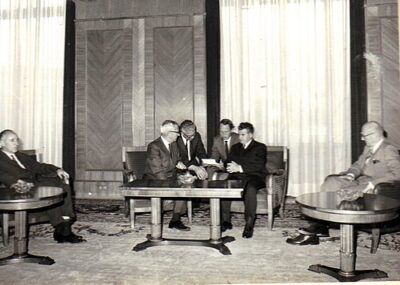
Lee Alvin DuBridge
Lee Alvin DuBridge was an American physicist. Born September 21, 1901, in Terre Haute. Died January 23, 1994, in Duarte. Educated at University of Wisconsin–Madison and Cornell College. Awards include Richtmyer Memorial Lecture Award and Fellow of the American Physical Society.
Facts
20 facts · 2 confirmed by two sources · 6 cited · 12 from one source
Where this comes from
Papalocal keeps its own record. It started from these sources; what each one said is kept here as it was copied, so a change on their side never changes this page by itself. Tap one to read its version.
What Wikidata says · copied November 19, 2026 · revision 2567266554
- Described as
- American physicist (1901–1994)
- Other names
- Lee Alvin Dubridge
- Born
- September 21, 1901 · 4 references
- Died
- January 23, 1994 · 4 references
- Born in
- Terre Haute · 2 references
- Died in
- Duarte · 1 reference
- Cause of death
- pneumonia
- Citizen of
- United States
- Occupation
- physicist · 1 reference; university teacher; writer · 1 reference
- Worked for
- University of Rochester; California Institute of Technology; Washington University in St. Louis · 1 reference
- Education
- University of Wisconsin–Madison; Cornell College
- Member of
- American Academy of Arts and Sciences; National Academy of Sciences; American Philosophical Society (1942–)
- Awards
- Richtmyer Memorial Lecture Award (1949) · 1 reference; Fellow of the American Physical Society
- Field
- physics · 1 reference
- Wikipedias with a page
- 13
Wikidata item Q465298 (wikidata.org/wiki/Q465298), public domain (CC0). Copied November 19, 2026.
What Wikipedia says · copied November 19, 2026 · revision 1384737900
Lee Alvin DuBridge (September 21, 1901 – January 23, 1994) was an American physicist and academic administrator. He led the MIT Radiation Laboratory, served as president of Caltech, and advised three U.S. presidents on science policy.
DuBridge's early research on the photoelectric effect produced the standard text on the subject, and at the University of Rochester he built one of the most powerful cyclotrons in the United States. In 1940, Ernest Lawrence and Alfred Loomis recruited him to direct the newly established MIT Radiation Laboratory, which under his leadership grew from a few dozen physicists to a staff of approximately 4,000 and developed over 100 types of microwave radar for the Allied war effort. DuBridge's management of the Rad Lab established a model for subsequent "big science" partnerships between civilian science and the military.
After the war DuBridge served as president of the California Institute of Technology for twenty-three years, overseeing a period of rapid growth in which the campus, endowment, and faculty roughly tripled in size. He held senior science advisory positions under presidents Truman, Eisenhower, and Nixon, and was a prominent defender of academic freedom during the McCarthy era.
Time featured him on its cover in 1955, calling him "the senior statesman of science." Harold Brown and John D. Roberts, in their memoir for the American Philosophical Society, described him as "one of the most influential American scientists of the 20th century."
- Born, in its opening lines
- September 21, 1901
- Died, in its opening lines
- January 23, 1994
From the Wikipedia article “Lee A. DuBridge” (en.wikipedia.org/wiki/Lee_A._DuBridge), by its contributors, under CC BY-SA 4.0 (creativecommons.org/licenses/by-sa/4.0/). Copied November 19, 2026; not changed.
Confirmed Two sources agree. Cited One source, and it names where it got it. One source One source, without a reference of its own. Sources disagree The sources disagree. We show the best-supported value and keep theirs below.
