
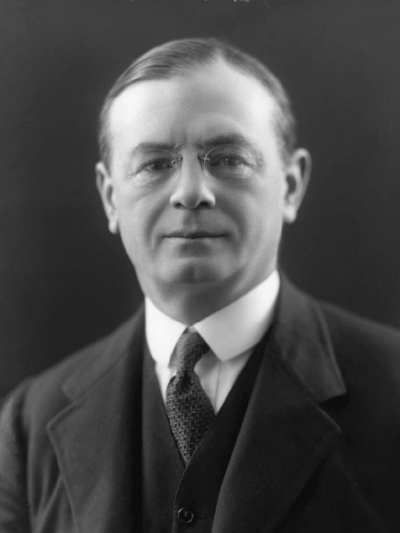
Leo Amery
Leo Amery was a British politician and journalist. Born November 22, 1873, in Gorakhpur. Died September 16, 1955, in London. Positions held include Secretary of State for the Colonies (1924–1929), Secretary of State for India (1940–1945) and Member of the Privy Council of the United Kingdom. Educated at Balliol College and Harrow School. Awards include Order of the Companions of Honour.
Facts
33 facts · 2 confirmed by two sources · 17 cited · 14 from one source
Where this comes from
Papalocal keeps its own record. It started from these sources; what each one said is kept here as it was copied, so a change on their side never changes this page by itself. Tap one to read its version.
What Wikidata says · copied November 18, 2026 · revision 2563035021
- Described as
- British politician and journalist (1873-1955)
- Other names
- Leopold Charles Maurice Stennett Amery, L. S. Amery
- Born
- November 22, 1873 · 7 references
- Died
- September 16, 1955 · 8 references
- Born in
- Gorakhpur · 1 reference
- Died in
- London · 1 reference
- Citizen of
- United Kingdom of Great Britain and Ireland (–1927); United Kingdom (1927–)
- Occupation
- politician · 2 references; journalist · 1 reference; writer
- Positions held
- Secretary of State for the Colonies (1924–1929); Secretary of State for India (1940–1945); Member of the Privy Council of the United Kingdom; First Lord of the Admiralty (1922–1924); member of the 37th Parliament of the United Kingdom (1935–1945) · 1 reference; member of the 36th Parliament of the United Kingdom (1931–1935) · 1 reference; member of the 35th Parliament of the United Kingdom (1929–1931) · 1 reference; member of the 34th Parliament of the United Kingdom (1924–1929) · 1 reference; member of the 33rd Parliament of the United Kingdom (1923–1924) · 1 reference; member of the 32nd Parliament of the United Kingdom (1922–1923) · 1 reference; member of the 31st Parliament of the United Kingdom (1918–1922) · 1 reference; member of the 30th Parliament of the United Kingdom (1911–1918) · 1 reference
- Political party
- Conservative Party; Liberal Unionist Party
- Worked for
- University of Oxford
- Education
- Balliol College; Harrow School
- Member of
- Académie des sciences d'outre-mer
- Awards
- Order of the Companions of Honour (1945)
- Spouse
- Adeliza Florence Louise Hamar Greenwood (1910–) · 2 references
- Children
- Julian Amery, Baron Amery of Lustleigh · 3 references; John Amery · 1 reference
- Father
- Charles Frederick Amery · 2 references
- Mother
- Elizabeth Johanna Saphir · 2 references
- Wikipedias with a page
- 23
Wikidata item Q333573 (wikidata.org/wiki/Q333573), public domain (CC0). Copied November 18, 2026.
What Wikipedia says · copied November 18, 2026 · revision 1384106917
Leopold Charles Maurice Stennett Amery (22 November 1873 – 16 September 1955), also known as L. S. Amery, was a British Conservative Party politician and journalist. During his career, he was known for his interest in military preparedness, British India, and the British Empire, and his opposition to appeasement. He was Secretary of State for the Colonies (1924–29), opposed the National Government of the 1930s, and served as Secretary of State for India during the Second World War (1940–45). He was also a prolific writer whose output included a multi-volume history of the Second Boer War and several volumes of memoirs and (posthumously published) diaries.
Nowadays he is best remembered for the remarks he made in the House of Commons on 7 May 1940 during the Norway Debate, attacking the Prime Minister, Neville Chamberlain, for incompetence in the fight against Hitler's Germany. Many of Amery's Parliamentary contemporaries pointed to this speech as one of the key drivers in the division of the House on the following day, 8 May, which led to Chamberlain being forced to resign and his replacement by Winston Churchill.
- Born, in its opening lines
- November 22, 1873
- Died, in its opening lines
- September 16, 1955
From the Wikipedia article “Leo Amery” (en.wikipedia.org/wiki/Leo_Amery), by its contributors, under CC BY-SA 4.0 (creativecommons.org/licenses/by-sa/4.0/). Copied November 18, 2026; not changed.
Confirmed Two sources agree. Cited One source, and it names where it got it. One source One source, without a reference of its own. Sources disagree The sources disagree. We show the best-supported value and keep theirs below.
