
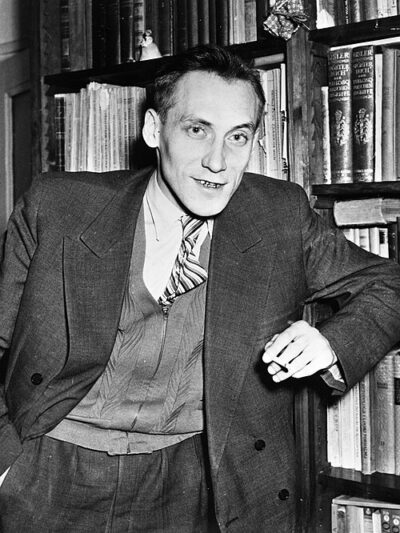
Leszek Kołakowski
Leszek Kołakowski was a Philosopher, historian of ideas. Born October 23, 1927, in Radom. Died July 17, 2009, in Oxford. Known for Is God Happy?. Educated at University of Łódź and University of Warsaw. Awards include Order of the White Eagle, Erasmus Prize and Peace Prize of the German Publishers' and Booksellers' Association.
Facts
46 facts · 2 confirmed by two sources · 12 cited · 32 from one source
Where this comes from
Papalocal keeps its own record. It started from these sources; what each one said is kept here as it was copied, so a change on their side never changes this page by itself. Tap one to read its version.
What Wikidata says · copied November 16, 2026 · revision 2567313252
- Described as
- Philosopher, historian of ideas (1927–2009)
- Other names
- Leszek Kolakowski
- Born
- October 23, 1927 · 13 references
- Died
- July 17, 2009 · 13 references
- Born in
- Radom · 4 references
- Died in
- Oxford · 4 references
- Buried in
- Powązki Military Cemetery
- Citizen of
- Second Polish Republic; Nazi Germany; Polish People's Republic; Poland
- Occupation
- philosopher · 5 references; historian; pedagogue; university teacher; writer · 1 reference; historian of ideas; essayist · 1 reference; prose writer · 1 reference
- Political party
- Polish United Workers' Party
- Worked for
- University of Warsaw; University of California, Berkeley · 1 reference; Goethe University Frankfurt · 1 reference
- Education
- University of Łódź; University of Warsaw (1953) · 1 reference
- Member of
- European Academy of Sciences and Arts; Polish Academy of Sciences · 1 reference; American Academy of Arts and Sciences; Bavarian Academy of Fine Arts; Stowarzyszenie Pisarzy Polskich · 1 reference
- Known for
- Is God Happy?
- Awards
- Order of the White Eagle; Erasmus Prize (1983) · 1 reference; Peace Prize of the German Publishers' and Booksellers' Association (1977) · 1 reference; Democracy Service Medal; Prix Européen de l'Essai Charles Veillon (1980); MacArthur Fellows Program (1983); Jefferson Lecture (1986); Kluge Prize (2003); Jerusalem Prize (2007); Ernst Bloch Award (1991); Gordon J. Laing Award (1991) · 1 reference; Honorary doctor of the University of Szczecin; Honorary doctor of the University of Gdańsk; Saint George medal; Prix Alexis de Tocqueville (1994)
- Field
- philosophy
- Children
- Agnieszka Kołakowska · 1 reference
- Wikipedias with a page
- 54
Wikidata item Q157318 (wikidata.org/wiki/Q157318), public domain (CC0). Copied November 16, 2026.
What Wikipedia says · copied November 16, 2026 · revision 1384373639
Leszek Kołakowski (; Polish: [ˈlɛʂɛk kɔwaˈkɔfskʲi]; 23 October 1927 – 17 July 2009) was a Polish philosopher and historian of ideas. He is best known for his critical analysis of contemporary Marxist thought and theory, as in his three-volume history of Marxist philosophy Main Currents of Marxism (1976). In his later work, Kołakowski increasingly focused on religious questions. In his 1986 Jefferson Lecture, he asserted that "we learn history not in order to know how to behave or how to succeed, but to know who we are".
Kołakowski was initially a Marxist humanist, but he came to renounce it. Owing to his criticism of Marxism and of the Communist state system, Kołakowski was effectively exiled from Poland in 1968. He spent most of the remainder of his career at the University of Oxford, as a Fellow of All Souls College. Despite being in exile, Kołakowski was a major inspiration to the Solidarity movement which flourished in Poland in the 1980s and is credited by some as having helped bring about the collapse of the Soviet Union. Bronisław Geremek dubbed him as the "awakener of human hopes". Among many awards, he was a laureate of the MacArthur Fellowship and Erasmus Prize in 1983, the 2003 Kluge Prize, and in 2007, the Jerusalem Prize.
- Born, in its opening lines
- October 23, 1927
- Died, in its opening lines
- July 17, 2009
From the Wikipedia article “Leszek Kołakowski” (en.wikipedia.org/wiki/Leszek_Kołakowski), by its contributors, under CC BY-SA 4.0 (creativecommons.org/licenses/by-sa/4.0/). Copied November 16, 2026; not changed.
Confirmed Two sources agree. Cited One source, and it names where it got it. One source One source, without a reference of its own. Sources disagree The sources disagree. We show the best-supported value and keep theirs below.
