
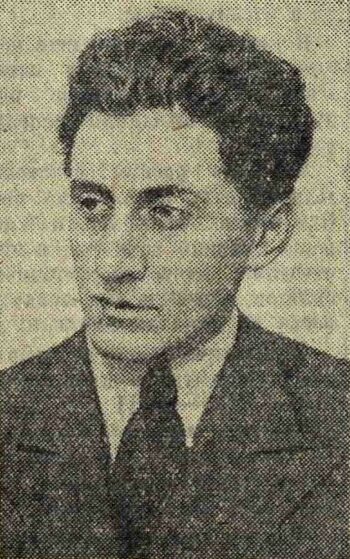
Lev Kerbel
Lev Kerbel was a Russian sculptor. Born November 7, 1917, in Semenivka. Died August 14, 2003, in Moscow. Known for Soviet War Memorial. Educated at Surikov State Academic Institute of Fine Arts and Russian Academy of Arts. Awards include Stalin Prize, Order of Lenin and Medal "For the Victory over Germany in the Great Patriotic War 1941–1945".
Facts
34 facts · 2 confirmed by two sources · 4 cited · 28 from one source
Where this comes from
Papalocal keeps its own record. It started from these sources; what each one said is kept here as it was copied, so a change on their side never changes this page by itself. Tap one to read its version.
What Wikidata says · copied November 18, 2026 · revision 2548935825
- Described as
- Russian sculptor (1917-2003)
- Other names
- Lev Kerbel', Lev Efimovič Kerbel', Lev Yefimovich Kerbel, Lev Efimovich Kerbel
- Born
- November 7, 1917 · 2 references
- Died
- August 14, 2003 · 3 references
- Born in
- Semenivka · 1 reference
- Died in
- Moscow · 1 reference
- Buried in
- Novodevichy Cemetery
- Citizen of
- Russian Republic; Russian Soviet Federative Socialist Republic; Soviet Union; Russia
- Occupation
- painter; sculptor · 2 references; artist · 1 reference
- Political party
- Communist Party of the Soviet Union
- Worked for
- Surikov State Academic Institute of Fine Arts
- Education
- Surikov State Academic Institute of Fine Arts; Russian Academy of Arts · 1 reference; Repin Institute of Arts · 1 reference
- Member of
- Artists' Union of the USSR
- Known for
- Soviet War Memorial
- Awards
- Stalin Prize; Order of Lenin; Medal "For the Victory over Germany in the Great Patriotic War 1941–1945"; Hero of Socialist Labour; Order of Karl Marx; National Prize of East Germany; Order of the Patriotic War, 2nd class; Order "For Merit to the Fatherland", 3rd class; People's Painter of the USSR; Order of the Red Banner of Labour; Order of Friendship of Peoples; Order of the Red Star; Medal "For the Defence of Moscow"; Medal "For the Defence of the Soviet Transarctic"; Medal "For the Capture of Berlin"
- Wikipedias with a page
- 20
Wikidata item Q571742 (wikidata.org/wiki/Q571742), public domain (CC0). Copied November 18, 2026.
What Wikipedia says · copied November 18, 2026 · revision 1375170574
Lev Yefimovich Kerbel (Russian: Лев Ефимович Кербель; 7 November [O.S. 25 October] 1917 – 14 August 2003) was a Soviet and Russian sculptor of socialist realist works. Kerbel's creations included statues of Karl Marx, Vladimir Lenin, Yuri Gagarin, which were sent by Soviet Government as gifts to socialist and the Third World countries across the world.
Kerbel was born to a Jewish family in the village of Semyonovka in Chernigov Governorate, Russian Republic (currently Semenivka, Chernihiv Oblast, Ukraine), on the day that the Winter Palace in Petrograd was stormed by the Bolsheviks. Lev's family moved to the Smolensk region, where he began sculpting as a child. He continued to sculpt and in 1934 he won an award from the Komsomol (Young Communist League) for a plaque of Lenin.
During World War II, Kerbel helped build the defenses for the Battle of Moscow, then served in the Northern Fleet, gaining renown as a military artist.
After the war, Kerbel's career took off with a wide range of commissions. In 1958 he sculpted a statue in Shanghai that depicted a huge Soviet and an equally large Chinese worker hand in hand. When Soviet-Chinese relations foundered a few years later, the statue was torn down by a mob.
In the 1950s to 1970s, Kerbel sculpted many portraits of Soviet and foreign intellectuals: writer Boris Lavrenyov and violinist David Oistrakh, Canadian clergyman James Gareth Endicott, Giacomo Manzù (sculptor) and Pietro Orgento (orchestral conductor) from Italy and many others. Another example of Kerbel's sculptures is the Lenin Monument in the Parque Lenin area of Havana, Cuba. In 1976 the Council of Ministers of the Soviet Union presented the Government of Sri Lanka the monument of Solomon Bandaranaike, the late Prime minister of the country, carved by Lev Kerbel.
While some people dismiss Kerbel's works as a form of flat Communist propaganda, Kerbel himself said that he was always more interested in art than politics. Many people now view his few remaining statues with nostalgia, particularly in Chemnitz, where his bust of Karl Marx is referred to as 'the head'. Among the monuments on the graves of the Soviet soldiers carefully preserved in Germany are Kerbel sculptures in Berlin and on Seelow Heights.
In the 1990s following the collapse of the socialist bloc many of his works of art were destroyed. However, his enormous Karl Marx Monument has been preserved as a cultural monument. One of Kerbel's last works was the memorial to the crew of the Kursk submarine, inaugurated in Moscow on August 12, 2002.
- Born, in its opening lines
- November 7, 1917
- Died, in its opening lines
- August 14, 2003
From the Wikipedia article “Lev Kerbel” (en.wikipedia.org/wiki/Lev_Kerbel), by its contributors, under CC BY-SA 4.0 (creativecommons.org/licenses/by-sa/4.0/). Copied November 18, 2026; not changed.
Confirmed Two sources agree. Cited One source, and it names where it got it. One source One source, without a reference of its own. Sources disagree The sources disagree. We show the best-supported value and keep theirs below.
