
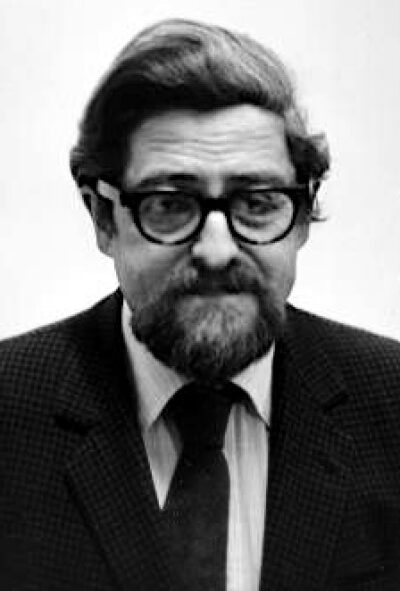
Louis Nirenberg
Louis Nirenberg was an American mathematician of Canadian origin. Born February 28, 1925, in Hamilton. Died January 26, 2020, in New York City. Positions held include director (1970–1972). Known for Gagliardo–Nirenberg interpolation inequality and Nirenberg's conjecture. Educated at McGill University and New York University. Awards include Guggenheim Fellowship, Chern Medal and Abel Prize.
Facts
40 facts · 2 confirmed by two sources · 23 cited · 15 from one source
Where this comes from
Papalocal keeps its own record. It started from these sources; what each one said is kept here as it was copied, so a change on their side never changes this page by itself. Tap one to read its version.
What Wikidata says · copied November 15, 2026 · revision 2567268205
- Described as
- American mathematician of Canadian origin (1925-2020)
- Born
- February 28, 1925 · 3 references
- Died
- January 26, 2020 · 2 references
- Born in
- Hamilton · 1 reference
- Died in
- New York City · 1 reference
- Citizen of
- Canada; United States
- Occupation
- mathematician · 1 reference; university teacher; scientist · 1 reference
- Positions held
- director (1970–1972) · 1 reference
- Worked for
- Courant Institute School of Mathematics, Computing, and Data Science (1949–1999) · 1 reference
- Education
- McGill University (1942–1945) · 1 reference; New York University (1945–1949) · 1 reference; Baron Byng High School (–1942) · 1 reference
- Member of
- French Academy of Sciences (1989–); National Academy of Sciences (1969–); Accademia Nazionale dei Lincei (1978–) · 1 reference; American Academy of Arts and Sciences; American Mathematical Society (2012–) · 2 references; Royal Society of Canada; American Philosophical Society (1987–)
- Known for
- Gagliardo–Nirenberg interpolation inequality; Nirenberg's conjecture
- Awards
- Guggenheim Fellowship (1966) · 1 reference; Chern Medal (2010) · 1 reference; Abel Prize (2015) · 1 reference; National Medal of Science (1995) · 1 reference; Bôcher Memorial Prize (1959) · 1 reference; Crafoord Prize in Mathematics (1982) · 1 reference; Steele Prize for Lifetime Achievement (1994) · 2 references; Steele Prize for Seminal Contribution to Research (2014) · 2 references; honorary doctorate from McMaster University; honorary doctorate from the McGill University; honorary doctorate from the University of British Columbia; honorary doctor of Paris Dauphine University (1989) · 1 reference; Fellow of the American Mathematical Society (2013) · 2 references
- Field
- partial differential equation · 1 reference; mathematics · 1 reference; inequality · 1 reference; mathematical interpolation · 1 reference
- Wikipedias with a page
- 31
Wikidata item Q596590 (wikidata.org/wiki/Q596590), public domain (CC0). Copied November 15, 2026.
What Wikipedia says · copied November 15, 2026 · revision 1368658801
Louis Nirenberg (February 28, 1925 – January 26, 2020) was a Canadian-American mathematician, considered one of the most outstanding mathematicians of the 20th century.
Nearly all of his work was in the field of partial differential equations. Many of his contributions are now regarded as fundamental to the field, such as his strong maximum principle for second-order parabolic partial differential equations and the Newlander–Nirenberg theorem in complex geometry. He is regarded as a foundational figure in the field of geometric analysis, with many of his works being closely related to the study of complex analysis and differential geometry.
- Born, in its opening lines
- February 28, 1925
- Died, in its opening lines
- January 26, 2020
From the Wikipedia article “Louis Nirenberg” (en.wikipedia.org/wiki/Louis_Nirenberg), by its contributors, under CC BY-SA 4.0 (creativecommons.org/licenses/by-sa/4.0/). Copied November 15, 2026; not changed.
Confirmed Two sources agree. Cited One source, and it names where it got it. One source One source, without a reference of its own. Sources disagree The sources disagree. We show the best-supported value and keep theirs below.
