
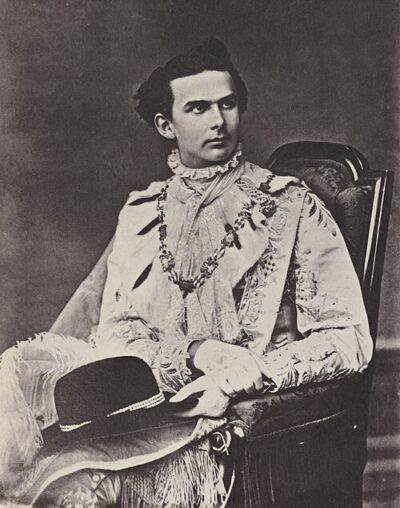
Ludwig II of Bavaria
Ludwig II of Bavaria was a King of Bavaria. Born August 25, 1845, in Nymphenburg Palace. Died June 13, 1886, in Lake Starnberg. Positions held include King of Bavaria (1864–1886). Awards include Knight of the Order of the Golden Fleece, Order of the Black Eagle and Order of St. Andrew.
Facts
27 facts · 2 confirmed by two sources · 5 cited · 20 from one source
Where this comes from
Papalocal keeps its own record. It started from these sources; what each one said is kept here as it was copied, so a change on their side never changes this page by itself. Tap one to read its version.
What Wikidata says · copied November 16, 2026 · revision 2568737960
- Described as
- King of Bavaria (1845–1886)
- Other names
- Ludwig Otto Friedrich Wilhelm, Swan King, der Märchenkönig, the Fairy Tale King, Ludwig II
- Born
- August 25, 1845 · 7 references
- Died
- June 13, 1886 · 8 references
- Born in
- Nymphenburg Palace
- Died in
- Lake Starnberg · 1 reference
- Buried in
- St. Michael's Church, Munich · 1 reference
- Cause of death
- drowning
- Name at birth
- Ludwig II. Otto Friedrich Wilhelm von Bayern
- Citizen of
- Kingdom of Bavaria
- Occupation
- art collector; monarch
- Positions held
- King of Bavaria (1864–1886) · 1 reference
- Awards
- Knight of the Order of the Golden Fleece; Order of the Black Eagle; Order of St. Andrew; Order of Saint Hubert; Military Order of Max Joseph; Merit Order of the Bavarian Crown; Order of Saint Michael; Military Merit Order (Bavaria); Order of Ludwig I; Order of the Most Holy Annunciation; Royal Order of the Seraphim
- Father
- Maximilian II of Bavaria · 1 reference
- Mother
- Marie of Prussia · 1 reference
- Siblings
- Otto, King of Bavaria
- Religion
- Catholicism
- Height
- 1.93 m (6 ft 4 in)
- Wikipedias with a page
- 72
Wikidata item Q44039 (wikidata.org/wiki/Q44039), public domain (CC0). Copied November 16, 2026.
What Wikipedia says · copied November 16, 2026 · revision 1385694819
Ludwig II (Louis II; Ludwig Otto Friedrich Wilhelm; German: [ˈluːtvɪç ˈɔto ˈfʁiː.dʁɪç ˈvɪlˌhɛlm]; 25 August 1845 – 13 June 1886), also called the Swan King or the Fairy Tale King (der Märchenkönig), was King of Bavaria from 1864 until his death in 1886.
He also held the titles of Count Palatine of the Rhine, Duke of Bavaria, Duke of Franconia and Duke in Swabia. Outside Germany, he is at times called "the Mad King" or Mad King Ludwig.
Ludwig ascended to the throne in 1864 at the age of 18. Two years later, Bavaria and its allies were defeated in the Austro-Prussian War. Despite his desire to preserve Bavaria's independence, the kingdom came under Prussian hegemony and joined the German Empire upon the unification of Germany in 1871. Ludwig increasingly withdrew from day-to-day affairs of state in favour of extravagant artistic and architectural projects. He commissioned the construction of lavish palaces: Neuschwanstein Castle, Linderhof Palace, and Herrenchiemsee. He was also a devoted patron of the composer Richard Wagner. Ludwig spent all his own private royal revenues (although not state funds as is commonly thought) on these projects, borrowed extensively, and defied all attempts by his ministers to restrain him. This extravagance was used against him to declare him insane, a determination that is now questioned.
Ludwig was taken into custody and effectively deposed on 12 June 1886; he and his doctor were found dead the following day. His death was ruled to be a suicide, a conclusion that is also now questioned. Today, his architectural and artistic legacy includes many of Bavaria's most important tourist attractions.
- Born, in its opening lines
- August 25, 1845
- Died, in its opening lines
- June 13, 1886
From the Wikipedia article “Ludwig II of Bavaria” (en.wikipedia.org/wiki/Ludwig_II_of_Bavaria), by its contributors, under CC BY-SA 4.0 (creativecommons.org/licenses/by-sa/4.0/). Copied November 16, 2026; not changed.
Confirmed Two sources agree. Cited One source, and it names where it got it. One source One source, without a reference of its own. Sources disagree The sources disagree. We show the best-supported value and keep theirs below.
