
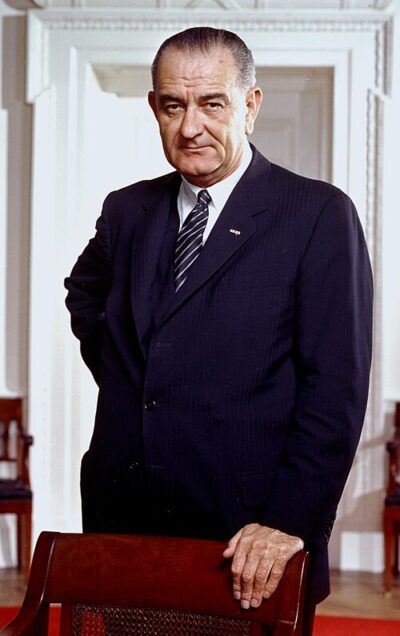
Lyndon B. Johnson
Lyndon B. Johnson was a president of the United States from 1963 to 1969. Born August 27, 1908, in LBJ Ranch. Died January 22, 1973, in LBJ Ranch House. Positions held include President of the United States (1963–1969), United States representative (1937–1949) and Vice President of the United States (1961–1963). Educated at Texas State University and Georgetown University Law Center. Awards include Presidential Medal of Freedom, Silver Star and Lasker-Bloomberg Public Service Award.

Facts
49 facts · 2 confirmed by two sources · 18 cited · 29 from one source
Where this comes from
Papalocal keeps its own record. It started from these sources; what each one said is kept here as it was copied, so a change on their side never changes this page by itself. Tap one to read its version.
What Wikidata says · copied November 13, 2026 · revision 2567577076
- Described as
- president of the United States from 1963 to 1969 (1908–1973)
- Other names
- President Johnson, LBJ, L. B. Johnson, Lyndon Baines Johnson, Lyndon Johnson
- Born
- August 27, 1908 · 13 references
- Died
- January 22, 1973 · 12 references
- Born in
- LBJ Ranch · 1 reference
- Died in
- LBJ Ranch House · 1 reference
- Buried in
- grave of Lyndon B. Johnson (1973–)
- Cause of death
- acute myocardial infarction
- Citizen of
- United States
- Occupation
- politician · 1 reference; teacher (1928–1931) · 1 reference; rancher; statesperson
- Positions held
- President of the United States (1963–1969); United States representative (1937–1949); Vice President of the United States (1961–1963); United States senator (1949–1961) · 1 reference
- Political party
- Democratic Party
- Worked for
- National Youth Administration (1935–1937); Sam Houston Math, Science, and Technology Center (1930–1931)
- Education
- Texas State University (–1930) · 1 reference; Georgetown University Law Center · 1 reference; Junction School (1912); Lyndon B. Johnson High School (–1924)
- Member of
- American Legion; Veterans of Foreign Wars
- Awards
- Presidential Medal of Freedom (1980) · 1 reference; Silver Star · 1 reference; Lasker-Bloomberg Public Service Award (1965) · 1 reference; honorary doctor of the Florida Atlantic University (1964) · 1 reference; American Campaign Medal · 1 reference; Asiatic-Pacific Campaign Medal · 1 reference; World War II Victory Medal · 1 reference
- Field
- gun control; politics · 1 reference; government · 1 reference
- Spouse
- Lady Bird Johnson (1934–1973) · 1 reference
- Children
- Lynda Bird Johnson Robb; Luci Baines Johnson
- Father
- Samuel Ealy Johnson Jr.
- Mother
- Rebekah Baines · 1 reference
- Siblings
- Sam Houston Johnson
- Religion
- Christian Church (Disciples of Christ); Restorationism
- Military branch
- United States Navy (1941–1942) · 1 reference
- Military rank
- lieutenant commander · 1 reference
- Lived in
- Kennedy-Warren Apartment Building (1937–1949) · 1 reference; White House (1963–1969); LBJ Ranch
- Nickname
- LBJ
- Height
- 1.92 m (6 ft 4 in) · 1 reference
- Wikipedias with a page
- 176
Wikidata item Q9640 (wikidata.org/wiki/Q9640), public domain (CC0). Copied November 13, 2026.
What Wikipedia says · copied November 13, 2026 · revision 1385002430
Lyndon Baines Johnson (August 27, 1908 – January 22, 1973), also known as LBJ, was the 36th president of the United States, serving from 1963 to 1969. The 37th vice president, he assumed the presidency following the assassination of John F. Kennedy. Johnson was a Southern Democrat who represented Texas in both houses of the U.S. Congress and earned a reputation as a talented and persuasive legislator. His presidency was marked by the passage of landmark civil rights legislation, the creation of Great Society programs such as Medicare and Medicaid, and a significant escalation in U.S. involvement in the Vietnam War.
Born in Stonewall, Texas, Johnson worked as a teacher and a congressional aide before winning election to the U.S. House of Representatives in 1937. In 1948, he was controversially declared the winner in the Democratic primary for the U.S. Senate election in Texas before winning the general election. He became Senate majority whip in 1951, Senate Democratic leader in 1953 and majority leader in 1954. Senator Kennedy bested Johnson and his other rivals for the 1960 Democratic presidential nomination before surprising many by offering to make Johnson his vice presidential running mate in order to balance the ticket and appeal to Southern voters. The Kennedy–Johnson ticket won the general election. Johnson assumed the presidency in 1963, after Kennedy was assassinated. The following year, Johnson won reelection to the presidency in a landslide, winning the largest share of the popular vote for the Democratic Party in history.
Johnson's domestic policy agenda known as the Great Society was aimed at expanding civil rights, public broadcasting, access to health care, aid to education and the arts, urban and rural development, consumer protection, environmentalism, and public services. He sought to create better living conditions for low-income Americans by spearheading the War on Poverty. As part of these efforts, Johnson signed the Social Security Amendments of 1965, which resulted in the creation of Medicare and Medicaid. Johnson made the Apollo Moon landing program a national priority; enacted the Higher Education Act of 1965 which established federally insured student loans; and signed the Immigration and Nationality Act of 1965 which laid the groundwork for U.S. immigration policy today. Johnson's civil rights legacy was shaped by the Civil Rights Act of 1964, the Voting Rights Act of 1965, and the Civil Rights Act of 1968. Due to his domestic agenda, Johnson's presidency marked the peak of modern American liberalism in the 20th century. Johnson's foreign policy prioritized containment of communism, including in the ongoing Vietnam War.
Johnson began his presidency with near-universal support, but his approval declined throughout his presidency as the public became frustrated with both the Vietnam War and domestic unrest, including race riots, increasing public skepticism with his reports and policies (coined the credibility gap), and increasing crime. Johnson initially sought to run for re-election in 1968; however, following disappointing results in the New Hampshire primary, he withdrew his candidacy. Johnson retired to his Texas ranch and kept a low public profile until he died in 1973. Public opinion and academic assessments of Johnson's legacy have fluctuated greatly. Historians and scholars rank Johnson in the upper tier for his accomplishments regarding domestic policy. His administration enacted several major laws that brought significant changes in the areas of civil rights, health care, welfare, and education. Conversely, Johnson is heavily criticized for his foreign policy, namely escalating American involvement in the Vietnam War.
- Born, in its opening lines
- August 27, 1908
- Died, in its opening lines
- January 22, 1973
From the Wikipedia article “Lyndon B. Johnson” (en.wikipedia.org/wiki/Lyndon_B._Johnson), by its contributors, under CC BY-SA 4.0 (creativecommons.org/licenses/by-sa/4.0/). Copied November 13, 2026; not changed.
Confirmed Two sources agree. Cited One source, and it names where it got it. One source One source, without a reference of its own. Sources disagree The sources disagree. We show the best-supported value and keep theirs below.
