
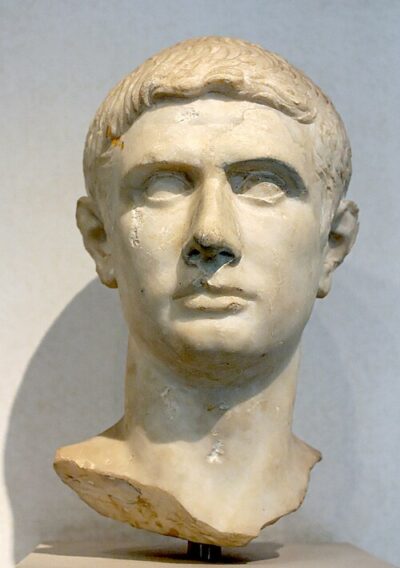
Marcus Junius Brutus
Marcus Junius Brutus was an assassin of Julius Caesar. Born 85 BC. Died October 23, 42 BC, in Philippi. Positions held include praetors, quaestor and Roman governor.
Facts
23 facts · 0 confirmed by two sources · 11 cited · 10 from one source · 2 where the sources disagree
What’s different
- Father: we show Marcus Junius Brutus the Elder (Sources disagree). Wikidata also lists Quintus Servilius Caepio
- Mother: we show Servilia (Sources disagree). Wikidata also lists Hortensia
Where this comes from
Papalocal keeps its own record. It started from these sources; what each one said is kept here as it was copied, so a change on their side never changes this page by itself. Tap one to read its version.
What Wikidata says · copied November 16, 2026 · revision 2567934765
- Described as
- assassin of Julius Caesar
- Other names
- Q. Caepio Brutus, Quintus Servilius Caepio Junianus, Marcus Iunius Brutus, Quintus Servilius Caepio Brutus, Quintus Caepio Brutus, Brutus, Marcus Junius Brutus the Younger
- Born
- 85 BC · 2 references
- Died
- October 23, 42 BC · 1 reference
- Died in
- Philippi · 1 reference
- Cause of death
- penetrating trauma
- Citizen of
- Ancient Rome
- Occupation
- philosopher; poet · 1 reference; politician · 1 reference
- Positions held
- praetors; quaestor; Roman governor; praetor urbanus; ancient Roman senator; triumvir monetalis (-54) · 1 reference; moneyer (-43–-42) · 1 reference
- Spouse
- Claudia (–-45) · 2 references; Porcia (-45–-43) · 2 references
- Father
- Marcus Junius Brutus the Elder · 3 references; Quintus Servilius Caepio · 1 reference
- Mother
- Servilia · 2 references; Hortensia · 1 reference
- Siblings
- Marcus Junius Silanus; Junia Prima · 2 references; Junia Secunda · 2 references; Junia Tertia · 2 references
- Wikipedias with a page
- 76
Wikidata item Q172248 (wikidata.org/wiki/Q172248), public domain (CC0). Copied November 16, 2026.
What Wikipedia says · copied November 16, 2026 · revision 1381518508
Marcus Junius Brutus (; Latin: [ˈmaːrkʊs juːniʊs ˈbruːtʊs]; c. 85 BC – 23 October 42 BC) was a Roman politician, orator, and the most famous of the assassins of Julius Caesar. After being adopted by a relative, his legal name became Quintus Servilius Caepio Brutus. He is often referred to simply as Brutus.
Early in his political career, Brutus opposed Pompey, who was responsible for Brutus' father's death. He also was close to Caesar. However, Caesar's attempts to evade accountability in the law courts put him at greater odds with his opponents in the Roman elite and the senate. Brutus eventually came to oppose Caesar and sided with Pompey against Caesar's forces during the ensuing civil war (49–45 BC). Pompey was defeated at the Battle of Pharsalus in 48, after which Brutus surrendered to Caesar, who granted him amnesty.
With Caesar's increasingly monarchical and autocratic behaviour after the civil war, several senators who later called themselves liberatores (liberators) plotted to assassinate him. Brutus took a leading role in the assassination, which was carried out successfully on the Ides of March (15 March) of 44 BC. In a settlement between the liberatores and the Caesarians, an amnesty was granted to the assassins while Caesar's acts were upheld for two years.
Popular unrest forced Brutus and his brother-in-law, fellow assassin Gaius Cassius Longinus, to leave Rome in April 44. After a complex political realignment, Octavian – Caesar's adopted son – made himself consul and, with his colleague, passed a law retroactively making Brutus and the other conspirators murderers. This led to a second civil war, in which Mark Antony and Octavian fought the liberatores led by Brutus and Cassius. The Caesarians decisively defeated the outnumbered armies of Brutus and Cassius at the two battles at Philippi in October 42. After the defeat, Brutus took his own life.
His name has become a synonym and byword for "betrayal" or "traitor" in most languages of Europe. His condemnation for betrayal of Caesar, his friend and benefactor, is perhaps rivalled only by the name of Judas Iscariot, with whom he is portrayed in Dante Alighieri's Inferno. He also has been praised in various narratives, both ancient and modern, as a virtuous and committed republican who fought – however futilely – for freedom and against tyranny.
From the Wikipedia article “Marcus Junius Brutus” (en.wikipedia.org/wiki/Marcus_Junius_Brutus), by its contributors, under CC BY-SA 4.0 (creativecommons.org/licenses/by-sa/4.0/). Copied November 16, 2026; not changed.
Confirmed Two sources agree. Cited One source, and it names where it got it. One source One source, without a reference of its own. Sources disagree The sources disagree. We show the best-supported value and keep theirs below.
