
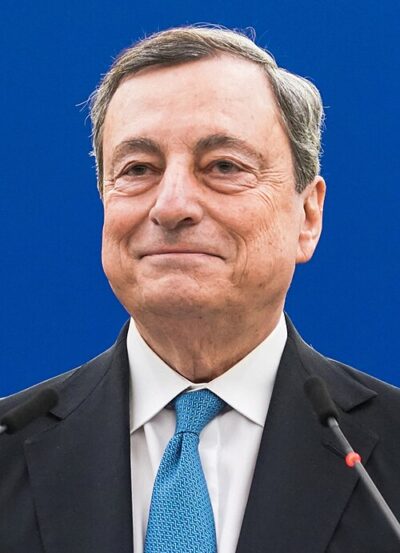
Mario Draghi
Mario Draghi is an Italian economist, academic, banker and politician; former prime minister of Italy. Born September 3, 1947, in Rome. Positions held include Governor of the Banca d'Italia (2006–2011), President of the European Central Bank (2011–2019) and Prime Minister of Italy (2021–2022). Educated at Liceo Classico Massimiliano Massimo and Sapienza University of Rome. Awards include Knight Grand Cross of the Order of Merit of the Italian Republic, honorary doctor of Tel Aviv University and honorary doctor of the University of Padua.
Facts
44 facts · 1 confirmed by two sources · 20 cited · 23 from one source
Where this comes from
Papalocal keeps its own record. It started from these sources; what each one said is kept here as it was copied, so a change on their side never changes this page by itself. Tap one to read its version.
What Wikidata says · copied November 16, 2026 · revision 2564447111
- Described as
- Italian economist, academic, banker and politician; former prime minister of Italy
- Born
- September 3, 1947 · 6 references
- Born in
- Rome · 1 reference
- Citizen of
- Italy
- Occupation
- economist · 2 references; banker; university teacher · 2 references; politician
- Positions held
- Governor of the Banca d'Italia (2006–2011); President of the European Central Bank (2011–2019); Prime Minister of Italy (2021–2022) · 2 references
- Political party
- independent politician · 1 reference
- Worked for
- University of Florence (1981–1994); John F. Kennedy School of Government; World Bank; Goldman Sachs (2002–2005); University of Turin; University of Padua · 1 reference; University of Trento · 1 reference
- Education
- Liceo Classico Massimiliano Massimo; Sapienza University of Rome (–1970); Massachusetts Institute of Technology (–1977)
- Member of
- Group of Thirty · 2 references; Pontifical Academy of Social Sciences (2020–) · 1 reference; Rhine Group (2026–) · 1 reference
- Awards
- Knight Grand Cross of the Order of Merit of the Italian Republic (2000) · 1 reference; honorary doctor of Tel Aviv University; honorary doctor of the University of Padua; Honorary doctor of the University of Bologna · 1 reference; Grand Collar of the Order of Prince Henry (2019) · 1 reference; honorary degree · 1 reference; Grand Cross 1st class of the Order of Merit of the Federal Republic of Germany (2020); M100 Media Award (2012) · 1 reference; Time 100 (2021) · 1 reference; Order of Prince Yaroslav the Wise, 1st class (2022) · 1 reference; Financial Times Person of the Year (2012); Global Citizen Awards (2015) · 1 reference; Commander of the Legion of Honour (2019) · 1 reference; Princess of Asturias Award for International Cooperation (2025) · 1 reference
- Field
- economics; mathematical economics · 1 reference; economics of banking · 1 reference
- Children
- Federica Draghi · 1 reference; Giacomo Draghi
- Siblings
- Andreina Draghi · 1 reference
- Wikipedias with a page
- 92
Wikidata item Q294460 (wikidata.org/wiki/Q294460), public domain (CC0). Copied November 16, 2026.
What Wikipedia says · copied November 16, 2026 · revision 1382590483
Mario Draghi (Italian: [ˈmaːrjo ˈdraːɡi]; born 3 September 1947) is an Italian politician, economist, academic, banker, statesman, and civil servant, who served as the prime minister of Italy from 13 February 2021 to 22 October 2022. Prior to his appointment as prime minister, he served as the president of the European Central Bank (ECB) between 2011 and 2019. Draghi was also the chair of the Financial Stability Board between 2009 and 2011, and governor of the Bank of Italy between 2006 and 2011.
After working as an economist, Draghi worked for the World Bank in Washington, D.C., throughout the 1980s, and in 1991 returned to Rome to become director general of the Italian Treasury. He left that role after a decade to join Goldman Sachs, where he remained until his appointment as governor of the Bank of Italy in 2006. His tenure as Governor coincided with the 2008 Great Recession, and in the midst of this he was selected to become the first chair of the Financial Stability Board, the global standard-setter that replaced the Financial Stability Forum.
He left those roles after his nomination by the European Council in 2011 to serve as president of the ECB. He presided over the institution during the Eurozone crisis, becoming famous throughout Europe for saying that he would be prepared to do "whatever it takes" to prevent the euro from failing. In 2014, Draghi was listed by Forbes as the eighth-most powerful person in the world. In 2015, Fortune magazine ranked him as the world's "second greatest leader". He is also the only Italian to be listed three times in the Time 100 annual listicle. In 2019, Paul Krugman described him as "the greatest central banker of modern times." Moreover, thanks to his monetary policies, he is widely considered the "saviour of the euro" during the Euro area crisis. He has been nicknamed Super Mario by some media, a nickname that was popularised during his time as president of the ECB, when he was credited by numerous sources as having played a key role in combatting the Eurozone crisis.
After Draghi's term as ECB President ended in 2019, he initially returned to private life. On 3 February 2021, in the midst of the COVID-19 pandemic in Italy, Draghi was invited by President Sergio Mattarella to form a government of national unity (Draghi Cabinet), following the resignation of Giuseppe Conte. After successful negotiations with parties including the League (Lega - Salvini Premier), the Five Star Movement (M5S), the Democratic Party (PD), and Forza Italia (FI), Draghi was sworn in as prime minister on 11 February, pledging to oversee effective implementation of COVID-19 economic stimulus. Draghi was rated highly in public opinion polls in Italy during his time as prime minister; at the end of his first year in office Politico Europe ranked him as the most powerful person in Europe and The Economist named Italy as "Country of the Year", singling out Draghi's leadership as central to its nomination.
On 14 July 2022, the M5S revoked support to Draghi's coalition government regarding a decree concerning economic stimulus to offset the energy crisis. On the same day, despite having won a confidence vote, Draghi announced his resignation as prime minister, which was rejected by President Mattarella. On 21 July, Draghi resigned for a second time following the failure of a confidence vote to pass with an absolute majority due to the withdrawals of M5S, Lega, and FI. On the same day, President Mattarella accepted the resignation and Draghi remained in office as caretaker prime minister. He was succeeded by Giorgia Meloni on 22 October 2022.
- Born, in its opening lines
- September 3, 1947
From the Wikipedia article “Mario Draghi” (en.wikipedia.org/wiki/Mario_Draghi), by its contributors, under CC BY-SA 4.0 (creativecommons.org/licenses/by-sa/4.0/). Copied November 16, 2026; not changed.
Confirmed Two sources agree. Cited One source, and it names where it got it. One source One source, without a reference of its own. Sources disagree The sources disagree. We show the best-supported value and keep theirs below.
