
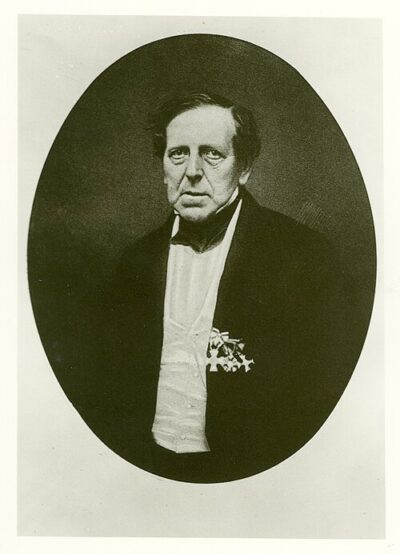
Martin Heinrich Rathke
Martin Heinrich Rathke was a German biologist. Born August 25, 1793, in Gdańsk. Died September 3, 1860, in Kaliningrad. Educated at University of Göttingen and Humboldt-Universität zu Berlin. Awards include Foreign Member of the Royal Society.
Facts
25 facts · 2 confirmed by two sources · 6 cited · 17 from one source
Where this comes from
Papalocal keeps its own record. It started from these sources; what each one said is kept here as it was copied, so a change on their side never changes this page by itself. Tap one to read its version.
What Wikidata says · copied November 18, 2026 · revision 2568988440
- Described as
- German biologist (1793–1860)
- Other names
- Rathke, H. Rathke, M. H. Rathke, Heinrich Rathke
- Born
- August 25, 1793 · 4 references
- Died
- September 3, 1860 · 3 references
- Born in
- Gdańsk · 2 references
- Died in
- Kaliningrad · 2 references
- Citizen of
- Kingdom of Prussia
- Occupation
- zoologist; anatomist; university teacher; carcinologist; physician · 1 reference; naturalist · 1 reference
- Worked for
- Imperial University of Dorpat; Academic Gymnasium Danzig
- Education
- University of Göttingen; Humboldt-Universität zu Berlin · 1 reference
- Member of
- Royal Society of London (1855–); German Academy of Sciences Leopoldina; Bavarian Academy of Sciences and Humanities; Saint Petersburg Academy of Sciences; Royal Prussian Academy of Sciences; Académie Nationale de Médecine; Göttingen Academy of Sciences and Humanities in Lower Saxony
- Awards
- Foreign Member of the Royal Society (1855) · 1 reference
- Father
- Georg Heinrich Rathke · 1 reference
- Lived in
- Kingdom of Prussia
- Wikipedias with a page
- 22
Wikidata item Q61281 (wikidata.org/wiki/Q61281), public domain (CC0). Copied November 18, 2026.
What Wikipedia says · copied November 18, 2026 · revision 1332235465
Martin Heinrich Rathke (25 August 1793, Danzig – 3 September 1860, Königsberg) was a German embryologist and anatomist. Along with Karl Ernst von Baer and Christian Heinrich Pander, he is recognized as one of the founders of modern embryology. He was the father of chemist Bernhard Rathke (1840–1923).
He studied medicine and natural history at the University of Göttingen, later relocating to Berlin, where he received his doctorate in medicine (1818). In 1828 he was named professor of physiology, pathology and semiotics at the Imperial University of Dorpat. In 1832/33 he undertook research expeditions to Finland and to the Crimea. Rathke was a professor of zoology and anatomy at Königsberg from 1835 to 1860. In 1839, while based in Königsberg, he travelled to Scandinavia, where he conducted studies of marine organisms.
He studied marine organisms and the embryonic development of sex organs. He was the first to describe the brachial clefts and gill arches in the embryos of mammals and birds. He also first described in 1839 the embryonic structure, now known as Rathke's pouch, from which the anterior lobe of the pituitary gland develops.
He was the first to discover that the amphioxus was a separate taxon, and not the larva of a mollusk, as previously thought. He was the author of several writings on crustaceans, mollusks and worms, and also the author of works on vertebrates, such as the lemming and various reptiles.
- Born, in its opening lines
- August 25, 1793
- Died, in its opening lines
- September 3, 1860
From the Wikipedia article “Martin Rathke” (en.wikipedia.org/wiki/Martin_Rathke), by its contributors, under CC BY-SA 4.0 (creativecommons.org/licenses/by-sa/4.0/). Copied November 18, 2026; not changed.
Confirmed Two sources agree. Cited One source, and it names where it got it. One source One source, without a reference of its own. Sources disagree The sources disagree. We show the best-supported value and keep theirs below.
