
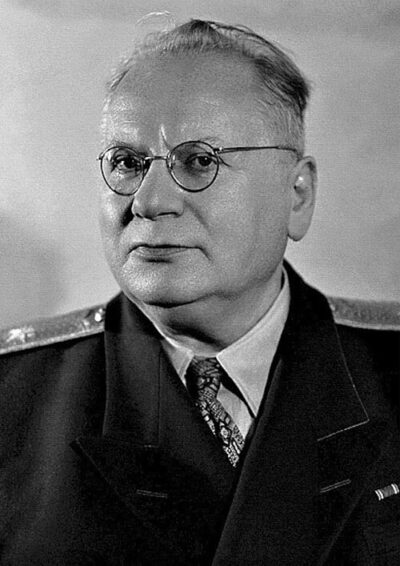
Maxim Litvinov
Maxim Litvinov was a Soviet diplomat and foreign minister. Born July 17, 1876, in Białystok. Died December 31, 1951, in Moscow. Positions held include deputy of the Supreme Soviet of the Soviet Union, Soviet Ambassador to the United States (1941–1943) and ambassador. Educated at VI High School – King Sigismund Augustus. Awards include Order of the Red Banner of Labour, Medal "For Valiant Labour in the Great Patriotic War 1941–1945" and Order of Lenin.
Facts
27 facts · 2 confirmed by two sources · 7 cited · 18 from one source
Where this comes from
Papalocal keeps its own record. It started from these sources; what each one said is kept here as it was copied, so a change on their side never changes this page by itself. Tap one to read its version.
What Wikidata says · copied November 16, 2026 · revision 2562685844
- Described as
- Soviet diplomat and foreign minister (1876–1951)
- Other names
- Maxim Litvinoff, Maxim Maximovich Litvinov, Maksim Maksimovitch Litvinov
- Born
- July 17, 1876 · 7 references
- Died
- December 31, 1951 · 9 references
- Born in
- Białystok · 3 references
- Died in
- Moscow · 3 references
- Buried in
- Novodevichy Cemetery
- Citizen of
- Soviet Union; Russian Empire; Russia · 1 reference
- Occupation
- politician · 2 references; diplomat · 2 references
- Positions held
- deputy of the Supreme Soviet of the Soviet Union; Soviet Ambassador to the United States (1941–1943); ambassador; People's Commissar for Foreign Affairs of the Soviet Union (1930–1939) · 1 reference
- Political party
- Communist Party of the Soviet Union (1918–1951) · 1 reference; Russian Social Democratic Labour Party (bolshevik) (1903–1918) · 1 reference; Russian Social Democratic Labour Party (1898–1903) · 1 reference
- Education
- VI High School – King Sigismund Augustus · 1 reference
- Member of
- Central Committee of the Communist Party of the Soviet Union; Central Executive Committee of the Soviet Union; All-Union Society of Old Bolsheviks
- Awards
- Order of the Red Banner of Labour (1945) · 1 reference; Medal "For Valiant Labour in the Great Patriotic War 1941–1945"; Order of Lenin (1936) · 1 reference
- Spouse
- Ivy Low Litvinov · 2 references
- Children
- Tatiana Litvinov · 1 reference; Mikhail Litvinov
- Wikipedias with a page
- 49
Wikidata item Q310100 (wikidata.org/wiki/Q310100), public domain (CC0). Copied November 16, 2026.
What Wikipedia says · copied November 16, 2026 · revision 1375445427
Maxim Maximovich Litvinov (Russian pronunciation: [mɐkˈsʲim mɐkˈsʲiməvʲɪtɕ lʲɪˈtvʲinəf]; born Meir Henoch Wallach-Finkelstein; 17 July 1876 – 31 December 1951) was a Russian revolutionary and prominent Soviet statesman and diplomat who served as People's Commissar for Foreign Affairs from 1930 to 1939.
Litvinov was an advocate for diplomatic agreements leading to disarmament, and was influential in making the Soviet Union a party to the 1928 Kellogg–Briand Pact. He was also responsible for the 1929 Litvinov Protocol, a multilateral agreement to implement the Kellogg-Briand Pact between the Soviet Union and several neighboring states.
In 1930, Litvinov was appointed People's Commissar of Foreign Affairs, the highest diplomatic position in the USSR. During the 1930s, Litvinov advocated the official Soviet policy of collective security with Western powers against Nazi Germany.
- Born, in its opening lines
- July 17, 1876
- Died, in its opening lines
- December 31, 1951
From the Wikipedia article “Maxim Litvinov” (en.wikipedia.org/wiki/Maxim_Litvinov), by its contributors, under CC BY-SA 4.0 (creativecommons.org/licenses/by-sa/4.0/). Copied November 16, 2026; not changed.
Confirmed Two sources agree. Cited One source, and it names where it got it. One source One source, without a reference of its own. Sources disagree The sources disagree. We show the best-supported value and keep theirs below.
