
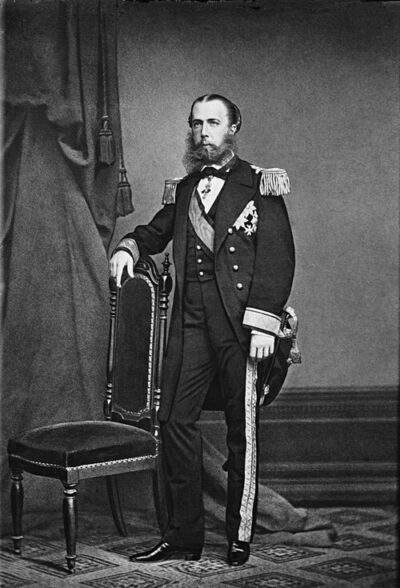
Maximilian I of Mexico
Maximilian I of Mexico was an emperor of Mexico. Born July 6, 1832, in Schönbrunn Palace. Died June 19, 1867, in Santiago de Querétaro. Positions held include Emperor of Mexico and Member of the House of Lords (Austria) (1861–1864). Awards include Knight of the Order of the Golden Fleece, Order of Saint Anna, 1st class and Order of the White Eagle.
Facts
41 facts · 2 confirmed by two sources · 3 cited · 36 from one source
Where this comes from
Papalocal keeps its own record. It started from these sources; what each one said is kept here as it was copied, so a change on their side never changes this page by itself. Tap one to read its version.
What Wikidata says · copied November 16, 2026 · revision 2569175468
- Described as
- emperor of Mexico (1832-1867)
- Other names
- Fernando Maximiliano de Austria, Fernando José Maximiliano, Maximiliano I, Maximilian I, Ferdinando Maximiliano de Hapsburgo, Ferdinand Maximilian Josef Maria
- Born
- July 6, 1832 · 6 references
- Died
- June 19, 1867 · 7 references
- Born in
- Schönbrunn Palace · 2 references
- Died in
- Santiago de Querétaro · 1 reference
- Buried in
- Imperial Crypt
- Cause of death
- gunshot wound
- Name at birth
- Ferdinand Maximilian Joseph Maria von Österreich
- Citizen of
- Austrian Empire; Second Mexican Empire
- Occupation
- politician; botanist
- Positions held
- Emperor of Mexico; Member of the House of Lords (Austria) (1861–1864)
- Member of
- Austrian Academy of Sciences · 1 reference
- Awards
- Knight of the Order of the Golden Fleece; Order of Saint Anna, 1st class; Order of the White Eagle; Order of Saint Stanislaus, 1st class; Order of Saint Alexander Nevsky; Order of St. Andrew; Order of Saint Stephen of Hungary; Sovereign Military Order of Malta; Equestrian Order of the Holy Sepulchre; Order of the Black Eagle; Order of Saint Hubert; Royal Order of the Welfs; Order of Philip the Magnanimous; Order of the Rue Crown; Order of Fidelity
- Spouse
- Charlotte of Belgium (1857–) · 1 reference
- Children
- Agustín de Iturbide y Green; Salvador de Iturbide y Marzán
- Father
- Archduke Franz Karl of Austria
- Mother
- Princess Sophie of Bavaria
- Siblings
- Archduchess Maria Anna of Austria; Franz Joseph I of Austria; Archduke Karl Ludwig of Austria; Archduke Ludwig Viktor of Austria
- Religion
- Catholicism
- Military rank
- admiral
- Lived in
- Chapultepec Castle
- Wikipedias with a page
- 67
Wikidata item Q84192 (wikidata.org/wiki/Q84192), public domain (CC0). Copied November 16, 2026.
What Wikipedia says · copied November 16, 2026 · revision 1385659248
Maximilian I (Spanish: Fernando Maximiliano José María de Habsburgo-Lorena; German: Ferdinand Maximilian Josef Maria von Habsburg-Lothringen; 6 July 1832 – 19 June 1867) was an Austrian archduke who became emperor of the Second Mexican Empire from 10 April 1864 until his execution by the Restored Republic of Mexico on 19 June 1867.
A member of the House of Habsburg-Lorraine, Maximilian was the younger brother of Emperor Franz Joseph I of Austria. Before becoming Emperor of Mexico, he was commander-in-chief of the small Imperial Austrian Navy and briefly the Austrian viceroy of Lombardy–Venetia, but was removed by the emperor. Two years before his dismissal, he briefly met with French emperor Napoleon III in Paris, where he was approached by conservative Mexican monarchists seeking a European royal to rule Mexico. Initially Maximilian was not interested, but following his dismissal as viceroy, the Mexican monarchists' plan was far more appealing to him.
Since Maximilian was a descendant of Charles V, Holy Roman Emperor, King of Spain when the Spaniards conquered the Aztecs (1519–21) and first brought Mexico into the Spanish Empire, a status it held until the Mexican independence in 1821, Maximilian seemed a perfect candidate for the conservatives' plans for monarchy in Mexico. Maximilian was interested in assuming the throne, but only with guarantees of French support. Mexican conservatives did not take sufficient account of Maximilian's embrace of liberalism, and Maximilian failed to understand he would be viewed as a foreign outsider. When Maximilian was first mentioned as a possible emperor of Mexico, the idea seemed far-fetched, but circumstances changed and made it viable. His tenure as emperor was just three years, ending with his execution by firing squad by forces of the Restored Republic on 19 June 1867.
Political conflicts in Mexico in the 1850s between conservative and liberal factions were domestic disputes initially, but the conservatives' loss on the battlefield to the liberal regime during a three-year civil war (1858–61) meant conservatives sought ways to return to power with outside allies, opening a path for France under Napoleon III to intervene in Mexico and set up a puppet regime with conservative Mexican support. When the liberal government of Mexican president Benito Juárez suspended payment on foreign debts in 1861, there was an opening for European powers to intervene militarily in Mexico. The intention of the French and Mexican conservatives was for regime change to oust the liberals, backed by the power of the French army. Mexican monarchists sought a European head of state and, with the brokering of Napoleon III, Maximilian was invited to establish what would come to be known as the Second Mexican Empire. With a pledge of French military support and at the formal invitation of a Mexican delegation, Maximilian accepted the crown of Mexico on 10 April 1864 following a bogus referendum in Mexico that purportedly showed the Mexican people backed him.
Maximilian's hold on power in Mexico was shaky from the beginning. Rather than enacting policies that would return power to Mexican conservatives, Maximilian instead sought to implement liberal policies, losing him his domestic conservative backers. Internationally, his legitimacy as ruler was in doubt since the United States continued to recognize Benito Juárez as the legal head of state rather than Emperor Maximilian. The U.S. saw the French invasion as a violation of the Monroe Doctrine, but the U.S. was unable to intervene politically due to the American Civil War (1861–1865). With the end of the American Civil War in 1865, the United States began providing material aid to Juárez's republican forces. In the face of a renewed U.S. interest in enforcing the Monroe Doctrine, under orders by Napoleon III, the French armies that had propped up Maximilian's regime began withdrawing from Mexico in 1866. With no popular support and republican forces in the ascendant, Maximilian's monarchy collapsed. Maximilian was captured in Querétaro. He was tried and executed by the restored Republican government alongside his generals Miguel Miramón, a former president of Mexico, and Tomás Mejía Camacho in June 1867. His death marked the end of monarchism as a major force in Mexico. In reassessments of his brief rule, he is portrayed in Mexican history less as the villain of nationalist, republican history and more as a liberal in Mexico, along with presidents of the Republic Juárez, Sebastián Lerdo de Tejada, and Porfirio Díaz.
- Born, in its opening lines
- July 6, 1832
- Died, in its opening lines
- June 19, 1867
From the Wikipedia article “Maximilian I of Mexico” (en.wikipedia.org/wiki/Maximilian_I_of_Mexico), by its contributors, under CC BY-SA 4.0 (creativecommons.org/licenses/by-sa/4.0/). Copied November 16, 2026; not changed.
Confirmed Two sources agree. Cited One source, and it names where it got it. One source One source, without a reference of its own. Sources disagree The sources disagree. We show the best-supported value and keep theirs below.
