
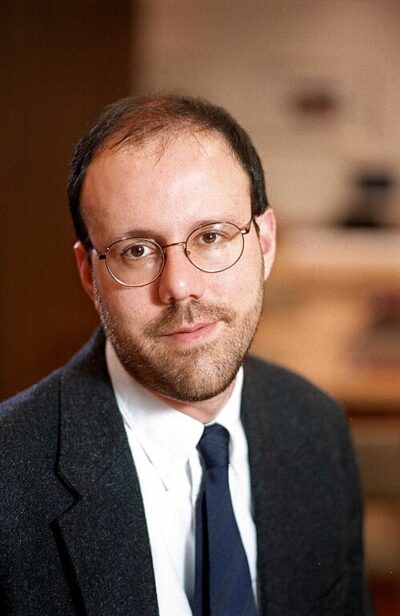
Michael Kremer
Michael Kremer is an American development economist. Born November 12, 1964, in New York City. Educated at Harvard University. Awards include MacArthur Fellows Program, Fellow of the Econometric Society and Presidential Early Career Award for Scientists and Engineers.
Facts
22 facts · 1 confirmed by two sources · 9 cited · 12 from one source
Where this comes from
Papalocal keeps its own record. It started from these sources; what each one said is kept here as it was copied, so a change on their side never changes this page by itself. Tap one to read its version.
What Wikidata says · copied November 13, 2026 · revision 2567242986
- Described as
- American development economist
- Other names
- Michael Robert Kremer, Michael R. Kremer, Michael R Kremer, M. R. Kremer, M R Kremer, M. Kremer, M Kremer, Kremer, Kremer M, Kremer M., Kremer M. R., Kremer MR
- Born
- November 12, 1964 · 2 references
- Born in
- New York City · 2 references
- Citizen of
- United States
- Occupation
- economist · 1 reference; university teacher · 1 reference
- Worked for
- Harvard University (1999–2021) · 1 reference; Massachusetts Institute of Technology · 1 reference; University of Chicago (2021–) · 1 reference
- Education
- Harvard University · 1 reference
- Member of
- American Academy of Arts and Sciences; National Academy of Sciences (2020–); Econometric Society (2008–) · 1 reference
- Awards
- MacArthur Fellows Program (1997) · 1 reference; Fellow of the Econometric Society (2008) · 1 reference; Presidential Early Career Award for Scientists and Engineers (1996) · 1 reference; Fellow of the American Academy of Arts and Sciences; Prize in Economic Sciences in Memory of Alfred Nobel (2019) · 1 reference
- Field
- development economics; health economics
- Spouse
- Rachel Glennerster
- Religion
- Judaism · 1 reference
- Website
- https://scholar.harvard.edu/kremer
- Wikipedias with a page
- 50
Wikidata item Q1635006 (wikidata.org/wiki/Q1635006), public domain (CC0). Copied November 13, 2026.
What Wikipedia says · copied November 13, 2026 · revision 1385354157
Michael Robert Kremer (born November 12, 1964) is an American development economist currently serving as university professor in economics at the University of Chicago and director of the Development Innovation Lab at the Becker Friedman Institute for Research in Economics. Kremer formerly served as the Gates Professor of Developing Societies at Harvard University, a role he held from 2003 to 2020. In 2019, Kremer was jointly awarded the Nobel Memorial Prize in Economic Sciences, together with Esther Duflo and Abhijit Banerjee, "for their experimental approach to alleviating global poverty".
In addition to his academic appointments, Kremer is the co-founder of the Bureau for Research and Economic Analysis of Development (BREAD), a member of the National Academy of Sciences, and a Research Associate at the National Bureau of Economic Research. In 2008, he was elected a Fellow of the Econometric Society. Kremer is also the Scientific Director of Development Innovation Ventures, a program of the United States Agency for International Development aimed at maximizing the impact of development spending through rigorous impact evaluation.
- Born, in its opening lines
- November 12, 1964
From the Wikipedia article “Michael Kremer” (en.wikipedia.org/wiki/Michael_Kremer), by its contributors, under CC BY-SA 4.0 (creativecommons.org/licenses/by-sa/4.0/). Copied November 13, 2026; not changed.
Confirmed Two sources agree. Cited One source, and it names where it got it. One source One source, without a reference of its own. Sources disagree The sources disagree. We show the best-supported value and keep theirs below.
