
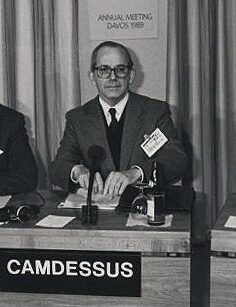
Michel Camdessus
Michel Camdessus is a French economist. Born May 1, 1933, in Bayonne. Positions held include Managing Director of the International Monetary Fund (1987–2000), Governor of the Banque de France (1984–1987) and general director of the Treasury (1982–1984). Educated at University of Paris and Paris Institute of Political Studies. Awards include Grand Officer of the Legion of Honour, Knight of the National Order of Merit and Commander of the Legion of Honour.
Facts
18 facts · 1 confirmed by two sources · 1 cited · 16 from one source
Where this comes from
Papalocal keeps its own record. It started from these sources; what each one said is kept here as it was copied, so a change on their side never changes this page by itself. Tap one to read its version.
What Wikidata says · copied November 17, 2026 · revision 2524186937
- Described as
- French economist
- Born
- May 1, 1933 · 5 references
- Born in
- Bayonne
- Citizen of
- France
- Occupation
- economist · 1 reference; banker
- Positions held
- Managing Director of the International Monetary Fund (1987–2000); Governor of the Banque de France (1984–1987); general director of the Treasury (1982–1984); president (2001–2007)
- Education
- University of Paris; Paris Institute of Political Studies; École nationale d'administration (1958–1960)
- Member of
- Pontifical Council for Justice and Peace
- Awards
- Grand Officer of the Legion of Honour; Knight of the National Order of Merit; Commander of the Legion of Honour; Zerilli-Marimò Prize (2005); Order of Manas, 3rd class
- Wikipedias with a page
- 26
Wikidata item Q551363 (wikidata.org/wiki/Q551363), public domain (CC0). Copied November 17, 2026.
What Wikipedia says · copied November 17, 2026 · revision 1373169168
Michel Camdessus (born 1 May 1933) is a French economist who served as the seventh managing director of the International Monetary Fund (IMF) from 1987 to 2000, making him the longest-serving in that position. Prior to his tenure at the IMF, he served as the Governor of the Banque de France from 1984 to 1987, after a brief term as Deputy Governor from August to November 1984 when elevated to the top position.
One notable events during his tenure at the IMF was the 1997 East Asian financial crisis. His role during the crisis has drawn criticism, for not paying attention to the unique circumstances of the East Asian countries and blindly imposing the measures that were followed in Mexico, leading to considerable turmoil and rioting in countries such as Indonesia.
Born in Bayonne, France, Mr. Camdessus studied at the University of Paris and earned postgraduate degrees in economics from the Institut d'Etudes Politiques de Paris (Sciences Po) in Paris and École nationale d'administration.
Camdessus is currently the president of the social initiative Semaines sociales de France (French social weeks), a social initiative, and a member of the Commission for Africa established by Tony Blair. He is also a member of the Pontifical Commission for Justice and Peace.
Additionally, Camdessus is a member of the Africa Progress Panel (APP), a group of ten distinguished individuals who advocate at the highest levels for equitable and sustainable development in Africa. As part of this Panel, he contributes to coalition-building, leverage and broker knowledge sharing, and influencing policies for lasting change in Africa.
He is also a member of the board of directors of the Fondation Chirac's, founded by former French president Jacques Chirac in 2008 to promote world peace. Camdessus participates in the jury for the Conflict Prevention Prize awarded every year by this foundation, and in the scientific committee of its Water and Sanitation program.
- Born, in its opening lines
- May 1, 1933
From the Wikipedia article “Michel Camdessus” (en.wikipedia.org/wiki/Michel_Camdessus), by its contributors, under CC BY-SA 4.0 (creativecommons.org/licenses/by-sa/4.0/). Copied November 17, 2026; not changed.
Confirmed Two sources agree. Cited One source, and it names where it got it. One source One source, without a reference of its own. Sources disagree The sources disagree. We show the best-supported value and keep theirs below.
