
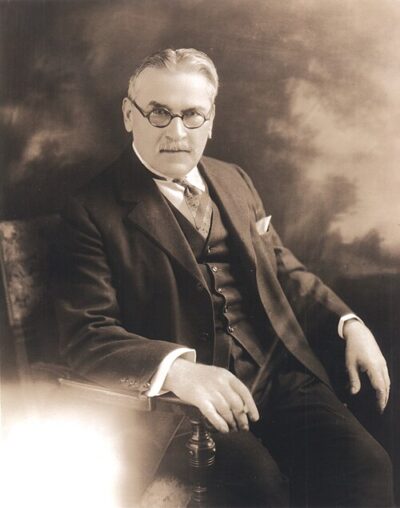
Mihajlo Pupin
Mihajlo Pupin was a Serbian-American physicist, physical chemist and philanthropist. Born October 4, 1858, in Idvor. Died March 12, 1935, in New York City. Educated at Fu Foundation School of Engineering and Applied Science and Columbia College. Awards include Edison Medal, IEEE Medal of Honor and Pulitzer Prize for Biography.
Facts
34 facts · 2 confirmed by two sources · 10 cited · 22 from one source
What’s different
- Born: we show October 4, 1858 (Confirmed). Wikidata also lists October 9, 1858
Where this comes from
Papalocal keeps its own record. It started from these sources; what each one said is kept here as it was copied, so a change on their side never changes this page by itself. Tap one to read its version.
What Wikidata says · copied November 13, 2026 · revision 2553832505
- Described as
- Serbian-American physicist, physical chemist and philanthropist (1858–1935)
- Other names
- Michael I. Pupin, Michael Pupin, Michael Idvorsky Pupin, Mihajlo Idvorski Pupin
- Born
- October 9, 1858; October 4, 1858 · 1 reference
- Died
- March 12, 1935 · 4 references
- Born in
- Idvor
- Died in
- New York City · 1 reference
- Buried in
- Woodlawn Cemetery · 1 reference
- Citizen of
- United States; Austrian Empire
- Occupation
- chemist; physicist; inventor; university teacher; mathematician; engineer · 1 reference
- Worked for
- Columbia University
- Education
- Fu Foundation School of Engineering and Applied Science; Columbia College (1879–1883); Frederick William University Berlin (1885–1889); University of Cambridge (1883–1885); Humboldt-Universität zu Berlin · 1 reference
- Member of
- National Advisory Committee for Aeronautics; Serbian Academy of Sciences and Arts (1912–1935); American Academy of Arts and Sciences; National Academy of Sciences (1905–)
- Awards
- Edison Medal (1920) · 1 reference; IEEE Medal of Honor (1924); Pulitzer Prize for Biography (1924) · 1 reference; Elliott Cresson Medal (1905) · 1 reference; John Fritz Medal (1932) · 1 reference; Josiah Willard Gibbs Lectureship (1923); National Inventors Hall of Fame (2011) · 1 reference; Washington Award (1928) · 1 reference
- Field
- physics · 1 reference
- Spouse
- Sarah Catharine Jackson
- Religion
- Serbian Orthodox Church
- Wikipedias with a page
- 43
Wikidata item Q196287 (wikidata.org/wiki/Q196287), public domain (CC0). Copied November 13, 2026.
What Wikipedia says · copied November 13, 2026 · revision 1379353889
Mihajlo Idvorski Pupin (Serbian Cyrillic: Михајло Идворски Пупин, pronounced [miˈxǎjlo ˈîdʋoɾski ˈpǔpin]; October 4, 1858 – March 12, 1935), also known as Michael Pupin, was a Serbian-American electrical engineer, physicist and inventor.
Pupin is best known for his numerous patents, including a means of greatly extending the range of long-distance telephone communication by placing loading coils (of wire) at predetermined intervals along the transmitting wire (known as "pupinization"). Pupin was a founding member of National Advisory Committee for Aeronautics (NACA) on 3 March 1915, which later became NASA, and he participated in the founding of American Mathematical Society and American Physical Society.
In 1924, he won a Pulitzer Prize for his autobiography. Pupin was elected president or vice-president of the highest scientific and technical institutions, such as the American Institute of Electrical Engineers, the New York Academy of Sciences, the Radio Institute of America, and the American Association for the Advancement of Science. He was also an honorary consul of Serbia in the United States from 1912 to 1920 and played a role in determining the borders of newly formed Kingdom of Serbs, Croats and Slovenes.
- Born, in its opening lines
- October 4, 1858
- Died, in its opening lines
- March 12, 1935
From the Wikipedia article “Mihajlo Pupin” (en.wikipedia.org/wiki/Mihajlo_Pupin), by its contributors, under CC BY-SA 4.0 (creativecommons.org/licenses/by-sa/4.0/). Copied November 13, 2026; not changed.
Confirmed Two sources agree. Cited One source, and it names where it got it. One source One source, without a reference of its own. Sources disagree The sources disagree. We show the best-supported value and keep theirs below.
