
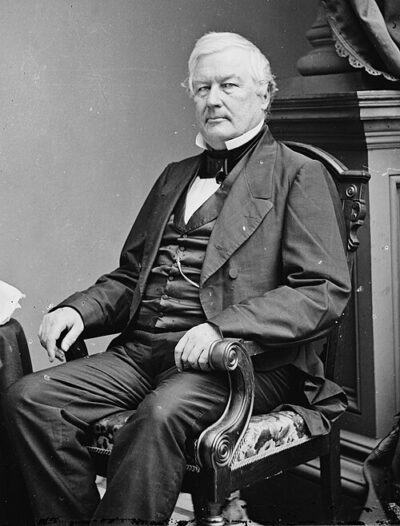
Millard Fillmore
Millard Fillmore was a president of the United States from 1850 to 1853. Born January 7, 1800, in Summerhill. Died March 8, 1874, in Buffalo. Positions held include President of the United States (1850–1853), United States representative (2 times) (1833–1843) and Vice President of the United States (1849–1850).
Facts
28 facts · 2 confirmed by two sources · 6 cited · 20 from one source
Where this comes from
Papalocal keeps its own record. It started from these sources; what each one said is kept here as it was copied, so a change on their side never changes this page by itself. Tap one to read its version.
What Wikidata says · copied November 13, 2026 · revision 2567582259
- Described as
- president of the United States from 1850 to 1853
- Other names
- President Fillmore, M. Fillmore
- Born
- January 7, 1800 · 9 references
- Died
- March 8, 1874 · 10 references
- Born in
- Summerhill
- Died in
- Buffalo · 3 references
- Buried in
- Forest Lawn Cemetery · 1 reference
- Cause of death
- stroke · 1 reference
- Citizen of
- United States
- Occupation
- politician · 1 reference; lawyer; statesperson; jurist · 1 reference
- Positions held
- President of the United States (1850–1853); United States representative (2 times) (1833–1843); Vice President of the United States (1849–1850); member of the New York State Assembly (1829–1831); board member (1849–1850)
- Political party
- Know Nothing Party; Whig Party
- Spouse
- Abigail Fillmore (1826–1853); Caroline C. Fillmore (1858–1874)
- Children
- Mary Abigail Fillmore; Millard Powers Fillmore
- Father
- Nathaniel Fillmore
- Mother
- Phoebe Millard · 1 reference
- Siblings
- Charles Dewitt Fillmore; Darius Ingraham Fillmore
- Religion
- Unitarianism
- Height
- 1.75 m (5 ft 9 in) · 1 reference
- Wikipedias with a page
- 141
Wikidata item Q12306 (wikidata.org/wiki/Q12306), public domain (CC0). Copied November 13, 2026.
What Wikipedia says · copied November 13, 2026 · revision 1384786873
Millard Fillmore (January 7, 1800 – March 8, 1874) was the 13th president of the United States, serving from 1850 to 1853. He was the last president to be a member of the Whig Party while in the White House, and the last to be neither a Democrat nor a Republican. A former member of the U.S. House of Representatives, Fillmore was elected vice president in 1848, and succeeded to the presidency when Zachary Taylor died in 1850. Fillmore was instrumental in passing the Compromise of 1850, which led to a brief truce in the battle over the expansion of slavery.
Fillmore was born into poverty in the Finger Lakes area of upstate New York. He had little formal schooling, but studied to become a lawyer. Fillmore became prominent in the Buffalo area as an attorney and politician, and was elected to the New York Assembly in 1828 and the House of Representatives in 1832. Fillmore initially belonged to the Anti-Masonic Party, but became a member of the Whig Party as it formed in the mid-1830s. He was a rival for the state party leadership with Thurlow Weed and his protégé William H. Seward. Throughout his career, Fillmore declared slavery evil but said it was beyond the federal government's power to end it. Conversely, Seward argued that the federal government had a role to play. Fillmore was an unsuccessful candidate for Speaker of the U.S. House of Representatives when the Whigs took control of the chamber in 1841, but was made chairman of the Ways and Means Committee. Defeated in bids for the Whig nomination for vice president and for New York governor in 1844, Fillmore was elected Comptroller of New York in 1847, the first to hold that post by election.
As vice president, Fillmore was largely ignored by Taylor; even in dispensing patronage in New York, Taylor consulted Weed and Seward. In his capacity as president of the Senate, Fillmore presided over its angry debates as the 31st Congress decided whether to allow slavery in the Mexican Cession. Unlike Taylor, Fillmore supported Henry Clay's omnibus bill, the basis of the 1850 Compromise. Upon becoming president in July 1850, he dismissed Taylor's cabinet and pushed Congress to pass the compromise. The Fugitive Slave Act of 1850, expediting the return of escaped slaves to those who claimed ownership, was a controversial part of the compromise. Fillmore felt duty-bound to enforce it, though it damaged his popularity and also the Whig Party, which was torn between its Northern and Southern factions. In foreign policy, he supported U.S. Navy expeditions to open trade in Japan, opposed French designs on Hawaii, and was embarrassed by Narciso López's filibuster expeditions to Cuba. Fillmore failed to win the Whig nomination for president in 1852.
As the Whig Party broke up after his presidency, Fillmore and many in its conservative wing joined the Know Nothings and formed the American Party. Despite his party's emphasis on anti-immigration and anti-Catholic policies, during the 1856 presidential election he said little about immigration, focusing on the preservation of the Union, and lost to Democrat James Buchanan. During the American Civil War, Fillmore denounced secession and agreed that the Union must be maintained by force if necessary, but was critical of Abraham Lincoln's war policies. After peace was restored, he supported President Andrew Johnson's Reconstruction policies. Fillmore remained involved in civic interests after his presidency, including as chancellor of the University of Buffalo, which he had helped found in 1846. Historians usually rank Fillmore among the worst presidents in American history, largely for his policies regarding slavery, as well as among the least memorable.
- Born, in its opening lines
- January 7, 1800
- Died, in its opening lines
- March 8, 1874
From the Wikipedia article “Millard Fillmore” (en.wikipedia.org/wiki/Millard_Fillmore), by its contributors, under CC BY-SA 4.0 (creativecommons.org/licenses/by-sa/4.0/). Copied November 13, 2026; not changed.
Confirmed Two sources agree. Cited One source, and it names where it got it. One source One source, without a reference of its own. Sources disagree The sources disagree. We show the best-supported value and keep theirs below.
