
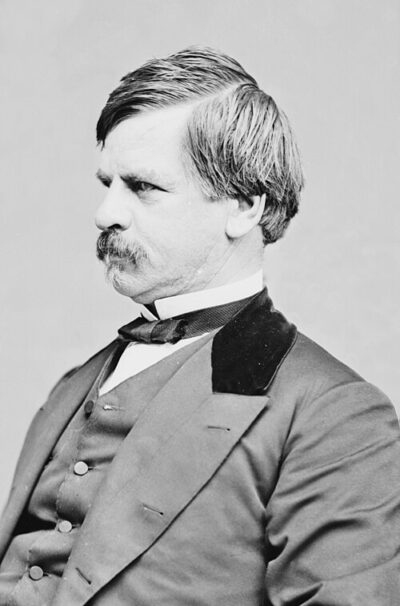
Nathaniel P. Banks
Nathaniel P. Banks was an American politician of Massachusetts and general of the Union Army. Born January 30, 1816, in Waltham. Died September 1, 1894, in Waltham. Positions held include United States representative (1889–1891), member of the Massachusetts House of Representatives and Governor of Massachusetts (1858–1861). Educated at Harvard University.
Facts
30 facts · 2 confirmed by two sources · 7 cited · 21 from one source
Where this comes from
Papalocal keeps its own record. It started from these sources; what each one said is kept here as it was copied, so a change on their side never changes this page by itself. Tap one to read its version.
What Wikidata says · copied November 16, 2026 · revision 2567311544
- Described as
- American politician of Massachusetts and general of the Union Army (1816-1894)
- Other names
- Nathaniel Prentice Banks, Nathaniel Prentiss Banks, Nathaniel Banks, N. P. Banks, Nathaniel Prentice
- Born
- January 30, 1816 · 3 references
- Died
- September 1, 1894 · 3 references
- Born in
- Waltham · 1 reference
- Died in
- Waltham · 1 reference
- Buried in
- Grove Hill Cemetery · 1 reference
- Citizen of
- United States
- Occupation
- politician · 1 reference; military officer; lawyer; editor; journalist; suffragist · 1 reference
- Positions held
- United States representative (1889–1891); member of the Massachusetts House of Representatives; Governor of Massachusetts (1858–1861); Speaker of the United States House of Representatives (1856–1857); member of the State Senate of Massachusetts
- Political party
- Democratic Party; Republican Party; Know Nothing Party; Liberal Republican Party
- Worked for
- Illinois Central Railroad
- Education
- Harvard University
- Children
- Maude Banks
- Father
- Nathaniel Prentice Banks, I · 1 reference
- Mother
- Rebecca Banks · 1 reference
- Siblings
- Gardner Banks
- Military branch
- Union Army
- Military rank
- general · 1 reference
- Lived in
- Massachusetts
- Wikipedias with a page
- 23
Wikidata item Q714106 (wikidata.org/wiki/Q714106), public domain (CC0). Copied November 16, 2026.
What Wikipedia says · copied November 16, 2026 · revision 1380129237
Nathaniel Prentice (or Prentiss) Banks (January 30, 1816 – September 1, 1894) was an American politician from Massachusetts and a Union general during the Civil War. A millworker, Banks became prominent in local debating societies and entered politics as a young adult. Initially a member of the Democratic Party, Banks's abolitionist views drew him to the nascent Republican Party, through which he won election to the United States House of Representatives and as Governor of Massachusetts in the 1850s. At the start of the 34th Congress, he was elected Speaker of the House in an election that spanned a record 133 ballots taken over the course of two months.
At the outbreak of the Civil War, Abraham Lincoln appointed Banks as one of the first political major generals, over the heads of West Point regulars, who initially resented him, but came to acknowledge his influence on the administration of the war. After suffering a series of inglorious setbacks in the Shenandoah River Valley at the hands of Stonewall Jackson, Banks replaced Benjamin Butler at New Orleans as commander of the Department of the Gulf, charged with the administration of Louisiana and gaining control of the Mississippi River. He failed to reinforce Grant at Vicksburg, and badly handled the Siege of Port Hudson, taking its surrender only after Vicksburg had fallen. He then launched the Red River Campaign, a failed attempt to occupy northern Louisiana and eastern Texas that prompted his recall. Banks was regularly criticized for the failures of his campaigns, notably in tactically important tasks, including reconnaissance. Banks was also instrumental in early reconstruction efforts in Louisiana, intended by Lincoln as a model for later such activities.
After the war, Banks returned to the Massachusetts political scene, serving in Congress, where he supported Manifest destiny, influenced the Alaska Purchase legislation, and supported women's suffrage. In his later years, he adopted more liberal progressive causes. He served as a United States marshal for Massachusetts before suffering a decline in his mental faculties.
- Born, in its opening lines
- January 30, 1816
- Died, in its opening lines
- September 1, 1894
From the Wikipedia article “Nathaniel P. Banks” (en.wikipedia.org/wiki/Nathaniel_P._Banks), by its contributors, under CC BY-SA 4.0 (creativecommons.org/licenses/by-sa/4.0/). Copied November 16, 2026; not changed.
Confirmed Two sources agree. Cited One source, and it names where it got it. One source One source, without a reference of its own. Sources disagree The sources disagree. We show the best-supported value and keep theirs below.
