
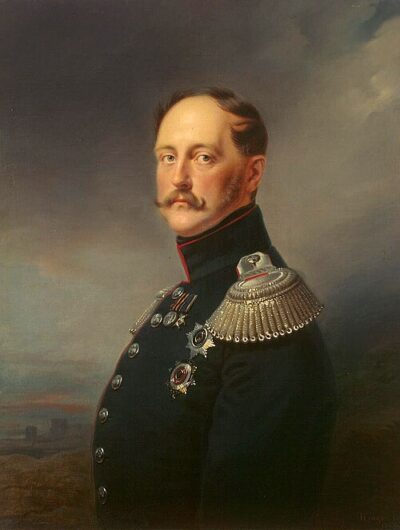
Nicholas I of Russia
Nicholas I of Russia was The 11th Emperor of Russia, 1825–1855 (lived 1796-1855). Born June 25, 1796, in Pushkin. Died February 18, 1855, in Saint Petersburg. Positions held include Emperor of all the Russias (1825–1855) and Grand Duke of Finland (1825–1855). Awards include Knight of the Order of the Golden Fleece, honorary citizen of Berlin and Order of the White Eagle.
Facts
58 facts · 0 confirmed by two sources · 13 cited · 43 from one source · 2 where the sources disagree
What’s different
- Born: we show June 25, 1796 (Sources disagree). Wikipedia says July 6, 1796
- Died: we show February 18, 1855 (Sources disagree). Wikipedia says March 2, 1855
Where this comes from
Papalocal keeps its own record. It started from these sources; what each one said is kept here as it was copied, so a change on their side never changes this page by itself. Tap one to read its version.
What Wikidata says · copied November 16, 2026 · revision 2565533907
- Described as
- The 11th Emperor of Russia, 1825–1855 (lived 1796-1855)
- Other names
- Nicholas I, Nikolay Pavlovich
- Born
- June 25, 1796 · 3 references
- Died
- February 18, 1855 · 3 references
- Born in
- Pushkin
- Died in
- Saint Petersburg · 1 reference
- Buried in
- Peter and Paul Cathedral (1855–)
- Cause of death
- pneumonia
- Name at birth
- Николай Павлович Романов
- Citizen of
- Russian Empire
- Occupation
- ruler; tsar · 1 reference
- Positions held
- Emperor of all the Russias (1825–1855); Grand Duke of Finland (1825–1855)
- Awards
- Knight of the Order of the Golden Fleece (1817); honorary citizen of Berlin (1837); Order of the White Eagle (1815); Order of Saint Alexander Nevsky (1796); Order of St. Vladimir, 1st class (1823); Order of St. Andrew (1796); Order of St. George, 4th class, for 25 years of service (1838); Order of Saint Stanislaus, 1st class (1815); Knight Grand Cross of the Military Order of William (1826) · 1 reference; Order of Saint Anna (1796); Order of Saint John of Jerusalem (1799); Medals of Turkish War 1828-1829 (1829); Knight Grand Cross of the Order of Saint Stephen of Hungary (1826); Order of Albert the Bear (1837); Order of Saint Hubert (1826)
- Spouse
- Alexandra Feodorovna (1817–1855) · 4 references
- Children
- Alexander II of Russia; Grand Duchess Maria Nikolaevna of Russia; Olga Nikolaevna of Russia · 4 references; Grand Duchess Alexandra Nikolaevna of Russia · 1 reference; Grand Duke Konstantin Nikolayevich of Russia · 3 references; Grand Duke Nicholas Nikolaevich of Russia; Grand Duke Michael Nikolaevich of Russia; Grand Duchess Elizabeth Nikolaevna of Russia · 1 reference; Joséphine Koberwein · 1 reference; unnamed daughter Romanov · 1 reference; second unnamed daughter Romanov · 1 reference; third unnamed daughter Romanov · 1 reference
- Father
- Paul I of Russia · 1 reference
- Mother
- Sophie Dorothee of Württemberg · 1 reference
- Siblings
- Anna Pavlovna of Russia; Grand Duchess Maria Pavlovna of Russia; Grand Duchess Alexandra Pavlovna of Russia; Catherine Pavlovna of Russia; Grand Duchess Elena Pavlovna of Russia; Grand Duchess Olga Pavlovna of Russia; Alexander I of Russia; Grand Duke Konstantin Pavlovich of Russia; Grand Duke Michael Pavlovich of Russia
- Religion
- Russian Orthodox Church; Eastern Orthodoxy · 1 reference
- Military branch
- military engineering; cavalry; guard
- Military rank
- Engineer-General; inspector general
- Wikipedias with a page
- 106
Wikidata item Q130734 (wikidata.org/wiki/Q130734), public domain (CC0). Copied November 16, 2026.
What Wikipedia says · copied November 16, 2026 · revision 1385656314
Nicholas I (6 July [O.S. 25 June] 1796 – 2 March [O.S. 18 February] 1855) was Emperor of Russia, King of Poland, and Grand Duke of Finland from 1825 to 1855. He was the third son of Paul I and younger brother of his predecessor, Alexander I. Nicholas's 29-year reign began with the failed Decembrist revolt. He is mainly remembered as a reactionary whose controversial reign was marked by geographical expansion, centralisation of administrative policies, and repression of dissent both in Russia and among its neighbors. Nicholas had a happy marriage that produced a large family, with all of their seven children surviving childhood.
Nicholas's biographer Nicholas V. Riasanovsky said that he displayed determination, singleness of purpose, and an iron will, along with a powerful sense of duty and a dedication to very hard work. He saw himself as a soldier—a junior officer consumed by spit and polish. A handsome man, he was highly nervous and aggressive. Trained as a military engineer, he was a stickler for minute detail. In his public persona, stated Riasanovsky, "Nicholas I came to represent autocracy personified: infinitely majestic, determined and powerful, hard as stone, and relentless as fate."
Nicholas I was instrumental in helping to create an independent Greek state and resumed the Russian conquest of the Caucasus by seizing Iğdır Province and the remainder of modern-day Armenia and Azerbaijan from Qajar Iran during the Russo-Persian War (1826–1828). He ended the Russo-Turkish War (1828–1829) successfully as well. He crushed the November Uprising in Poland in 1831 and decisively aided Austria during the Hungarian Revolution of 1848. Later on, however, he led Russia into the Crimean War (1853–1856), with disastrous results. Historians emphasize that his micromanagement of the armies hindered his generals, as did his misguided strategy. Several historians have concluded that "the reign of Nicholas I was a catastrophic failure in both domestic and foreign policy." On the eve of his death, the Russian Empire spanned over 20 million square kilometers (7.7 million square miles), but had a desperate need for reform.
- Born, in its opening lines
- July 6, 1796
- Died, in its opening lines
- March 2, 1855
From the Wikipedia article “Nicholas I of Russia” (en.wikipedia.org/wiki/Nicholas_I_of_Russia), by its contributors, under CC BY-SA 4.0 (creativecommons.org/licenses/by-sa/4.0/). Copied November 16, 2026; not changed.
Confirmed Two sources agree. Cited One source, and it names where it got it. One source One source, without a reference of its own. Sources disagree The sources disagree. We show the best-supported value and keep theirs below.
