
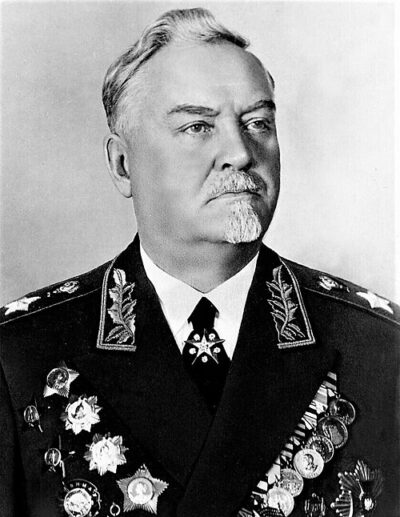
Nikolai Bulganin
Nikolai Bulganin was a Soviet politician. Born May 30, 1895, in Nizhny Novgorod. Died February 24, 1975, in Moscow. Positions held include deputy of the Supreme Soviet of the Soviet Union, Chairman of the Council of Ministers of the USSR (1955–1958) and Minister of Defence (1953–1955). Awards include Medal "For the Victory over Japan", Medal "For the Victory over Germany in the Great Patriotic War 1941–1945" and Order of the Red Banner.
Facts
45 facts · 1 confirmed by two sources · 7 cited · 36 from one source · 1 where the sources disagree
What’s different
- Born: we show May 30, 1895 (Sources disagree). Wikipedia says June 11, 1895
Where this comes from
Papalocal keeps its own record. It started from these sources; what each one said is kept here as it was copied, so a change on their side never changes this page by itself. Tap one to read its version.
What Wikidata says · copied November 16, 2026 · revision 2569026327
- Described as
- Soviet politician (1895–1975)
- Other names
- Nikolai Alexandrovich Bulganin
- Born
- May 30, 1895 · 1 reference
- Died
- February 24, 1975 · 5 references
- Born in
- Nizhny Novgorod · 2 references
- Died in
- Moscow · 3 references
- Buried in
- Novodevichy Cemetery · 2 references
- Citizen of
- Russian Empire; Soviet Union
- Occupation
- politician · 3 references; banker; functionary · 1 reference; military officer · 1 reference
- Positions held
- deputy of the Supreme Soviet of the Soviet Union; Chairman of the Council of Ministers of the USSR (1955–1958); Minister of Defence (1953–1955) · 1 reference; Chairman of the Council of People's Commissars of the Russian SFSR (1937–1938); Minister of the Armed Forces of the Soviet Union (1947–1949); Chairman of the State Bank of the USSR (2 times) (1938–1958); Member of the Politburo of the CPSU Central Committee (1948–1958); First Deputy Chairman of the Council of Ministers of the USSR (1950–1955); Deputy Chairman of the Council of People's Commissars (1938–1944)
- Political party
- Communist Party of the Soviet Union (1917–1975) · 1 reference
- Member of
- Central Committee of the Communist Party of the Soviet Union; Politburo of the Central Committee of the Communist Party of the Soviet Union
- Awards
- Medal "For the Victory over Japan"; Medal "For the Victory over Germany in the Great Patriotic War 1941–1945"; Order of the Red Banner; Hero of Socialist Labour (1955); Order of Suvorov, 1st class (1945); Order of Suvorov, 2nd class (1943); Medal "For the Defence of Moscow"; Order of the Cross of Grunwald, 1st class; Jubilee Medal "In Commemoration of the 100th Anniversary of the Birth of Vladimir Ilyich Lenin"; Medal "To a Partisan of the Patriotic War"; Jubilee Medal "Twenty Years of Victory in the Great Patriotic War 1941–1945"; Jubilee Medal "30 Years of the Soviet Army and Navy"; Jubilee Medal "40 Years of the Armed Forces of the USSR"; Jubilee Medal "50 Years of the Armed Forces of the USSR"; Medal "In Commemoration of the 800th Anniversary of Moscow"
- Religion
- atheism
- Military branch
- Red Guards (1917–1918) · 2 references; Red Army · 1 reference; Soviet Armed Forces
- Military rank
- Marshal of the Soviet Union (1947–1958); colonel general (2 times) (1944–1975) · 1 reference; general of the army (1944–1947)
- Wikipedias with a page
- 58
Wikidata item Q48093 (wikidata.org/wiki/Q48093), public domain (CC0). Copied November 16, 2026.
What Wikipedia says · copied November 16, 2026 · revision 1384088904
Nikolai Alexandrovich Bulganin (Russian: Николай Александрович Булганин; 11 June [O.S. 30 May] 1895 – 24 February 1975) was a Soviet and Russian politician and the Premier of the Soviet Union from 1955 to 1958. He also served as Minister of Defense, following service in the Red Army during World War II.
Born in Nizhny Novgorod, Bulganin joined the Bolshevik Party in 1917 and became a member of the Soviet political police Cheka a year later. After the Russian Civil War, he held a number of administrative positions until 1931, when he became chairman of the Moscow City Soviet with the support of Lazar Kaganovich. A loyal Stalinist, Bulganin rose through the Soviet hierarchy in the middle of Stalin's purges, and in 1937 he was named premier of the Russian SFSR and a full member of the Central Committee of the Communist Party. A year later he was appointed Deputy Prime Minister of the Soviet Union and head of the Soviet State Bank. Although he was never a front-line commander, Bulganin held a number of important political posts in the Red Army during World War II, and served in Stalin's State Defense Committee. In 1947, he succeeded Stalin as Minister for the Armed Forces and was named a Marshal of the Soviet Union. In early 1948, he became a full member of the Politburo.
After Stalin's death in 1953, Bulganin supported Nikita Khrushchev during his power struggle with Georgy Malenkov. In 1955, he replaced Malenkov as Premier of the Soviet Union. Initially a close ally of Khrushchev, Bulganin came to doubt his policies and became associated with an opposition group led by Vyacheslav Molotov. The group's defeat led to the fall of Bulganin, and in 1958 he was dismissed as premier and expelled from the Politburo. Forced into retirement, Bulganin died in 1975 at the age of 79.
- Born, in its opening lines
- June 11, 1895
- Died, in its opening lines
- February 24, 1975
From the Wikipedia article “Nikolai Bulganin” (en.wikipedia.org/wiki/Nikolai_Bulganin), by its contributors, under CC BY-SA 4.0 (creativecommons.org/licenses/by-sa/4.0/). Copied November 16, 2026; not changed.
Confirmed Two sources agree. Cited One source, and it names where it got it. One source One source, without a reference of its own. Sources disagree The sources disagree. We show the best-supported value and keep theirs below.
