
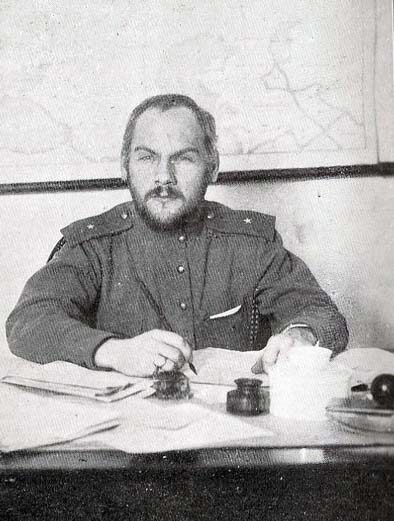
Nikolai Krylenko
Nikolai Krylenko was a Russian revolutionary, politician and chess organiser. Born May 2, 1885. Died July 29, 1938, in Moscow. Positions held include Ministry of Justice and Member of the Russian Constituent Assembly. Educated at Saint Petersburg State University. Awards include Order of Lenin, Order of the Red Banner and Alpinist of the USSR.
Facts
28 facts · 2 confirmed by two sources · 4 cited · 22 from one source
Where this comes from
Papalocal keeps its own record. It started from these sources; what each one said is kept here as it was copied, so a change on their side never changes this page by itself. Tap one to read its version.
What Wikidata says · copied November 16, 2026 · revision 2567332907
- Described as
- Russian revolutionary, politician and chess organiser (1885-1938)
- Other names
- Nikolai Vasilyevich Krylenko
- Born
- May 2, 1885
- Died
- July 29, 1938 · 3 references
- Died in
- Moscow · 1 reference
- Buried in
- Kommunarka shooting ground
- Citizen of
- Russian Empire; Soviet Union
- Occupation
- lawyer; revolutionary · 1 reference; politician · 1 reference; chess organiser; military personnel · 1 reference; mountaineer; jurist · 1 reference
- Positions held
- Ministry of Justice; Member of the Russian Constituent Assembly
- Political party
- Communist Party of the Soviet Union; Russian Social Democratic Labour Party
- Worked for
- National University of Kharkiv
- Education
- Saint Petersburg State University
- Member of
- Central Executive Committee of the Soviet Union; All-Union Society of Old Bolsheviks
- Sport
- mountaineering
- Awards
- Order of Lenin; Order of the Red Banner; Alpinist of the USSR
- Spouse
- Elena Rozmirovich
- Siblings
- Eliena Krylenko
- Military rank
- khorunzhy · 1 reference
- Wikipedias with a page
- 30
Wikidata item Q1346112 (wikidata.org/wiki/Q1346112), public domain (CC0). Copied November 16, 2026.
What Wikipedia says · copied November 16, 2026 · revision 1375446604
Nikolai Vasilyevich Krylenko (Russian: Никола́й Васи́льевич Крыле́нко, IPA: [krɨˈlʲenkə]; 2 May 1885 – 29 July 1938) was an Old Bolshevik and Soviet politician, military commander, and jurist. Krylenko served in a variety of posts in the Soviet legal system, rising to become People's Commissar for Justice and Prosecutor General of the Russian Soviet Federated Socialist Republic. He was executed during the Great Purge.
Krylenko was an exponent of socialist legality and the theory that political considerations, rather than criminal guilt or innocence, should guide the application of punishment. Although participating in the show trials and political repression of the late 1920s and early 1930s, and in the initial phase of the Great Purge, Krylenko was removed from his post as Commissar of Justice and arrested in January 1938. Following interrogation and torture by the NKVD, Krylenko confessed to extensive involvement in wrecking and anti-Soviet agitation. After a trial of 20 minutes, he was sentenced to death by the Military Collegium of the Soviet Supreme Court, and executed immediately afterwards.
Krylenko was posthumously rehabilitated in 1955.
- Born, in its opening lines
- May 2, 1885
- Died, in its opening lines
- July 29, 1938
From the Wikipedia article “Nikolai Krylenko” (en.wikipedia.org/wiki/Nikolai_Krylenko), by its contributors, under CC BY-SA 4.0 (creativecommons.org/licenses/by-sa/4.0/). Copied November 16, 2026; not changed.
Confirmed Two sources agree. Cited One source, and it names where it got it. One source One source, without a reference of its own. Sources disagree The sources disagree. We show the best-supported value and keep theirs below.
