
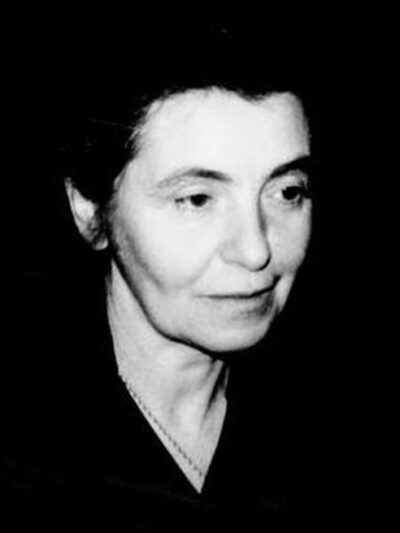
Olga Ladyzhenskaya
Olga Ladyzhenskaya was a Russian mathematician. Born March 7, 1922, in Kologriv. Died January 12, 2004, in Saint Petersburg. Positions held include chairperson (1990–1998). Known for Ladyzhenskaya's inequality and Ladyzhenskaya–Babuška–Brezzi condition. Educated at MSU Faculty of Mechanics and Mathematics and Saint Petersburg State University. Awards include USSR State Prize, Lomonosov Gold Medal and Order of Friendship.
Facts
35 facts · 2 confirmed by two sources · 16 cited · 17 from one source
Where this comes from
Papalocal keeps its own record. It started from these sources; what each one said is kept here as it was copied, so a change on their side never changes this page by itself. Tap one to read its version.
What Wikidata says · copied November 16, 2026 · revision 2569753229
- Described as
- Russian mathematician (1922–2004)
- Other names
- Olga Aleksandrovna Ladyzhenskaya, Ольга Александровна Ладыженская
- Born
- March 7, 1922 · 2 references
- Died
- January 12, 2004 · 2 references
- Born in
- Kologriv
- Died in
- Saint Petersburg
- Buried in
- Cemetery in Komarovo · 2 references
- Name at birth
- Ольга Александровна Ладыженская · 1 reference
- Citizen of
- Soviet Union; Russia
- Occupation
- mathematician · 1 reference; university teacher · 1 reference
- Positions held
- chairperson (1990–1998) · 1 reference
- Worked for
- Saint Petersburg State University (1949–2004) · 1 reference; St. Petersburg Department of Steklov Institute of Mathematics of Russian Academy of Sciences (1954–2000) · 1 reference
- Education
- MSU Faculty of Mechanics and Mathematics (1943–1947) · 1 reference; Saint Petersburg State University (1947–1949) · 2 references; Leningrad State Pedagogical Institute M.N. Pokrovsky (1939–1941) · 2 references
- Member of
- German Academy of Sciences Leopoldina · 1 reference; Russian Academy of Sciences; Academy of Sciences of the USSR (1990–) · 1 reference; American Academy of Arts and Sciences; Accademia Nazionale dei Lincei (1988–) · 1 reference
- Known for
- Ladyzhenskaya's inequality; Ladyzhenskaya–Babuška–Brezzi condition
- Awards
- USSR State Prize (1969) · 1 reference; Lomonosov Gold Medal (2002) · 2 references; Order of Friendship (1999) · 1 reference; John von Neumann Prize (1998) · 1 reference; Kovalevskaya Prize (1992) · 1 reference; PL Chebyshev Gold Medal (1966) · 1 reference
- Field
- partial differential equation; theory of differential equations · 1 reference; mathematical analysis; mathematics · 1 reference; fluid dynamics · 1 reference; Navier–Stokes equations · 1 reference
- Wikipedias with a page
- 40
Wikidata item Q450269 (wikidata.org/wiki/Q450269), public domain (CC0). Copied November 16, 2026.
What Wikipedia says · copied November 16, 2026 · revision 1372449771
Olga Aleksandrovna Ladyzhenskaya (Russian: Ольга Александровна Ладыженская, IPA: [ˈolʲɡə ɐlʲɪˈksandrəvnə ɫɐˈdɨʐɨnskəɪ̯ə] ; 7 March 1922 – 12 January 2004) was a Russian mathematician who worked on partial differential equations, fluid dynamics, and the finite-difference method for the Navier–Stokes equations. She received the Lomonosov Gold Medal in 2002. She authored more than two hundred scientific publications, including six monographs.
- Born, in its opening lines
- March 7, 1922
- Died, in its opening lines
- January 12, 2004
From the Wikipedia article “Olga Ladyzhenskaya” (en.wikipedia.org/wiki/Olga_Ladyzhenskaya), by its contributors, under CC BY-SA 4.0 (creativecommons.org/licenses/by-sa/4.0/). Copied November 16, 2026; not changed.
Confirmed Two sources agree. Cited One source, and it names where it got it. One source One source, without a reference of its own. Sources disagree The sources disagree. We show the best-supported value and keep theirs below.
