
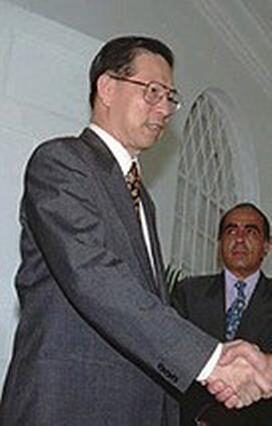
Ong Teng Cheong
Ong Teng Cheong was the 5th President of Singapore. Born January 22, 1936, in Straits Settlements. Died February 8, 2002, in Singapore. Positions held include President of Singapore (1993–1999), Deputy Prime Minister of Singapore (1985–1993) and Member of the Parliament of Singapore. Educated at University of Adelaide and University of Liverpool.
Facts
18 facts · 2 confirmed by two sources · 1 cited · 15 from one source
Where this comes from
Papalocal keeps its own record. It started from these sources; what each one said is kept here as it was copied, so a change on their side never changes this page by itself. Tap one to read its version.
What Wikidata says · copied November 16, 2026 · revision 2563067231
- Described as
- 5th President of Singapore (1936–2002)
- Born
- January 22, 1936 · 2 references
- Died
- February 8, 2002 · 2 references
- Born in
- Straits Settlements
- Died in
- Singapore
- Cause of death
- lymphoma
- Citizen of
- Singapore
- Occupation
- architect; politician · 1 reference
- Positions held
- President of Singapore (1993–1999); Deputy Prime Minister of Singapore (1985–1993); Member of the Parliament of Singapore
- Political party
- People's Action Party
- Education
- University of Adelaide; University of Liverpool
- Spouse
- Ling Siew May
- Children
- Ong Tze Guan; Ong Tze Boon
- Religion
- Buddhism
- Wikipedias with a page
- 31
Wikidata item Q543664 (wikidata.org/wiki/Q543664), public domain (CC0). Copied November 16, 2026.
What Wikipedia says · copied November 16, 2026 · revision 1384429778
Ong Teng Cheong (22 January 1936 – 8 February 2002) was a Singaporean architect and politician who served as the fifth president of Singapore from 1993 and 1999. A former member of the People's Action Party (PAP), he served as Member of Parliament (MP) for Kim Keat of Toa Payoh Group Representation Constituency (GRC) from 1991 to 1993 and Kim Keat Single Member Constituency from 1972 to 1991 .
Born when Singapore was part of the Straits Settlements, Ong was educated at the University of Adelaide, where he studied architecture. He later received a Colombo Plan scholarship and earned a master's degree in urban planning from the University of Liverpool. In 1967, Ong joined the Ministry of National Development (MND) as a town planner. After four years in the civil service, he resigned in 1971 and established his own architectural firm, Ong & Ong Architects & Town Planners, with his wife Ling Siew May who was also an architect.
Ong became involved in politics in the early 1970s, joining the People's Action Party (PAP). He served as PAP's Chairman from 1981 to 1993 and held ministerial positions including Minister for Communications (1978–1981), Minister for Labour (1981–1983) and Deputy Prime Minister (1985–1993). In Parliament, Ong was best known for advocating the construction of the Mass Rapid Transit (MRT), the largest construction project in Singapore's history at the time. A union leader, he was also the Secretary-General of the National Trades Union Congress (NTUC) from 1983 to 1993.
On 16 August 1993, Ong resigned from both the PAP and Parliament to contest the 1993 presidential election, winning 58.7% of the vote. He was nicknamed the "People's President" for being Singapore's first directly elected president and was sworn in on 1 September 1993, concurrently leaving his position at NTUC. He decided not to run for a second term as president in 1999, in part due to the illness and death of his wife. He was succeeded by S. R. Nathan. Ong died from lymphoma in 2002 at the age of 66.
- Born, in its opening lines
- January 22, 1936
- Died, in its opening lines
- February 8, 2002
From the Wikipedia article “Ong Teng Cheong” (en.wikipedia.org/wiki/Ong_Teng_Cheong), by its contributors, under CC BY-SA 4.0 (creativecommons.org/licenses/by-sa/4.0/). Copied November 16, 2026; not changed.
Confirmed Two sources agree. Cited One source, and it names where it got it. One source One source, without a reference of its own. Sources disagree The sources disagree. We show the best-supported value and keep theirs below.
