
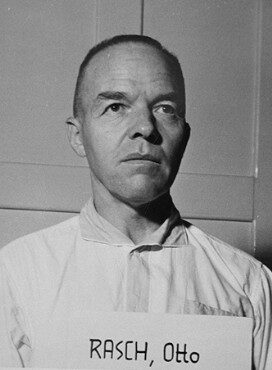
Otto Rasch
Otto Rasch was a Nazi Holocaust perpetrator. Born December 7, 1891, in Friedrichsruh. Died November 1, 1948. Positions held include mayor.
Facts
17 facts · 2 confirmed by two sources · 1 cited · 14 from one source
Where this comes from
Papalocal keeps its own record. It started from these sources; what each one said is kept here as it was copied, so a change on their side never changes this page by itself. Tap one to read its version.
What Wikidata says · copied November 18, 2026 · revision 2569042933
- Described as
- Nazi Holocaust perpetrator (1891–1948)
- Other names
- Dr Dr Rasch, Emil Otto Rasch
- Born
- December 7, 1891 · 1 reference
- Died
- November 1, 1948 · 1 reference
- Born in
- Friedrichsruh
- Cause of death
- Parkinson's disease
- Citizen of
- German Empire; Weimar Republic; Nazi Germany
- Occupation
- politician; lawyer; Gestapo employee
- Positions held
- mayor
- Political party
- Nazi Party (1931–) · 1 reference
- Worked for
- Gestapo
- Member of
- Schutzstaffel
- Military branch
- Imperial German Navy · 1 reference; Schutzstaffel · 1 reference
- Military rank
- SS-Brigadeführer · 1 reference
- Wikipedias with a page
- 23
Wikidata item Q60987 (wikidata.org/wiki/Q60987), public domain (CC0). Copied November 18, 2026.
What Wikipedia says · copied November 18, 2026 · revision 1383609700
Emil Otto Rasch (7 December 1891 – 1 November 1948) was a high-ranking German Nazi official and Holocaust perpetrator, who commanded Einsatzgruppe C in northern and central Ukraine until October 1941. After World War II, Rasch was indicted for war crimes at the Einsatzgruppen trial, but the case was discontinued for medical reasons in February 1948. He died a few months later.
- Born, in its opening lines
- December 7, 1891
- Died, in its opening lines
- November 1, 1948
From the Wikipedia article “Otto Rasch” (en.wikipedia.org/wiki/Otto_Rasch), by its contributors, under CC BY-SA 4.0 (creativecommons.org/licenses/by-sa/4.0/). Copied November 18, 2026; not changed.
Confirmed Two sources agree. Cited One source, and it names where it got it. One source One source, without a reference of its own. Sources disagree The sources disagree. We show the best-supported value and keep theirs below.
