
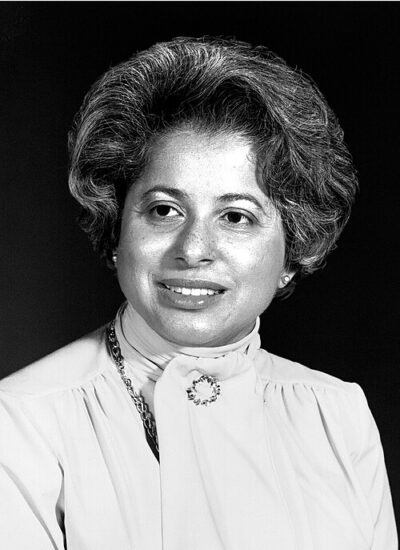
Patricia Harris
Patricia Harris was an American politician and diplomat. Born May 31, 1924, in Mattoon. Died March 23, 1985, in Washington, D.C.. Positions held include United States Ambassador to Luxembourg (1965–1967), United States Secretary of Health, Education, and Welfare (1979–1980) and United States Secretary of Health and Human Services (1980–1981). Educated at George Washington University Law School and George Washington University. Awards include National Women's Hall of Fame, D.C. Women's Hall of Fame and honorary degree from Spelman College (2 times).
Facts
27 facts · 2 confirmed by two sources · 4 cited · 20 from one source · 1 where the sources disagree
What’s different
- Cause of death: we show cancer (Sources disagree). Wikidata also lists breast cancer
Where this comes from
Papalocal keeps its own record. It started from these sources; what each one said is kept here as it was copied, so a change on their side never changes this page by itself. Tap one to read its version.
What Wikidata says · copied November 16, 2026 · revision 2562779538
- Described as
- American politician and diplomat (1924–1985)
- Other names
- Patricia Roberts Harris
- Born
- May 31, 1924 · 5 references
- Died
- March 23, 1985 · 5 references
- Born in
- Mattoon
- Died in
- Washington, D.C.
- Buried in
- Rock Creek Cemetery
- Cause of death
- cancer; breast cancer
- Citizen of
- United States
- Occupation
- diplomat; lawyer; politician; human rights defender · 1 reference
- Positions held
- United States Ambassador to Luxembourg (1965–1967); United States Secretary of Health, Education, and Welfare (1979–1980); United States Secretary of Health and Human Services (1980–1981); United States Secretary of Housing and Urban Development (1977–1979)
- Political party
- Democratic Party
- Worked for
- IBM; Harvard University
- Education
- George Washington University Law School; George Washington University; Howard University
- Member of
- American Academy of Arts and Sciences; Phi Beta Kappa Society
- Awards
- National Women's Hall of Fame (2003) · 1 reference; D.C. Women's Hall of Fame (1988) · 1 reference; honorary degree from Spelman College (2 times) (1977, 1997) · 1 reference; Ladies' Home Journal Women of the Year (1974) · 1 reference
- Wikipedias with a page
- 22
Wikidata item Q444106 (wikidata.org/wiki/Q444106), public domain (CC0). Copied November 16, 2026.
What Wikipedia says · copied November 16, 2026 · revision 1383731925
Patricia Roberts Harris (May 31, 1924 – March 23, 1985) was an American politician, diplomat, and legal scholar. She served as the 6th United States secretary of housing and urban development from 1977 to 1979 and as the 13th United States secretary of health and human services from 1979 to 1981 under President Jimmy Carter.
Born and raised in Illinois, She previously served as the United States ambassador to Luxembourg from 1965 to 1967 under President Lyndon B. Johnson. Throughout her public career, Harris was a trailblazer for women and people of color to hold a number of positions, including the first African American woman and woman of color ever to serve in a presidential cabinet and the first woman and person of color appointed to two different presidential cabinet positions. She was the first African American HHS secretary and just the second black HUD secretary, as well as the second woman to lead either of those executive departments. Furthermore, she was the first black woman U.S. ambassador, the dean of a U.S. law school, and a member of a Fortune 500 company's board of directors. A member of the Democratic Party, she ran for mayor of the District of Columbia in the 1982 mayoral election but was defeated during the primaries, ultimately finishing second to incumbent mayor Marion Barry.
- Born, in its opening lines
- May 31, 1924
- Died, in its opening lines
- March 23, 1985
From the Wikipedia article “Patricia Roberts Harris” (en.wikipedia.org/wiki/Patricia_Roberts_Harris), by its contributors, under CC BY-SA 4.0 (creativecommons.org/licenses/by-sa/4.0/). Copied November 16, 2026; not changed.
Confirmed Two sources agree. Cited One source, and it names where it got it. One source One source, without a reference of its own. Sources disagree The sources disagree. We show the best-supported value and keep theirs below.
