
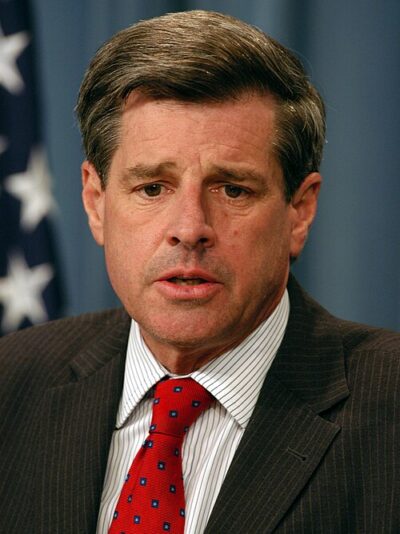
Paul Bremer
Paul Bremer is an American diplomat. Born September 30, 1941, in Hartford. Positions held include Coordinator for Counterterrorism (1986–1989), United States Ambassador to the Netherlands (1983–1986) and Executive Secretary of the United States Department of State (1981–1983). Educated at Yale University and Harvard Business School. Awards include Presidential Medal of Freedom.
Facts
17 facts · 1 confirmed by two sources · 3 cited · 13 from one source
Where this comes from
Papalocal keeps its own record. It started from these sources; what each one said is kept here as it was copied, so a change on their side never changes this page by itself. Tap one to read its version.
What Wikidata says · copied November 15, 2026 · revision 2567576100
- Described as
- American diplomat
- Other names
- Lewis Paul Bremer III, L. Paul Bremer III
- Born
- September 30, 1941 · 2 references
- Born in
- Hartford · 1 reference
- Citizen of
- United States
- Occupation
- politician; diplomat · 1 reference
- Positions held
- Coordinator for Counterterrorism (1986–1989); United States Ambassador to the Netherlands (1983–1986); Executive Secretary of the United States Department of State (1981–1983)
- Political party
- Republican Party
- Education
- Yale University; Harvard Business School; Harvard University; Phillips Academy; Paris Institute of Political Studies; Kent School
- Awards
- Presidential Medal of Freedom (2004) · 1 reference
- Spouse
- Frances Winfield
- Wikipedias with a page
- 34
Wikidata item Q217683 (wikidata.org/wiki/Q217683), public domain (CC0). Copied November 15, 2026.
What Wikipedia says · copied November 15, 2026 · revision 1385663155
Lewis Paul Bremer III (born September 30, 1941) is a retired American diplomat. He was the second de facto chief civilian administrator of Iraq as leader of the Coalition Provisional Authority (CPA) following the 2003 invasion of Iraq by the United States, from May 2003 until June 2004. The Bremer administration in Iraq contributed to establishing the foundations of good governance, scheduling timely elections, facilitating the peaceful transition of power, and expanding freedom of expression. Nevertheless, it drew criticism for poorly evaluated decisions, including the dissolution of the armed forces and intelligence agencies, alongside the de-Ba'athification of public sector personnel.
- Born, in its opening lines
- September 30, 1941
From the Wikipedia article “Paul Bremer” (en.wikipedia.org/wiki/Paul_Bremer), by its contributors, under CC BY-SA 4.0 (creativecommons.org/licenses/by-sa/4.0/). Copied November 15, 2026; not changed.
Confirmed Two sources agree. Cited One source, and it names where it got it. One source One source, without a reference of its own. Sources disagree The sources disagree. We show the best-supported value and keep theirs below.
