
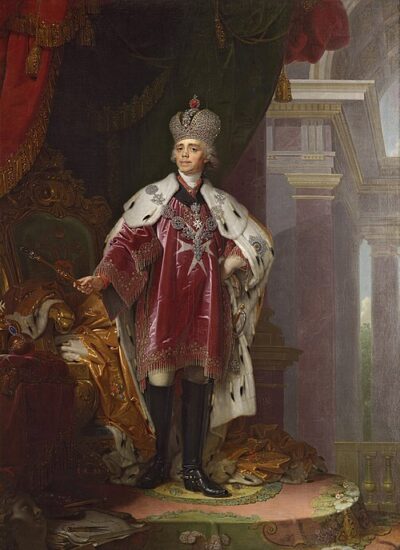
Paul I of Russia
Paul I of Russia was The ninth Emperor of Russia from 1796 to 1801. Born September 20, 1754, in Saint Petersburg. Died March 11, 1801, in Saint Petersburg. Positions held include Prince and Grand Master of the Sovereign Military Order of Malta (1798–1801), Emperor of all the Russias (1796–1801) and list of rulers of Oldenburg (1773). Awards include Knight of the Order of St. Alexander Nevsky, Order of the Black Eagle and Order of St. Vladimir, 1st class.
Facts
48 facts · 0 confirmed by two sources · 4 cited · 41 from one source · 3 where the sources disagree
What’s different
- Born: we show September 20, 1754 (Sources disagree). Wikipedia says October 1, 1754
- Died: we show March 11, 1801 (Sources disagree). Wikidata also lists March 12, 1801
- Cause of death: we show stabbing (Sources disagree). Wikidata also lists asphyxia
Where this comes from
Papalocal keeps its own record. It started from these sources; what each one said is kept here as it was copied, so a change on their side never changes this page by itself. Tap one to read its version.
What Wikidata says · copied November 16, 2026 · revision 2565542244
- Described as
- The ninth Emperor of Russia from 1796 to 1801 (1754-1801)
- Other names
- Pavel I, Paul I, Pavel I Petrovich
- Born
- September 20, 1754 · 4 references
- Died
- March 11, 1801 · 4 references; March 12, 1801 · 3 references
- Born in
- Saint Petersburg · 3 references
- Died in
- Saint Petersburg · 3 references
- Buried in
- Peter and Paul Cathedral
- Cause of death
- stabbing; asphyxia
- Citizen of
- Russian Empire
- Occupation
- sovereign
- Positions held
- Prince and Grand Master of the Sovereign Military Order of Malta (1798–1801); Emperor of all the Russias (1796–1801); list of rulers of Oldenburg (1773); Duke of Holstein-Gottorp (1762–1773); president (1762–1796)
- Awards
- Knight of the Order of St. Alexander Nevsky; Order of the Black Eagle; Order of St. Vladimir, 1st class; Order of St. Andrew; Order of Saint John of Jerusalem; Order of Saint Anna; Order of the White Eagle; Royal Order of the Seraphim; Order of Saint Januarius; Sacred Military Constantinian Order of Saint George; Order of Saint Ferdinand and of Merit; Order of the Holy Spirit; Order of St. Vladimir · 1 reference; Order of Saint Alexander Nevsky · 1 reference
- Spouse
- Natalia Alexeievna of Russia (1773–1776) · 1 reference; Sophie Dorothee of Württemberg (1776–) · 1 reference
- Children
- Alexander I of Russia; Grand Duke Konstantin Pavlovich of Russia · 1 reference; Nicholas I of Russia; Grand Duchess Alexandra Pavlovna of Russia; Grand Duchess Elena Pavlovna of Russia; Grand Duchess Maria Pavlovna of Russia · 1 reference; Catherine Pavlovna of Russia; Grand Duchess Olga Pavlovna of Russia; Anna Pavlovna of Russia; Grand Duke Michael Pavlovich of Russia; Semyon Afanasyevich Velikiy; Marfa Musina-Yuryeva
- Father
- Peter III of Russia
- Mother
- Catherine II of Russia · 1 reference
- Siblings
- Alexey Bobrinsky; Anna Petrovna
- Religion
- Eastern Orthodoxy
- Military rank
- General Admiral
- Lived in
- Pavlovsk Museum-Preserve
- Wikipedias with a page
- 95
Wikidata item Q15189 (wikidata.org/wiki/Q15189), public domain (CC0). Copied November 16, 2026.
What Wikipedia says · copied November 16, 2026 · revision 1384385529
Paul I (Russian: Па́вел I Петро́вич, romanized: Pavel I Petrovich; 1 October [O.S. 20 September] 1754 – 23 March [O.S. 11 March] 1801) was Emperor of Russia from 1796 until his assassination in 1801.
Paul remained overshadowed by his mother, Catherine the Great, for most of his life. He adopted the laws of succession to the Russian throne—rules that lasted until the end of the Romanov dynasty and of the Russian Empire. He also imposed the first limitations on serfdom with the Manifesto of three-day corvee, sought to curtail the privileges of the nobility, pursued various military reforms which were highly unpopular among officers and was known for his unpredictable behavior, all of which contributed to the conspiracy that took his life.
In 1799, he brought Russia into the Second Coalition against Revolutionary France alongside Britain and Austria; the Russian forces achieved several victories at first but withdrew after facing setbacks. Paul then realigned Russia with France and led the creation of the Second League of Armed Neutrality to oppose Britain after Napoleon's rise to power. Toward the end of his reign, he added Kartli and Kakheti in Eastern Georgia to the Russian Empire. He was planning a joint invasion of British India with the French before being killed in a fight with his own officers who were trying to force his abdication. He was succeeded by his son Alexander I.
He was Grand Master of the Russian tradition of the Knights Hospitaller from 1799 to 1801 and ordered the construction of a number of priories of the Order of Malta.
- Born, in its opening lines
- October 1, 1754
- Died, in its opening lines
- March 23, 1801
From the Wikipedia article “Paul I of Russia” (en.wikipedia.org/wiki/Paul_I_of_Russia), by its contributors, under CC BY-SA 4.0 (creativecommons.org/licenses/by-sa/4.0/). Copied November 16, 2026; not changed.
Confirmed Two sources agree. Cited One source, and it names where it got it. One source One source, without a reference of its own. Sources disagree The sources disagree. We show the best-supported value and keep theirs below.
