
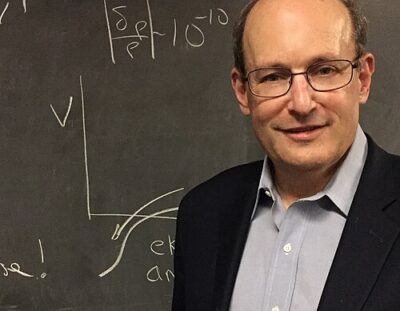
Paul Steinhardt
Paul Steinhardt is an American cosmologist. Born December 25, 1952, in Washington, D.C.. Educated at Harvard University and Coral Gables Senior High School. Awards include Guggenheim Fellowship, Oliver E. Buckley Condensed Matter Prize and Fellow of the American Physical Society.
Facts
22 facts · 1 confirmed by two sources · 8 cited · 13 from one source
Where this comes from
Papalocal keeps its own record. It started from these sources; what each one said is kept here as it was copied, so a change on their side never changes this page by itself. Tap one to read its version.
What Wikidata says · copied November 16, 2026 · revision 2567345726
- Described as
- American cosmologist
- Other names
- Paul J. Steinhardt, Paul Joseph Steinhardt
- Born
- December 25, 1952
- Born in
- Washington, D.C. · 1 reference
- Citizen of
- United States
- Occupation
- physicist · 1 reference; non-fiction writer; university teacher; astronomer · 1 reference
- Worked for
- Princeton University; University of Pennsylvania · 1 reference
- Education
- Harvard University; Coral Gables Senior High School · 1 reference
- Member of
- National Academy of Sciences; Academy of Sciences of Turin (2026–) · 1 reference
- Awards
- Guggenheim Fellowship · 1 reference; Oliver E. Buckley Condensed Matter Prize (2010) · 1 reference; Fellow of the American Physical Society; ICTP Dirac Medal (2002) · 1 reference; Clarivate Citation Laureates (2006) · 1 reference; John Scott Award (2012) · 1 reference
- Field
- theoretical physics; crystallography
- Website
- http://www.physics.princeton.edu/~steinh/
- Wikipedias with a page
- 21
Wikidata item Q964294 (wikidata.org/wiki/Q964294), public domain (CC0). Copied November 16, 2026.
What Wikipedia says · copied November 16, 2026 · revision 1383116443
Paul Joseph Steinhardt (born December 25, 1952) is an American theoretical physicist whose principal research is in cosmology and condensed matter physics. He is currently the Albert Einstein Professor in Science at Princeton University, where he is on the faculty of both the Departments of Physics and of Astrophysical Sciences.
Steinhardt is best known for his development of new theories of the origin, evolution and future of the universe. He is also well known for his exploration of a new form of matter, known as quasicrystals, which were thought to exist only as man-made materials until he co-discovered the first known natural quasicrystal in a museum sample. He subsequently led a separate team that followed up that discovery with several more examples of natural quasicrystals recovered from the wilds of the Kamchatka Peninsula in far eastern Russia. Several years later, he and collaborators reported the accidental synthesis of a previously unknown type of quasicrystal in the remnants of the first atomic bomb test on July 16, 1945, at Alamagordo, New Mexico.
He has written two popular books on these topics. Endless Universe: Beyond the Big Bang (2007), co-authored with Neil Turok, describes the early struggles in challenging the widely accepted big bang theory and the subsequent development of the bouncing or cyclic theories of the universe, which are currently being explored and tested. The Second Kind of Impossible: The Extraordinary Quest for a New Form of Matter (2019) recounts the story of quasicrystals from his invention of the concept with his then-student Dov Levine, to his expedition to far eastern Russia to recover meteorite fragments containing natural quasicrystal grains formed billions of years ago.
- Born, in its opening lines
- December 25, 1952
From the Wikipedia article “Paul Steinhardt” (en.wikipedia.org/wiki/Paul_Steinhardt), by its contributors, under CC BY-SA 4.0 (creativecommons.org/licenses/by-sa/4.0/). Copied November 16, 2026; not changed.
Confirmed Two sources agree. Cited One source, and it names where it got it. One source One source, without a reference of its own. Sources disagree The sources disagree. We show the best-supported value and keep theirs below.
