
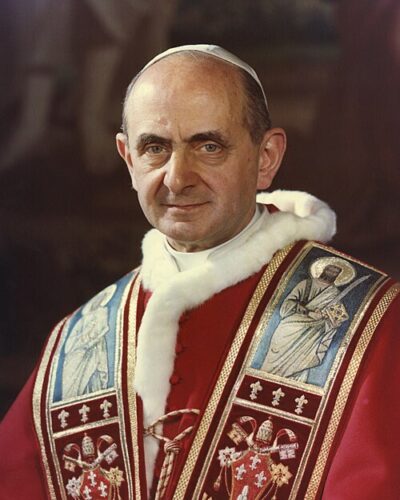
Paul VI
Paul VI was a pope of the Catholic Church from 1963 to 1978. Born September 26, 1897, in Concesio. Died August 6, 1978, in Castel Gandolfo. Positions held include Pope (1963–1978), Roman Catholic Archbishop of Milan (1954–1963) and cardinal (1958–1963). Educated at Pontifical Ecclesiastical Academy and Pontifical Gregorian University. Awards include Knight Grand Cross of the Order of Merit of the Italian Republic, Order of St. Gregory the Great and Order of Pius IX.

Facts
33 facts · 2 confirmed by two sources · 6 cited · 25 from one source
Where this comes from
Papalocal keeps its own record. It started from these sources; what each one said is kept here as it was copied, so a change on their side never changes this page by itself. Tap one to read its version.
What Wikidata says · copied November 16, 2026 · revision 2568903033
- Described as
- pope of the Catholic Church from 1963 to 1978 (1897–1978)
- Other names
- Jan Baptist Montini, Paulus VI, Pope Paul VI, Saint Paul VI, Giovanni Battista Montini, Paulus PP. VI, Giovanni Battista Enrico Antonio Maria Montini
- Born
- September 26, 1897 · 12 references
- Died
- August 6, 1978 · 12 references
- Born in
- Concesio · 2 references
- Died in
- Castel Gandolfo · 2 references
- Buried in
- Vatican Grotto
- Cause of death
- myocardial infarction
- Name at birth
- Giovanni Battista Enrico Antonio Maria Montini
- Citizen of
- Italy (1946–); Vatican City; Kingdom of Italy (–1946)
- Occupation
- Latin Catholic priest (1920–) · 1 reference; diplomat; Catholic bishop
- Positions held
- Pope (1963–1978) · 2 references; Roman Catholic Archbishop of Milan (1954–1963) · 2 references; cardinal (1958–1963) · 1 reference; Substitute for General Affairs (1937–1953)
- Education
- Pontifical Ecclesiastical Academy; Pontifical Gregorian University; Sapienza University of Rome · 1 reference
- Awards
- Knight Grand Cross of the Order of Merit of the Italian Republic (1953); Order of St. Gregory the Great; Order of Pius IX; Order of the Golden Spur; Grand Cross of the Order of Isabella the Catholic · 1 reference; Grand Cross 1st class of the Order of Merit of the Federal Republic of Germany; Grand Cross of the Order of Charles III · 1 reference; Order of Charles III · 1 reference; Order of Merit of the Federal Republic of Germany · 1 reference; Silver medal of Merit Croce Rossa Italiana
- Father
- Giorgio Montini · 1 reference
- Siblings
- Lodovico Montini
- Religion
- Catholic Church · 1 reference
- Wikipedias with a page
- 125
Wikidata item Q16975 (wikidata.org/wiki/Q16975), public domain (CC0). Copied November 16, 2026.
What Wikipedia says · copied November 16, 2026 · revision 1385798073
Pope Paul VI (born Giovanni Battista Enrico Antonio Maria Montini; 26 September 1897 – 6 August 1978) was head of the Catholic Church and sovereign of Vatican City from 21 June 1963 until his death on 6 August 1978. Succeeding John XXIII, he continued the Second Vatican Council, which he closed in 1965, implementing its numerous reforms. He fostered improved ecumenical relations with Eastern Orthodox and Protestant churches, which resulted in many historic meetings and agreements.
Born in Concesio, Montini served in the Holy See's Secretariat of State from 1922 to 1954, and along with Domenico Tardini was considered the closest and most influential advisor of Pope Pius XII. In 1954, Pius named Montini Archbishop of Milan, the largest Italian diocese. Montini later became the Secretary of the Italian Bishops' Conference. John XXIII elevated Montini to the College of Cardinals in 1958, and after his death, Montini was, with little to no opposition, elected his successor, taking the name Paul VI.
He reconvened the Second Vatican Council, which had been suspended during the interregnum. After its conclusion, Paul VI took charge of the interpretation and implementation of its mandates, finely balancing the conflicting expectations of various Catholic groups. The resulting reforms were among the widest and deepest in the Church's history.
Paul VI spoke repeatedly to Marian conventions and Mariological meetings, visited Marian shrines and issued three Marian encyclicals. Following Ambrose of Milan, he named Mary as the Mother of the Church during the Second Vatican Council. In January 1964, he flew to Jordan, the first time a reigning pontiff had left Italy in more than a century. His opposition to birth control was published in the 1968 encyclical Humanae vitae. Paul VI described himself as a humble servant of a suffering humanity and demanded significant changes from the rich in North America and Europe in favour of the poor in the Third World.
Pope Benedict XVI, citing his heroic virtue, proclaimed him venerable on 20 December 2012. Pope Francis beatified Paul VI on 19 October 2014, after the recognition of a miracle attributed to his intercession. His liturgical feast was celebrated on the date of his birth, 26 September, until 2019 when it was changed to the date of his priestly ordination, 29 May. Pope Francis canonised him on 14 October 2018. Paul VI is venerated in the Catholic Church, and the Palmarian Catholic Church.
- Born, in its opening lines
- September 26, 1897
- Died, in its opening lines
- August 6, 1978
From the Wikipedia article “Pope Paul VI” (en.wikipedia.org/wiki/Pope_Paul_VI), by its contributors, under CC BY-SA 4.0 (creativecommons.org/licenses/by-sa/4.0/). Copied November 16, 2026; not changed.
Confirmed Two sources agree. Cited One source, and it names where it got it. One source One source, without a reference of its own. Sources disagree The sources disagree. We show the best-supported value and keep theirs below.
