
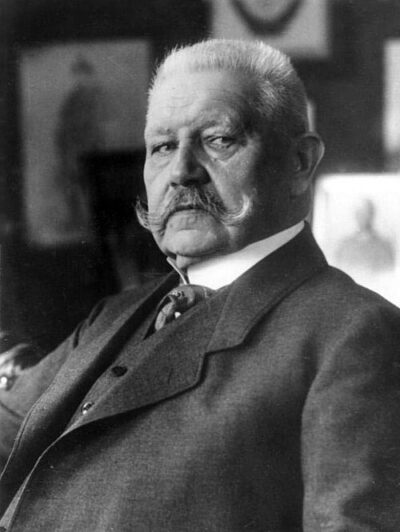
Paul von Hindenburg
Paul von Hindenburg was a Prussian-German field marshal of the German Empire, statesman and president of Weimar Germany and Nazi Germany. Born October 2, 1847, in 6 Podgórna Street in Poznań. Died August 2, 1934, in Ogrodzieniec. Positions held include president of Germany (1925–1934) and president. Educated at Prussian Military Academy. Awards include Pour le Mérite, Knight of the Order of the Golden Fleece and Grand Cross of the Military Order of Maria Theresa.
Facts
43 facts · 2 confirmed by two sources · 11 cited · 30 from one source
Where this comes from
Papalocal keeps its own record. It started from these sources; what each one said is kept here as it was copied, so a change on their side never changes this page by itself. Tap one to read its version.
What Wikidata says · copied November 16, 2026 · revision 2565531427
- Described as
- Prussian-German field marshal of the German Empire, statesman and president of Weimar Germany and Nazi Germany (1847–1934)
- Other names
- Hindenburg, von Hindenburg, Paul Ludwig Hans Anton von Beneckendorff und von Hindenburg
- Born
- October 2, 1847 · 10 references
- Died
- August 2, 1934 · 11 references
- Born in
- 6 Podgórna Street in Poznań · 2 references
- Died in
- Ogrodzieniec
- Buried in
- St. Elisabeth's Church
- Cause of death
- lung cancer
- Name at birth
- Paul Ludwig Hans Anton von Beneckendorff und von Hindenburg
- Citizen of
- Germany; Kingdom of Prussia
- Occupation
- politician · 1 reference; military personnel; soldier · 1 reference; lord of the manor · 1 reference; Generalfeldmarschall · 1 reference
- Positions held
- president of Germany (1925–1934); president · 1 reference
- Education
- Prussian Military Academy · 1 reference
- Member of
- Corps Saxo-Montania zu Freiberg und Dresden in Aachen · 1 reference
- Awards
- Pour le Mérite; Knight of the Order of the Golden Fleece; Grand Cross of the Military Order of Maria Theresa; Military Merit Cross I. Class; Order of the Black Eagle; Large Military Merit Medal; Military Order of Max Joseph; honorary doctor of the Dresden University of Technology; honorary citizen of Sankt Andreasberg (1933–); honorary citizen of Paderborn (1933); honorary doctorate of the University of Graz; honorary citizen of Bonn (1933) · 1 reference; honorary citizen of Berlin (–2020); honorary doctor of the University of Königsberg; honorary doctor of the University of Bonn
- Spouse
- Gertrud Wilhelmine von Hindenburg · 1 reference
- Children
- Oskar von Hindenburg · 1 reference; Irmengard Pauline Louise Gertrud von Brockhusen
- Father
- Hans Robert Ludwig von Beneckendorff und von Hindenburg · 1 reference
- Mother
- Luise Schwickart · 1 reference
- Siblings
- Bernhard von Hindenburg
- Religion
- Lutheranism
- Military branch
- Prussian Army · 1 reference
- Military rank
- Generalfeldmarschall; general · 1 reference
- Wikipedias with a page
- 108
Wikidata item Q2667 (wikidata.org/wiki/Q2667), public domain (CC0). Copied November 16, 2026.
What Wikipedia says · copied November 16, 2026 · revision 1385267944
Paul Ludwig Hans Anton von Beneckendorff und von Hindenburg (2 October 1847 – 2 August 1934) was a German military officer and statesman who led the Imperial German Army during World War I and later became President of Germany from 1925 until his death in 1934. Though ideologically opposed to Nazism, he played a key role in the Nazi seizure of power in 1933 through his appointment of Adolf Hitler as Chancellor of Germany.
Hindenburg was born to a family of minor Prussian nobility in the Grand Duchy of Posen. Upon completing his education as a cadet, he enlisted in the Third Regiment of Foot Guards. In this unit, Hindenburg saw combat during the Austro-Prussian and Franco-Prussian wars. In 1873, he was admitted to the Prussian War College in Berlin, where he studied before being appointed to the General Staff Corps. In 1885, he was promoted to major and became a member of the German General Staff. After teaching at the War Academy, Hindenburg rose to the rank of lieutenant general by 1900. In 1911, he retired from the military.
After World War I broke out in July 1914, Hindenburg was recalled and achieved fame on the Eastern Front as the victor of the Battle of Tannenberg. On 1 November 1914, he was promoted to field marshal and named commander of all German forces in the East. Hindenburg's continued success in battling the Russians ultimately made him a national hero and the center of an extensive personality cult. By 1916, his popularity had risen to the point that he replaced General Erich von Falkenhayn as Chief of the Great General Staff, the commander-in-chief of the German Army. Thereafter, he and his deputy, General Erich Ludendorff, took advantage of Kaiser Wilhelm II's immense delegation of authority to the Supreme Army Command to establish a de facto military dictatorship. Under their leadership, the German Empire secured Russia's defeat on the Eastern Front and achieved the largest advance on the Western Front seen since the early days of the war. However, Germany was eventually defeated in the Second Battle of the Marne and the Allies' Hundred Days Offensive. Following the armistice, Hindenburg stepped down as Chief of the Army General Staff before retiring again from the military in 1919.
In 1925, Hindenburg returned to public life to become the second elected president of the Weimar Republic. Opposed to Hitler and the Nazi Party, Hindenburg nonetheless played a major role in the instability that resulted in their rise to power. After twice dissolving the Reichstag in 1932, Hindenburg reluctantly agreed in January 1933 to appoint Hitler as chancellor in coalition with the German National People's Party. In response to the February 1933 Reichstag fire, Hindenburg approved the Reichstag Fire Decree, which suspended various civil liberties. He likewise signed the Enabling Act of 1933, which gave the Nazi regime emergency powers. After Hindenburg died the following year, Hitler combined the presidency with the chancellery before declaring himself Führer (lit. 'Leader') of Germany and transforming the country into a totalitarian dictatorship.
- Born, in its opening lines
- October 2, 1847
- Died, in its opening lines
- August 2, 1934
From the Wikipedia article “Paul von Hindenburg” (en.wikipedia.org/wiki/Paul_von_Hindenburg), by its contributors, under CC BY-SA 4.0 (creativecommons.org/licenses/by-sa/4.0/). Copied November 16, 2026; not changed.
Confirmed Two sources agree. Cited One source, and it names where it got it. One source One source, without a reference of its own. Sources disagree The sources disagree. We show the best-supported value and keep theirs below.
