
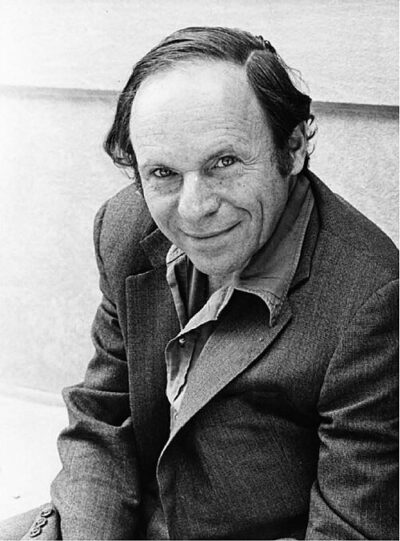
Philip Morrison
Philip Morrison was an American astrophysicist. Born November 7, 1915, in Somerville. Died April 22, 2005, in Cambridge. Educated at Carnegie Mellon University and University of California, Berkeley. Awards include William Procter Prize for Scientific Achievement, Oersted Medal and Richtmyer Memorial Lecture Award.
Facts
28 facts · 2 confirmed by two sources · 4 cited · 22 from one source
Where this comes from
Papalocal keeps its own record. It started from these sources; what each one said is kept here as it was copied, so a change on their side never changes this page by itself. Tap one to read its version.
What Wikidata says · copied November 16, 2026 · revision 2558474219
- Described as
- American astrophysicist (1915–2005)
- Born
- November 7, 1915 · 4 references
- Died
- April 22, 2005 · 4 references
- Born in
- Somerville
- Died in
- Cambridge
- Citizen of
- United States
- Occupation
- physicist; non-fiction writer; university teacher; nuclear physicist; narrator
- Worked for
- Cornell University; Massachusetts Institute of Technology · 1 reference; Los Alamos National Laboratory
- Education
- Carnegie Mellon University; University of California, Berkeley (–1940) · 1 reference
- Member of
- National Academy of Sciences; American Academy of Arts and Sciences; Boston study group; American Philosophical Society (1974–); International Astronomical Union
- Awards
- William Procter Prize for Scientific Achievement (1997) · 1 reference; Oersted Medal (1965) · 1 reference; Richtmyer Memorial Lecture Award (1958) · 1 reference; Fellow of the American Physical Society; Joseph A. Burton Forum Award (1982) · 1 reference; Karl G. Jansky Lectureship (1982)
- Field
- astrophysics
- Spouse
- Emily Morrison (1938–1961)
- Wikipedias with a page
- 21
Wikidata item Q1425110 (wikidata.org/wiki/Q1425110), public domain (CC0). Copied November 16, 2026.
What Wikipedia says · copied November 16, 2026 · revision 1380700160
Philip Morrison (November 7, 1915 – April 22, 2005) was an American professor of physics at the Massachusetts Institute of Technology (MIT). He is known for his work on the Manhattan Project during World War II, and for his later work in quantum physics, nuclear physics, high energy astrophysics, and SETI.
A graduate of Carnegie Tech, Morrison became interested in physics, which he studied at the University of California, Berkeley, under the supervision of J. Robert Oppenheimer. He also joined the Communist Party. During World War II he joined the Manhattan Project's Metallurgical Laboratory at the University of Chicago, where he worked with Eugene Wigner on the design of nuclear reactors.
In 1944 he moved to the Manhattan Project's Los Alamos Laboratory in New Mexico, where he worked with George Kistiakowsky on the development of explosive lenses required to detonate the implosion-type nuclear weapon. Morrison transported the core of the Trinity test device to the test site in the back seat of a Dodge sedan. As leader of Project Alberta's pit crew he helped load the atomic bombs on board the aircraft that participated in the atomic bombing of Hiroshima and Nagasaki. After the war ended, he traveled to Hiroshima as part of the Manhattan Project's mission to assess the damage.
After the war he became a champion of nuclear nonproliferation. He wrote for the Bulletin of the Atomic Scientists, and helped found the Federation of American Scientists and the Institute for Defense and Disarmament Studies. He was one of the few ex-communists to remain employed and academically active throughout the 1950s, but his research turned away from nuclear physics towards astrophysics. He published papers on cosmic rays, and a 1958 paper of his is considered to mark the birth of gamma ray astronomy. He was also known for writing popular science books and articles, and appearing in television programs.
- Born, in its opening lines
- November 7, 1915
- Died, in its opening lines
- April 22, 2005
From the Wikipedia article “Philip Morrison” (en.wikipedia.org/wiki/Philip_Morrison), by its contributors, under CC BY-SA 4.0 (creativecommons.org/licenses/by-sa/4.0/). Copied November 16, 2026; not changed.
Confirmed Two sources agree. Cited One source, and it names where it got it. One source One source, without a reference of its own. Sources disagree The sources disagree. We show the best-supported value and keep theirs below.
