
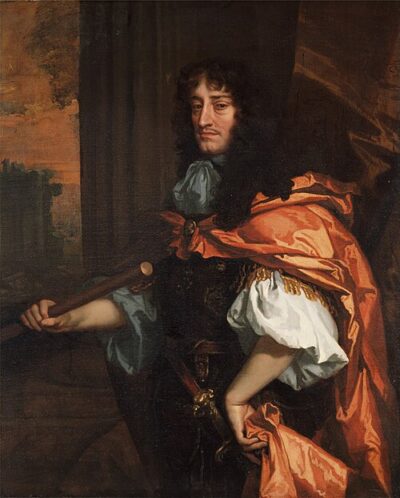
Prince Rupert of the Rhine
Prince Rupert of the Rhine was an English-German aristocrat, army officer, admiral, scientist, and colonial administrator. Born December 17, 1619, in Prague. Died November 29, 1682, in Westminster. Positions held include Member of the Privy Council of the United Kingdom, Lord Lieutenant of Berkshire (1670–1682) and Lord Lieutenant of Surrey (1675–1682). Known for The Great Executioner. Awards include Knight of the Garter and Royal Fellow of the Royal Society.
Facts
37 facts · 2 confirmed by two sources · 16 cited · 19 from one source
Where this comes from
Papalocal keeps its own record. It started from these sources; what each one said is kept here as it was copied, so a change on their side never changes this page by itself. Tap one to read its version.
What Wikidata says · copied November 16, 2026 · revision 2569167503
- Described as
- English-German aristocrat, army officer, admiral, scientist, and colonial administrator (1619–1682)
- Other names
- Prince Palatine of the Rhine Rupert, Prince Rupert du Rhin, Count Palatine of the Rhine, Duke of Bavaria, 1st Duke of Cumberland, 1st Earl of Holderness Rupert, Prince of Bavaria Rupert, Prince, Count Palatine Robert, prince palatin Rupert, Prince Robert, Prince Ruprecht, Prince of Bavaria Prince Palatine of The Rhine Ruprecht, Prince of Bavaria Ruprecht, Prince, Count Palatine Rupert, Prince Rupert
- Born
- December 17, 1619 · 6 references
- Died
- November 29, 1682 · 8 references
- Born in
- Prague · 4 references
- Died in
- Westminster
- Buried in
- Westminster Abbey · 1 reference
- Occupation
- engraver; politician; inventor · 1 reference; military leader · 2 references; admiral · 2 references; etcher · 2 references
- Positions held
- Member of the Privy Council of the United Kingdom; Lord Lieutenant of Berkshire (1670–1682); Lord Lieutenant of Surrey (1675–1682); Master of the Horse (England) (1653–1655); Lord High Admiral (1673–1679)
- Member of
- Royal Society of London (1665–) · 1 reference
- Known for
- The Great Executioner
- Awards
- Knight of the Garter; Royal Fellow of the Royal Society (1665) · 1 reference
- Children
- Dudley Bard · 1 reference; Ruperta Hughes · 1 reference
- Father
- Frederick V of the Palatinate · 2 references
- Mother
- Elizabeth Stuart, Queen of Bohemia · 1 reference
- Siblings
- Louise Hollandine of the Palatinate · 1 reference; Henriette Marie of the Palatinate; Sophia of Hanover · 1 reference; Elisabeth of the Palatinate; Charles I Louis, Elector Palatine · 2 references; Edward, Count Palatine of Simmern; Gustavus Adolphus of the Palatinate; Henry Frederick, Hereditary Prince of the Palatinate; Maurice of the Palatinate · 1 reference; Philip Frederick of the Palatinate
- Military branch
- Royal Navy
- Military rank
- admiral; general · 2 references
- Wikipedias with a page
- 37
Wikidata item Q76930 (wikidata.org/wiki/Q76930), public domain (CC0). Copied November 16, 2026.
What Wikipedia says · copied November 16, 2026 · revision 1385105851
Prince Rupert of the Rhine, Duke of Cumberland (17 December [O.S. 7 December] 1619 – 29 November [O.S. 19 November] 1682) was an English–German army officer, admiral, scientist, and colonial governor. He first rose to prominence as a Royalist cavalry commander during the English Civil War. Rupert was the third son of the German Prince Frederick V of the Palatinate and Elizabeth, eldest daughter of King James VI and I of Scotland and England respectively.
Prince Rupert had a varied career. He was a teenage soldier fighting alongside Dutch forces against Habsburg Spain during the Eighty Years' War (1568–1648), and against the Holy Roman Emperor in Germany during the Thirty Years' War (1618–1648). Aged 23, he was appointed commander of the Royalist cavalry during the English Civil War, becoming the archetypal "Cavalier" of the war and ultimately the senior Royalist general. He surrendered after the fall of Bristol and was banished from England. He served under King Louis XIV of France against Spain, and then as a Royalist privateer in the Caribbean Sea. Following the Restoration, Rupert returned to England, becoming a senior English naval commander during the Second Anglo-Dutch War and Third Anglo-Dutch War, and serving as the first governor of the Hudson's Bay Company. He died in England in 1682, aged 62.
Rupert is considered to have been a quick-thinking and energetic cavalry general, but ultimately undermined by his youthful impatience in dealing with his peers during the Civil War. In the Interregnum, Rupert continued the conflict against Parliament by sea from the Mediterranean to the Caribbean, showing considerable persistence in the face of adversity. As the head of the Royal Navy in his later years, he showed greater maturity and made impressive and long-lasting contributions to the Royal Navy's doctrine and development. As colonial governor, Rupert shaped the political geography of modern Canada: the English possession of Rupert's Land was created for him to administer as its first governor and one of the founders of the Hudson's Bay Company. Rupert's varied and numerous scientific and administrative interests, combined with his considerable artistic skills, made him one of the more colourful public figures in England of the Restoration period.
- Born, in its opening lines
- December 17, 1619
- Died, in its opening lines
- November 29, 1682
From the Wikipedia article “Prince Rupert of the Rhine” (en.wikipedia.org/wiki/Prince_Rupert_of_the_Rhine), by its contributors, under CC BY-SA 4.0 (creativecommons.org/licenses/by-sa/4.0/). Copied November 16, 2026; not changed.
Confirmed Two sources agree. Cited One source, and it names where it got it. One source One source, without a reference of its own. Sources disagree The sources disagree. We show the best-supported value and keep theirs below.
