
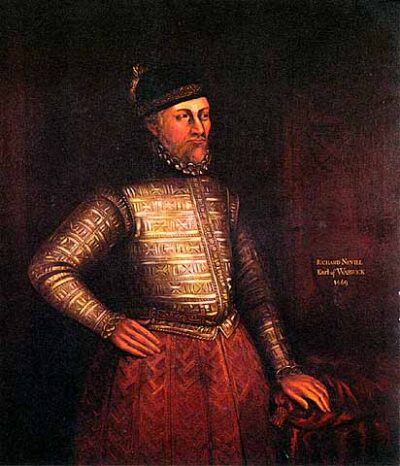
Richard Neville
Richard Neville was a jure uxoris 16th Earl of Warwick and suo jure 6th Earl of Salisbury. Born November 22, 1428, in Norwich. Died April 14, 1471, in London Borough of Barnet. Positions held include member of the House of Lords, Lord Warden of the Cinque Ports (1460–1470) and Lord High Admiral (1461–1462). Awards include Knight of the Garter.
Facts
29 facts · 2 confirmed by two sources · 14 cited · 13 from one source
Where this comes from
Papalocal keeps its own record. It started from these sources; what each one said is kept here as it was copied, so a change on their side never changes this page by itself. Tap one to read its version.
What Wikidata says · copied November 16, 2026 · revision 2561573912
- Described as
- jure uxoris 16th Earl of Warwick and suo jure 6th Earl of Salisbury (1428-1471)
- Other names
- The Kingmaker
- Born
- November 22, 1428 · 1 reference
- Died
- April 14, 1471 · 1 reference
- Born in
- Norwich
- Died in
- London Borough of Barnet
- Buried in
- Bisham Abbey
- Citizen of
- Kingdom of England
- Occupation
- military leader · 1 reference; diplomat; politician · 1 reference
- Positions held
- member of the House of Lords; Lord Warden of the Cinque Ports (1460–1470); Lord High Admiral (1461–1462); Lord Great Chamberlain (1464–1471)
- Member of
- Order of the Garter (1461–)
- Awards
- Knight of the Garter (1461) · 1 reference
- Spouse
- Anne Beauchamp, 16th Countess of Warwick (1434–) · 2 references
- Children
- Anne Neville · 1 reference; Isabel Neville, Duchess of Clarence · 1 reference; Margaret Neville · 1 reference
- Father
- Richard Neville, 5th Earl of Salisbury · 1 reference
- Mother
- Alice Montacute, 5th Countess of Salisbury · 1 reference
- Siblings
- Cecily Neville, Duchess of Warwick · 1 reference; Alice Neville · 1 reference; Katherine Neville, Baroness Hastings · 1 reference; George Neville; John Neville, 1st Marquess of Montagu · 1 reference; Eleanor Neville · 1 reference; Lady Margaret Neville · 1 reference
- Religion
- Catholicism · 1 reference
- Wikipedias with a page
- 35
Wikidata item Q437571 (wikidata.org/wiki/Q437571), public domain (CC0). Copied November 16, 2026.
What Wikipedia says · copied November 16, 2026 · revision 1385121044
Richard Neville, 16th Earl of Warwick, 6th Earl of Salisbury (22 November 1428 – 14 April 1471), known as Warwick the Kingmaker, was an English nobleman, administrator, landowner of the House of Neville fortune and military commander. The eldest son of Richard Neville, 5th Earl of Salisbury, he became Earl of Warwick through marriage, and was the wealthiest and most powerful English peer of his age, with political connections that went beyond the country's borders. One of the principal leaders in the Wars of the Roses (1455–1487), originally on the Yorkist side but later switching to the Lancastrian side, he was instrumental in the rise of a king and the deposition of two, which led to his epithet of "Kingmaker".
Through fortunes of marriage and inheritance, Warwick emerged in the 1450s at the centre of English politics. Originally, he was a supporter of King Henry VI; a territorial dispute with Edmund Beaufort, 2nd Duke of Somerset, led him to collaborate with his uncle, Richard, Duke of York, in opposing the king. From this conflict, he gained the strategically valuable post of Captain of Calais, a position that benefited him greatly in the years to come. The political conflict later turned into rebellion, where in battle York was slain, as was Warwick's father, Salisbury. York's son and Warwick's cousin later triumphed with Warwick's assistance and was crowned King Edward IV. Edward initially ruled with Warwick's support, but the two later fell out over foreign policy and the king's choice to marry Elizabeth Woodville. After a failed plot to crown Edward's brother, George, Duke of Clarence, Warwick instead restored Henry VI to the throne. The triumph was short-lived, on 14 April 1471, Warwick was defeated and killed by Edward at the Battle of Barnet.
Warwick's historical legacy has been a matter of much dispute. Historical opinion has alternated between seeing him as self-centred and rash, regarding him as a victim of the whims of an ungrateful king. It is generally agreed that he enjoyed great popularity in all layers of society, and that he was skilled at appealing to popular sentiments for political support.
- Born, in its opening lines
- November 22, 1428
- Died, in its opening lines
- April 14, 1471
From the Wikipedia article “Richard Neville, 16th Earl of Warwick” (en.wikipedia.org/wiki/Richard_Neville,_16th_Earl_of_Warwick), by its contributors, under CC BY-SA 4.0 (creativecommons.org/licenses/by-sa/4.0/). Copied November 16, 2026; not changed.
Confirmed Two sources agree. Cited One source, and it names where it got it. One source One source, without a reference of its own. Sources disagree The sources disagree. We show the best-supported value and keep theirs below.
