
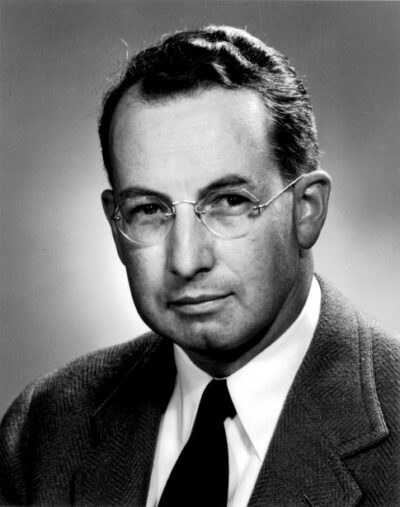
Robert Bacher
Robert Bacher was an American nuclear physicist. Born August 31, 1905, in Loudonville. Died November 18, 2004, in Montecito. Educated at University of Michigan College of Literature, Science, and the Arts and University of Michigan. Awards include Fellow of the American Physical Society and Fellow of the American Academy of Arts and Sciences.
Facts
19 facts · 2 confirmed by two sources · 1 cited · 16 from one source
Where this comes from
Papalocal keeps its own record. It started from these sources; what each one said is kept here as it was copied, so a change on their side never changes this page by itself. Tap one to read its version.
What Wikidata says · copied November 16, 2026 · revision 2513941234
- Described as
- American nuclear physicist (1905–2004)
- Other names
- Robert Fox Bacher
- Born
- August 31, 1905 · 3 references
- Died
- November 18, 2004 · 3 references
- Born in
- Loudonville
- Died in
- Montecito
- Name at birth
- Robert Fox Bacher
- Citizen of
- United States
- Occupation
- physicist; nuclear physicist; university teacher
- Worked for
- Cornell University; California Institute of Technology
- Education
- University of Michigan College of Literature, Science, and the Arts; University of Michigan · 1 reference
- Member of
- American Academy of Arts and Sciences; National Academy of Sciences; American Philosophical Society (1948–)
- Awards
- Fellow of the American Physical Society; Fellow of the American Academy of Arts and Sciences
- Field
- physics · 1 reference
- Wikipedias with a page
- 20
Wikidata item Q1349434 (wikidata.org/wiki/Q1349434), public domain (CC0). Copied November 16, 2026.
What Wikipedia says · copied November 16, 2026 · revision 1373073829
Robert Fox Bacher (August 31, 1905 – November 18, 2004) was an American nuclear physicist and one of the leaders of the Manhattan Project. Born in Loudonville, Ohio, Bacher obtained his undergraduate degree and doctorate from the University of Michigan, writing his 1930 doctoral thesis under the supervision of Samuel Goudsmit on the Zeeman effect of the hyperfine structure of atomic levels. After graduate work at the California Institute of Technology (Caltech) and the Massachusetts Institute of Technology (MIT), he accepted a job at Columbia University. In 1935 he accepted an offer from Hans Bethe to work with him at Cornell University in Ithaca, New York. It was there that Bacher collaborated with Bethe on his book Nuclear Physics. A: Stationary States of Nuclei (1936), the first of three books that would become known as the "Bethe Bible".
In December 1940, Bacher joined the Radiation Laboratory at MIT, although he did not immediately cease his research at Cornell into the neutron cross section of cadmium. The Radiation Laboratory was organized into two sections, one for incoming radar signals, and one for outgoing radar signals. Bacher was appointed to handle the incoming signals section. Here he gained valuable experience in administration, coordinating not just the efforts of his scientists, but also those of General Electric and RCA. In 1942, Bacher was approached by Robert Oppenheimer to join the Manhattan Project at its new laboratory in Los Alamos, New Mexico. It was at Bacher's insistence that Los Alamos became a civilian rather than a military laboratory. At Los Alamos, Bacher headed the project's P (Physics) Division, and later its G (Gadget) Division. Bacher worked closely with Oppenheimer, and the two men discussed the project's progress on a daily basis.
After the war, Bacher became director of the Laboratory of Nuclear Studies at Cornell. He also served on the U.S. Atomic Energy Commission, the civilian agency that replaced the wartime Manhattan Project, and in 1947 he became one of its inaugural commissioners. He left in 1949 to become head Division of Physics, Mathematics, and Astronomy at Caltech. He was appointed a member of the President's Science Advisory Committee (PSAC) in 1958. In 1962, he became Caltech's vice president and provost. He stepped down from the post of provost in 1970, and became a professor emeritus in 1976. He died in 2004 at the age of 99.
- Born, in its opening lines
- August 31, 1905
- Died, in its opening lines
- November 18, 2004
From the Wikipedia article “Robert Bacher” (en.wikipedia.org/wiki/Robert_Bacher), by its contributors, under CC BY-SA 4.0 (creativecommons.org/licenses/by-sa/4.0/). Copied November 16, 2026; not changed.
Confirmed Two sources agree. Cited One source, and it names where it got it. One source One source, without a reference of its own. Sources disagree The sources disagree. We show the best-supported value and keep theirs below.
