
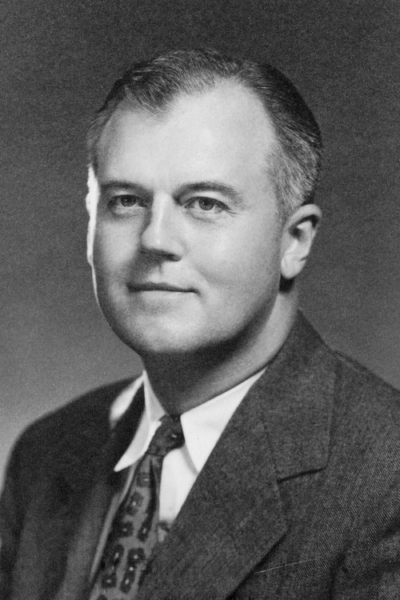
Robert J. Van de Graaff
Robert J. Van de Graaff was an American physicist. Born December 20, 1901, in Tuscaloosa. Died January 16, 1967, in Boston. Educated at University of Alabama and Princeton University. Awards include Elliott Cresson Medal, Tom W. Bonner Prize in Nuclear Physics and Rhodes Scholarship.
Facts
27 facts · 2 confirmed by two sources · 7 cited · 18 from one source
Where this comes from
Papalocal keeps its own record. It started from these sources; what each one said is kept here as it was copied, so a change on their side never changes this page by itself. Tap one to read its version.
What Wikidata says · copied November 15, 2026 · revision 2567327115
- Described as
- American physicist (1901–1967)
- Other names
- Robert Jemison Van de Graaff
- Born
- December 20, 1901 · 3 references
- Died
- January 16, 1967 · 3 references
- Born in
- Tuscaloosa
- Died in
- Boston
- Buried in
- Beverly Central Cemetery · 1 reference
- Citizen of
- United States
- Occupation
- physicist · 1 reference; university teacher
- Worked for
- Princeton University; Massachusetts Institute of Technology
- Education
- University of Alabama; Princeton University; University of Paris; The Queen's College · 1 reference
- Member of
- American Academy of Arts and Sciences
- Awards
- Elliott Cresson Medal (1936) · 1 reference; Tom W. Bonner Prize in Nuclear Physics (1966) · 1 reference; Rhodes Scholarship (1925) · 1 reference; Dennis Gabor Medal and Prize (1947) · 1 reference; Fellow of the American Physical Society
- Field
- physics
- Father
- Adrian Sebastian Van de Graaff
- Mother
- Minnie Cherokee Hargrove
- Siblings
- Adrian Van de Graaff; Hargrove Van de Graaff; William T. Van de Graaff
- Lived in
- Tuscaloosa
- Wikipedias with a page
- 37
Wikidata item Q116879 (wikidata.org/wiki/Q116879), public domain (CC0). Copied November 15, 2026.
What Wikipedia says · copied November 15, 2026 · revision 1384096782
Robert Jemison Van de Graaff (December 20, 1901 – January 16, 1967) was an American physicist and inventor. He is best known for developing the Van de Graaff generator, a high-voltage electrostatic machine that became a fundamental tool in nuclear physics research.
Raised in Tuscaloosa, Alabama, Van de Graaff earned his DPhil degree at Oxford as a Rhodes Scholar. In Europe, lectures by Marie Curie and Ernest Rutherford encouraged him to develop methods for accelerating particles to nuclear energies. He built his first electrostatic generator at Princeton University in 1929 and demonstrated a 1.5-million-volt model in 1931, more than twice the highest direct current voltage previously achieved. After joining the Massachusetts Institute of Technology he constructed the 5-megavolt Round Hill generator. He collaborated with John G. Trump, his former student, on creating compact, gas-insulated machines, which became the first accelerators used in clinical medicine. During World War II, he directed development of high-voltage X-ray equipment for the U.S. Navy.
A high school football injury, aggravated by wartime overwork and later accidents, left Van de Graaff with chronic health problems in his later career. Nevertheless, in 1946 he joined Trump and Denis M. Robinson in organizing the High Voltage Engineering Corporation (HVEC), the first company to manufacture particle accelerators. As Chief Scientist, he guided development of commercial accelerators. In the 1950s, he invented the insulating-core transformer and was instrumental in commercializing HVEC's tandem accelerators. By 1967, more than 500 high-voltage Van de Graaff generators were operating worldwide, and HVEC had installed accelerators in hospitals and labs in 30 countries. He received the Tom W. Bonner Prize in 1966 for his contributions to electrostatic accelerator development.
- Born, in its opening lines
- December 20, 1901
- Died, in its opening lines
- January 16, 1967
From the Wikipedia article “Robert J. Van de Graaff” (en.wikipedia.org/wiki/Robert_J._Van_de_Graaff), by its contributors, under CC BY-SA 4.0 (creativecommons.org/licenses/by-sa/4.0/). Copied November 15, 2026; not changed.
Confirmed Two sources agree. Cited One source, and it names where it got it. One source One source, without a reference of its own. Sources disagree The sources disagree. We show the best-supported value and keep theirs below.
