
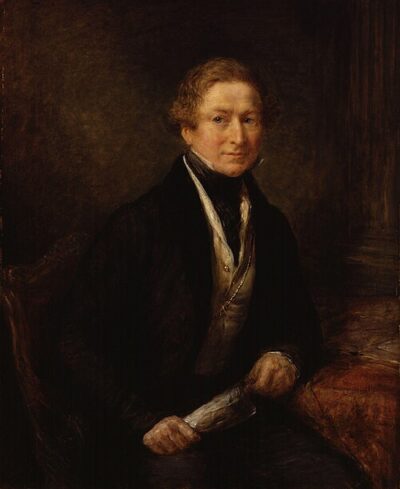
Robert Peel
Robert Peel was a Former Prime Minister of the United Kingdom. Born February 5, 1788, in Ramsbottom. Died July 2, 1850, in Westminster. Positions held include Prime Minister of the United Kingdom (2 times) (1834–1846), Leader of the Opposition (2 times) (1827–1841) and Chancellor of the Exchequer (1834–1835). Educated at Christ Church and Harrow School. Awards include Fellow of the Royal Society.
Facts
54 facts · 2 confirmed by two sources · 26 cited · 26 from one source
Where this comes from
Papalocal keeps its own record. It started from these sources; what each one said is kept here as it was copied, so a change on their side never changes this page by itself. Tap one to read its version.
What Wikidata says · copied November 16, 2026 · revision 2562947393
- Described as
- Former Prime Minister of the United Kingdom (1788–1850)
- Other names
- Sir Robert Peel, 2nd Baronet, 2nd Bart. Sir Robert Peel, Sir Robert Peel, Sir Robert Peel (1788-1850), Peel Collection [2nd Bart.], Robert, 2nd Baronet Peel, Robert, Sir, 2nd Bart. Peel, Sir Robert Peel, 2nd Bt, Robert, Sir Peel, Robert Peel (1788-1850), 2nd Baronet Peel
- Born
- February 5, 1788 · 13 references
- Died
- July 2, 1850 · 14 references
- Born in
- Ramsbottom
- Died in
- Westminster
- Buried in
- Church of St Peter, Drayton Bassett
- Cause of death
- horse fall
- Citizen of
- United Kingdom of Great Britain and Ireland; Kingdom of Great Britain (–1801)
- Occupation
- politician · 2 references; art collector; minister · 1 reference
- Positions held
- Prime Minister of the United Kingdom (2 times) (1834–1846); Leader of the Opposition (2 times) (1827–1841); Chancellor of the Exchequer (1834–1835); Home Secretary (1822–1830); Member of the Privy Council of Ireland; Member of the Privy Council of the United Kingdom; member of the 15th Parliament of the United Kingdom (1847–1850) · 1 reference; member of the 14th Parliament of the United Kingdom (1841–1847) · 2 references; member of the 13th Parliament of the United Kingdom (1837–1841) · 2 references; member of the 12th Parliament of the United Kingdom (1835–1837) · 2 references; member of the 11th Parliament of the United Kingdom (1832–1834) · 2 references; member of the 10th Parliament of the United Kingdom (1831–1832) · 1 reference; member of the 4th Parliament of the United Kingdom (1809–1812) · 1 reference; member of the 5th Parliament of the United Kingdom (1812–1818) · 1 reference; member of the 6th Parliament of the United Kingdom (1818–1820) · 1 reference
- Political party
- Conservative Party
- Worked for
- University of Glasgow
- Education
- Christ Church; Harrow School · 1 reference; Hipperholme Grammar School; Bury Grammar School
- Member of
- Royal Society of London; Chetham Society
- Awards
- Fellow of the Royal Society
- Field
- politics · 1 reference
- Spouse
- Julia Peel (1820–) · 3 references
- Children
- Arthur Peel · 2 references; Sir Robert Peel, 3rd Baronet · 2 references; William Peel · 3 references; Julia Child-Villiers, Countess of Jersey · 1 reference; Frederick Peel · 2 references; John Floyd Peel · 2 references; Eliza Peel · 2 references
- Father
- Sir Robert Peel, 1st Baronet · 1 reference
- Mother
- Ellen Yates · 2 references
- Siblings
- Laurence Peel · 1 reference; Edmund Peel; Jonathan Peel · 1 reference; William Yates Peel · 1 reference; Joseph Peel · 1 reference
- Religion
- Christianity
- Military branch
- British Army · 1 reference
- Military rank
- lieutenant
- Wikipedias with a page
- 77
Wikidata item Q181875 (wikidata.org/wiki/Q181875), public domain (CC0). Copied November 16, 2026.
What Wikipedia says · copied November 16, 2026 · revision 1385843957
Sir Robert Peel, 2nd Baronet (5 February 1788 – 2 July 1850), was a British Conservative statesman who served as Prime Minister of the United Kingdom (1834–1835, 1841–1846), Chancellor of the Exchequer (1834–1835), and Home Secretary (1822–1827, 1828–1830). He is regarded as the father of modern British policing, owing to his founding of the Metropolitan Police while he was Home Secretary. Peel was one of the founders of the modern Conservative Party.
The son of a wealthy textile manufacturer and politician, Peel was the first prime minister from an industrial business background. He earned a double first in classics and mathematics from Christ Church, Oxford. He entered the House of Commons in 1809 and became a rising star in the Tory Party. Peel entered the Cabinet as Home Secretary (1822–1827), in which post he reformed and liberalised the criminal law and created the modern police force, leading to a new type of officer known in tribute to him as "bobbies" and "peelers"(most often peelers). After a brief period out of office he returned as Home Secretary under his political mentor the Duke of Wellington (1828–1830), also serving as Leader of the House of Commons. Initially a supporter of continued legal discrimination against Catholics, Peel reversed his stance and supported the Roman Catholic Relief Act 1829 and the 1828 repeal of the Test Act, writing, "though emancipation was a great danger, civil strife was a greater danger".
After being in opposition from 1830 to 1834, he became prime minister in November 1834. Peel issued the Tamworth Manifesto in December 1834, laying down the principles upon which the modern Conservative Party is based. His first ministry was a minority government, dependent on Whig support and with Peel serving as his own Chancellor of the Exchequer. After only four months, his government collapsed and he was Leader of the Opposition during the second Melbourne ministry (1835–1841). Peel became prime minister again after the 1841 general election. His second ministry lasted five years. He cut tariffs to stimulate trade, replacing the lost revenue with a 3 per cent income tax. He played a central role in making free trade a reality and set up a modern banking system. His government's major legislation included the Mines and Collieries Act 1842, the Income Tax Act 1842, the Factories Act 1844 and the Railway Regulation Act 1844. Peel's government was weakened by anti-Catholic sentiment following the controversial increase in the Maynooth Grant of 1845. After the outbreak of the Great Irish Famine, his decision to join with Whigs and Radicals to repeal the Corn Laws led to his resignation as prime minister in 1846. Peel remained an influential MP and leader of the Peelite faction until his death in 1850.
Peel often started from a traditional Tory position in opposition to a measure, then reversed his stance and became the leader in supporting liberal legislation. This happened with the Test Act, Catholic emancipation, the Reform Act, income tax, and most notably the repeal of the Corn Laws. The historian A. J. P. Taylor wrote: "Peel was in the first rank of 19th-century statesmen. He carried Catholic Emancipation; he repealed the Corn Laws; he created the modern Conservative Party on the ruins of the old Toryism."
- Born, in its opening lines
- February 5, 1788
- Died, in its opening lines
- July 2, 1850
From the Wikipedia article “Robert Peel” (en.wikipedia.org/wiki/Robert_Peel), by its contributors, under CC BY-SA 4.0 (creativecommons.org/licenses/by-sa/4.0/). Copied November 16, 2026; not changed.
Confirmed Two sources agree. Cited One source, and it names where it got it. One source One source, without a reference of its own. Sources disagree The sources disagree. We show the best-supported value and keep theirs below.
