
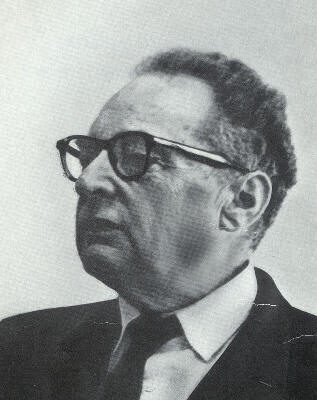
Roman Jakobson
Roman Jakobson was a Russian linguist. Born September 28, 1896, in Moscow. Died July 18, 1982, in Cambridge. Positions held include president of the Linguistic Society of America. Educated at Faculty of History and Philology of Moscow University and philosophy faculty of the German university of Prague. Awards include Order of Tomáš Garrigue Masaryk, 2nd class, Guggenheim Fellowship and Knight of the Legion of Honour.
Facts
43 facts · 1 confirmed by two sources · 11 cited · 29 from one source · 2 where the sources disagree
What’s different
- Born: we show September 28, 1896 (Sources disagree). Wikipedia says October 10, 1896
- Died in: we show Cambridge (Sources disagree). Wikidata also lists Boston
Where this comes from
Papalocal keeps its own record. It started from these sources; what each one said is kept here as it was copied, so a change on their side never changes this page by itself. Tap one to read its version.
What Wikidata says · copied November 13, 2026 · revision 2568753235
- Described as
- Russian linguist (1896–1982)
- Other names
- Roman Osipovič Jakobson, Roman Osipovich Jakobson
- Born
- September 28, 1896 · 2 references
- Died
- July 18, 1982 · 14 references
- Born in
- Moscow · 2 references
- Died in
- Cambridge · 1 reference; Boston · 1 reference
- Buried in
- Mount Auburn Cemetery
- Citizen of
- Russian Empire; Russian Socialist Federative Soviet Republic; Soviet Union; Czechoslovakia
- Occupation
- linguist · 2 references; literary scholar · 1 reference; pedagogue; historian · 1 reference; writer; critic · 1 reference; teacher · 1 reference; philologist · 2 references
- Positions held
- president of the Linguistic Society of America
- Worked for
- Harvard University; Massachusetts Institute of Technology · 1 reference; Masaryk University · 1 reference
- Education
- Faculty of History and Philology of Moscow University; philosophy faculty of the German university of Prague · 1 reference
- Member of
- Serbian Academy of Sciences and Arts; American Academy of Arts and Sciences; Polish Academy of Sciences
- Awards
- Order of Tomáš Garrigue Masaryk, 2nd class; Guggenheim Fellowship (1946) · 1 reference; Knight of the Legion of Honour (1947); doctor honoris causa from the University of Grenoble (1966) · 1 reference; honorary doctorate from the University of Nice-Sophia Antipolis (1966) · 1 reference; honorary doctorate of the Masaryk University (1968) · 1 reference; Feltrinelli Prize (1980); Hegel Prize (1982)
- Field
- linguistics; structuralism; poetics; morphology; Russian literature; philology · 1 reference
- Spouse
- Soňa Haasová
- Religion
- Judaism
- Military branch
- Czechoslovak army in exile · 1 reference
- Wikipedias with a page
- 66
Wikidata item Q156201 (wikidata.org/wiki/Q156201), public domain (CC0). Copied November 13, 2026.
What Wikipedia says · copied November 13, 2026 · revision 1383880424
Roman Osipovich Jakobson (born Roman Iosel-Berovich Yakobson; 10 October [O.S. 28 September] 1896 – 18 July 1982) was a Russian linguist and literary theorist. A pioneer of structural linguistics, Jakobson was one of the most celebrated and influential linguists of the twentieth century. With Nikolai Trubetzkoy, he developed revolutionary new techniques for the analysis of linguistic sound systems, in effect founding the modern discipline of phonology. Jakobson went on to extend similar principles and techniques to the study of other aspects of language such as syntax, morphology and semantics. He made numerous contributions to Slavic linguistics, most notably two studies of Russian case and an analysis of the categories of the Russian verb. Drawing on insights from C. S. Peirce's semiotics, as well as from communication theory and cybernetics, he proposed methods for the investigation of poetry, music, and the visual arts including cinema.
Through his decisive influence on Claude Lévi-Strauss and Roland Barthes, among others, Jakobson became a pivotal figure in the adaptation of structural analysis to disciplines beyond linguistics, including philosophy, anthropology and literary theory; his development of the approach pioneered by Ferdinand de Saussure, known as "structuralism", became a major post-war intellectual movement in Europe and the United States. Meanwhile, though the influence of structuralism declined during the 1970s, Jakobson's work has continued to receive attention in linguistic anthropology, especially through the ethnography of communication developed by Dell Hymes and the semiotics of culture developed by Jakobson's former student Michael Silverstein. Jakobson's concept of underlying linguistic universals, particularly his celebrated theory of distinctive features, decisively influenced the early thinking of Noam Chomsky, who became the dominant figure in theoretical linguistics during the second half of the twentieth century.
- Born, in its opening lines
- October 10, 1896
- Died, in its opening lines
- July 18, 1982
From the Wikipedia article “Roman Jakobson” (en.wikipedia.org/wiki/Roman_Jakobson), by its contributors, under CC BY-SA 4.0 (creativecommons.org/licenses/by-sa/4.0/). Copied November 13, 2026; not changed.
Confirmed Two sources agree. Cited One source, and it names where it got it. One source One source, without a reference of its own. Sources disagree The sources disagree. We show the best-supported value and keep theirs below.
